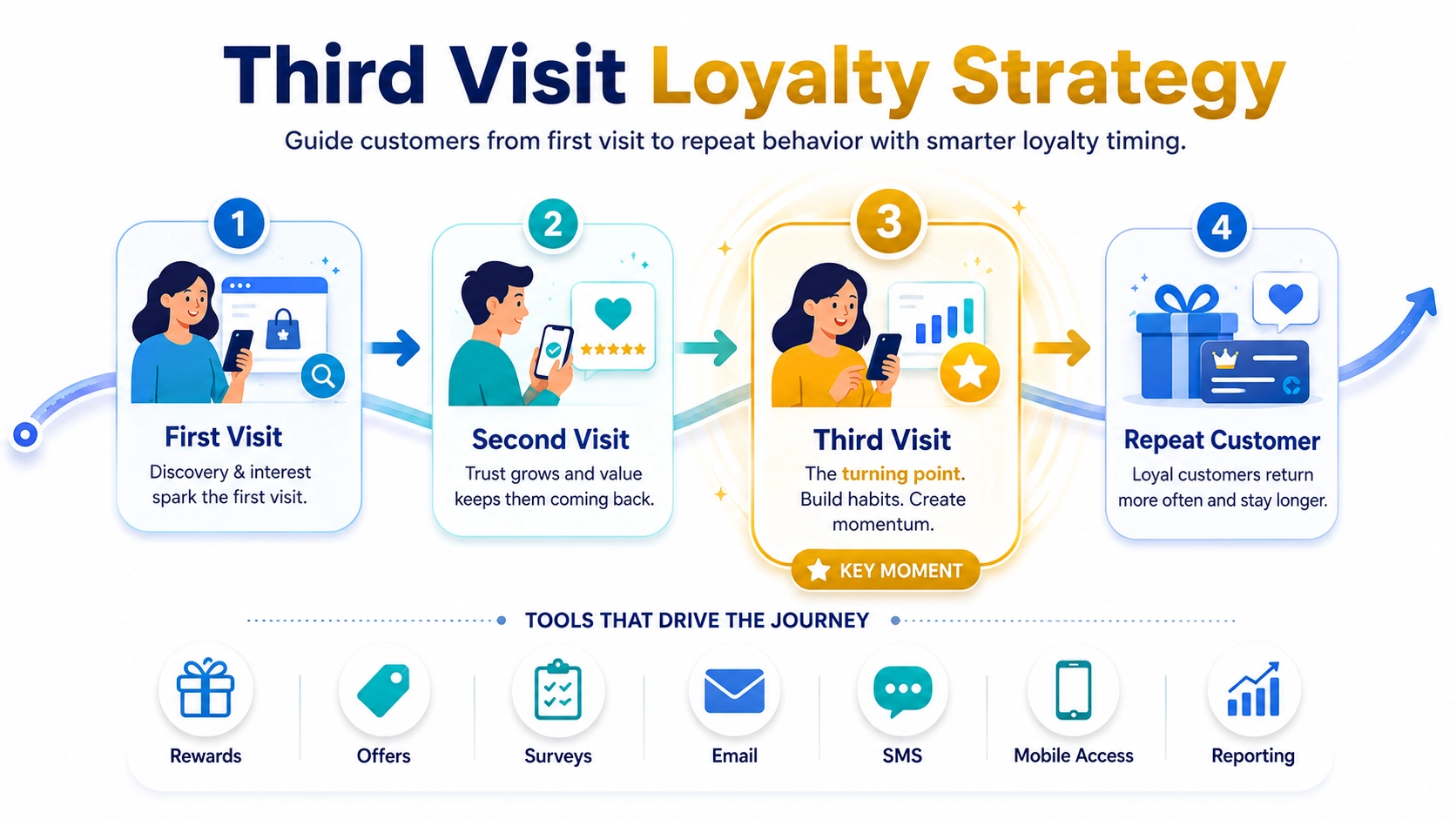
Use Preferred Patron™ to help turn a first visit into a second visit, a third visit, and eventually a repeat customer habit.
The first visit creates awareness. The second visit builds trust. The third visit starts a habit. Preferred Patron™ helps businesses build that journey with rewards, visit rules, promotions, surveys, email, SMS, mobile access, and reporting.
This page is not a general explanation of why the third visit matters. It is an implementation guide for businesses that want to use Preferred Patron™ loyalty software to identify first, second, and third visit milestones, automate early customer follow-up, and measure whether those campaigns lead to repeat visits, rewards, surveys, redemptions, and longer-term retention.
The third visit strategy helps businesses stop thinking of retention as a single follow-up message. It creates a planned path from first-time interest to repeat customer behavior.
Recognize the first visit and give the customer a clear, useful reason to come back soon.
Use the second visit to reinforce trust, encourage the next action, and keep the relationship moving.
Use the third visit to recognize loyalty, reward progress, request feedback, and invite the customer into a longer-term relationship.
A third visit loyalty strategy is a planned customer retention approach that guides a customer through the early relationship stages: first visit, second visit, third visit, and continuing engagement.
Preferred Patron™ provides customer retention software tools that help put this strategy into action. The platform can support visit history, rewards, promotions, customer groups, email, SMS, surveys, mobile member access, and reporting.
For the advisory strategy behind this page, read the companion article: Why Smart Businesses Market for the Third Visit, Not the First.
Each early visit has a different job. Preferred Patron™ helps businesses recognize the stage and match the next loyalty action to that stage.
| Journey Stage | Customer Moment | Preferred Patron™ Implementation | Business Goal |
|---|---|---|---|
| First visit | The customer tried the business for the first time. | Welcome offer, enrollment reward, survey invitation, or second-visit bounce-back campaign. | Create a clear reason for Visit 2. |
| Second visit | The customer returned and is showing early trust. | Second-visit promotion, bonus points, related product or service offer, survey reward, or reward progress reminder. | Guide the customer toward Visit 3. |
| Third visit | The customer has repeated enough to start building a habit. | VIP bonus, special member-only reward, tier progress, referral prompt, review request, or thank-you offer. | Move the customer from trial behavior to repeat behavior. |
| Fourth visit and beyond | The customer is now a stronger candidate for retention campaigns. | Ongoing loyalty rewards, tier campaigns, customer groups, milestone recognition, return triggers, and personalized offers. | Increase lifetime value and long-term engagement. |
| Missed return window | The customer should have returned but did not. | Early lapse segment, win-back message, reward reminder, survey follow-up, or missed visit campaign. | Recover the customer before the relationship goes cold. |
Preferred Patron™ can be configured around visit milestones, rewards, surveys, promotions, and communication so businesses can automate the early customer journey.
Recognize whether a customer is new, returning for a second visit, reaching a third visit, becoming active, or starting to lapse.
Use welcome campaigns, enrollment rewards, bonus points, bounce-back offers, and mobile reward visibility to give new customers a clear reason to return.
When a customer returns, use a second-visit promotion, survey reward, product follow-up, service reminder, or reward progress message to keep the journey moving.
Use the third visit as a meaningful loyalty moment with VIP points, thank-you rewards, tier progress, referral offers, or member-only benefits.
Ask customers about their experience after early visits, reward survey participation, and use feedback to improve future campaigns.
Review repeat visits, offer response, reward redemption, survey activity, message engagement, spend, and customer movement through the early retention journey.
The strategy becomes practical when the loyalty platform can connect visit milestones to rewards, campaigns, messages, and reporting.
Use customer activity and visit behavior to identify first visits, second visits, third visits, repeat visits, and missed return windows.
Create welcome rewards, bounce-back offers, bonus points, special member rewards, coupons, and milestone-based incentives.
Remind customers between visits with email, text messages, reward notices, mobile account access, and targeted follow-up campaigns.
Ask about the first visit, second visit, service quality, customer interests, and what would bring the customer back sooner.
Build audiences such as new customers, second-visit customers, third-visit customers, reward-ready customers, and early lapse customers.
Measure which offers, messages, rewards, and surveys helped customers return and move through the early retention journey.
The third visit strategy works across many businesses because the early repeat-visit journey matters in almost every customer relationship.
Use first-visit welcome offers, second-visit dessert or menu incentives, third-visit VIP bonuses, birthday rewards, and feedback surveys.
Reward the first purchase, promote a related second purchase, and use the third purchase to introduce VIP benefits, tier progress, or referral rewards.
Encourage the next service visit, request feedback, send maintenance reminders, and recognize customers who return for multiple services.
Guide clients from first appointment to follow-up visit, treatment package, product purchase, referral, survey response, or ongoing rebooking habit.
Use rounds, check-ins, lessons, events, classes, challenges, and milestone rewards to encourage repeat participation.
Use early participation milestones, account follow-up, reorder activity, training participation, employee recognition, incentive progress, and internal contests to build recurring engagement.
Many businesses spend heavily to win the first visit, then do not have a clear plan to keep the customer moving. A third visit strategy helps protect the acquisition investment by giving each early visit a purpose.
Use these pages to connect the third visit strategy with the broader Preferred Patron loyalty, retention, and automation platform.
Explore the broader Preferred Patron platform for rewards, promotions, marketing, reporting, customer engagement, and retention.
Create welcome offers, bounce-back promotions, second-visit campaigns, third-visit rewards, and milestone incentives.
Automate messages, surveys, reminders, rewards, and targeted campaigns around customer behavior and visit history.
Use timely text reminders for rewards, survey incentives, return visit offers, and missed return windows.
Give customers mobile access to rewards, offers, progress, surveys, and account activity between visits.
Use early customer behavior and survey feedback to make second and third visit campaigns more relevant.
Preferred Patron™ can help your business connect visit history, loyalty rewards, promotions, surveys, email, SMS, customer groups, mobile access, and reporting into a practical third visit loyalty strategy.
A third visit loyalty strategy is a customer retention approach that guides a customer from first visit to second visit, third visit, and continuing engagement using rewards, reminders, surveys, and targeted follow-up campaigns.
The third visit is important because the customer has moved beyond trying the business once. By the third visit, the customer is showing stronger repeat behavior and may be more likely to form a lasting habit.
Preferred Patron™ supports the third visit strategy through visit history rules, loyalty rewards, promotions, customer groups, surveys, email, SMS, mobile member access, and campaign reporting.
No. Restaurants can use the strategy, but the same approach can also help retailers, salons, medspas, automotive service centers, golf courses, fitness businesses, franchises, B2B programs, and B2E internal engagement programs.
The first follow-up offer should give the customer a simple reason to return for a second visit. Examples include bonus points, a reward reminder, a small bounce-back offer, a survey incentive, or a relevant product or service follow-up.
A business should measure whether customers return for the second visit, reach the third visit, redeem rewards, complete surveys, respond to messages, increase spend, and continue visiting after the early retention journey.