
The Customer Retention Problem Most Businesses Miss
Customer retention software can help businesses turn first-time visitors into repeat customers, but the strategy starts with a simple idea: the first visit is not the finish line. It is the beginning of the customer relationship.
Most businesses work hard to get a new customer in the door. That matters. But the bigger opportunity is to bring that customer back again, then again, and then again. That is where loyalty starts.
Restaurant and hospitality expert Jon Taffer, best known as the host of Bar Rescue, shared a customer retention concept that highlights the importance of encouraging repeat visits. While his example focused on restaurants, the same principle applies across many industries.
Watch the original Jon Taffer video here.
The restaurant use case is simple, but powerful. It shows how a business can think beyond the first transaction and build a planned path toward repeat customer behavior.
The Surprising Customer Retention Lesson
In the video, Taffer cites statistics suggesting that even after a flawless first experience, many customers still do not return.
He further explains that repeat visit behavior strengthens significantly once a customer reaches a third visit.
Whether the exact percentages vary by business type, the larger lesson remains the same: customers who return multiple times are far more likely to become long-term customers.
Think about that for a moment.
The biggest challenge is not only attracting customers.
It is getting them to return enough times to form a habit.
That is why smart businesses focus less on only winning the first visit and more on guiding customers through a repeat-visit journey.
The Problem With Traditional Marketing
Many businesses spend hundreds or even thousands of dollars trying to attract a single new customer.
They invest in:
- Social media advertising
- Search engine marketing
- Radio advertising
- Direct mail
- Sponsorships
- Digital display ads
These channels can have value, but they often stop working once the customer walks through the door.
The customer visits once and then disappears.
Without a follow-up strategy, the acquisition investment is weakened because the business has no clear plan for turning that first visit into a second or third visit.
Why Smart Businesses Market Beyond Visit One
In the video, Taffer explains that even a great first experience does not guarantee that a customer will return.
His larger point is that repeat visit behavior becomes stronger when a customer comes back several times.
That is the big lesson:
A customer is more likely to become loyal after several good visits, not just one.
Many businesses spend most of their money trying to win the first visit. But they do not have a clear plan to win the second and third visits.
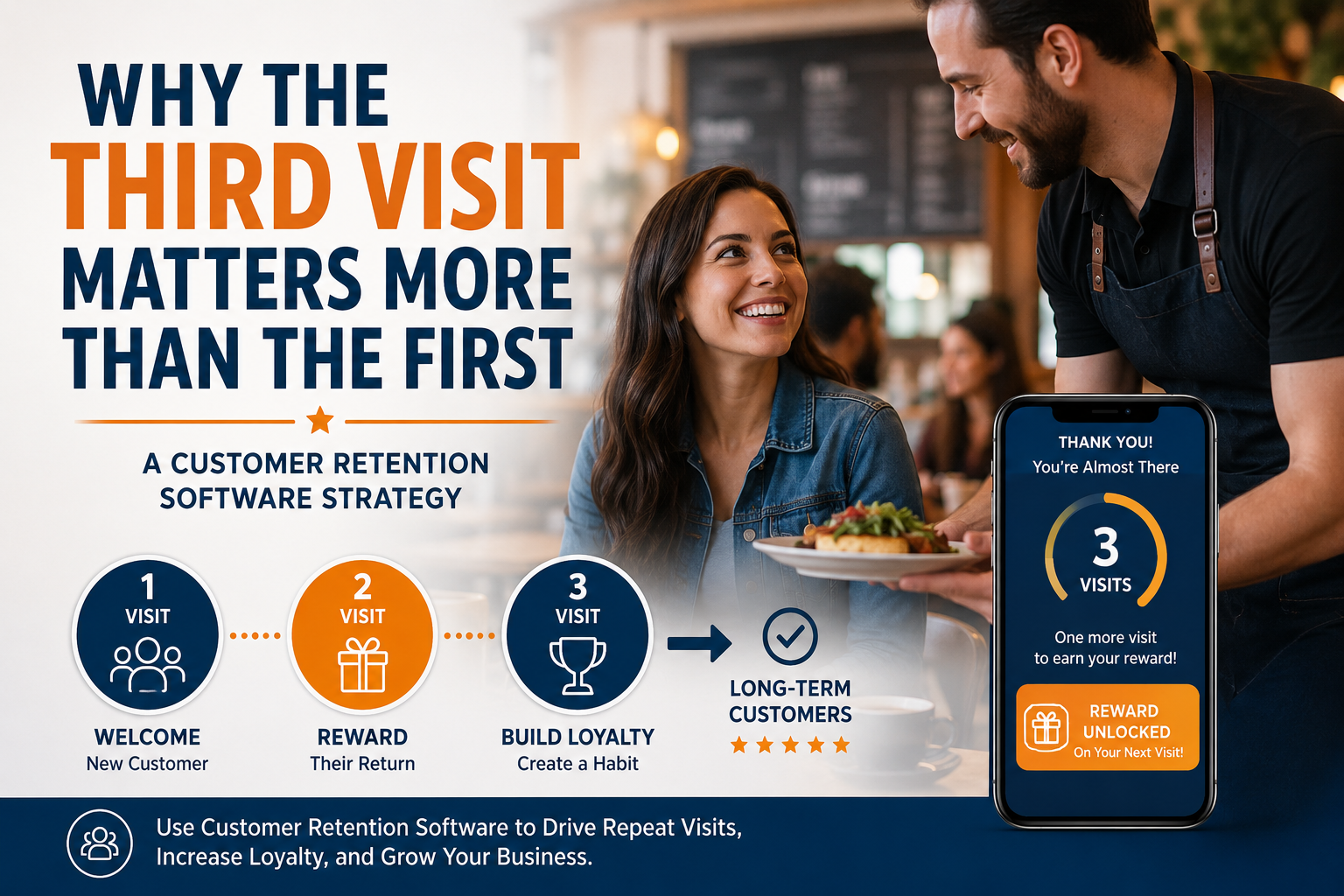
The third visit strategy gives business owners a better way to think about retention. The first visit creates awareness. The second visit builds familiarity and trust. The third visit starts to create routine.
How the Three-Visit Customer Retention Strategy Works
The restaurant in the example used a smart step-by-step plan. The exact offer can change by business type, but the strategy is the same: recognize the customer early, give them a reason to return, and keep the relationship moving.
Visit 1: Make the New Customer Feel Special
When a guest visited for the first time, the team identified that person as a new customer.
The staff made the guest feel welcome. A manager came over. The guest received personal attention.
Then the business gave the guest a reason to return.
The offer was not random. It was designed to create Visit 2.
Visit 2: Reward the Return Visit
When the guest came back, the business knew this was the second visit.
The staff welcomed the customer again and gave another offer for a future visit.
This offer was designed to create Visit 3.
Visit 3: Build the Customer Habit
By the third visit, the customer had now experienced the business several times.
The customer was no longer just trying the business once. The customer was starting to build a habit.
The first visit creates awareness. The second visit builds trust. The third visit starts loyalty.
Why the Third Visit Matters
The third visit matters because it suggests the customer is no longer acting on curiosity alone. Something has begun to feel familiar. The customer knows what to expect. The business has had more than one chance to create trust.
That does not mean a third visit guarantees lifetime loyalty. It means the customer has crossed an important early threshold.
For many local and repeat-visit businesses, that threshold is where a casual buyer can begin to feel like a regular customer.
The First Visit Is Usually Fragile
A first visit may happen because of an ad, a referral, a convenient location, a coupon, a search result, or simple curiosity.
That does not always mean the customer has built a relationship with the business.
The customer may enjoy the experience and still forget to return. They may choose a competitor next time. They may wait until another discount appears. They may simply move on.
The Second Visit Builds Familiarity
A second visit is different. The customer has now chosen to come back.
At this stage, the business has an opportunity to reinforce the customer’s decision. A good second experience can confirm that the first visit was not a one-time success.
The Third Visit Starts the Habit
By the third visit, the customer has had multiple interactions with the business.
They may recognize the staff, know the menu, understand the service process, remember the location, or begin checking their reward progress.
That repeated familiarity is the beginning of retention.
How Loyalty Software Helps Support the Third Visit Strategy
The third visit strategy works best when a business can recognize where a customer is in the early relationship. Loyalty software can help identify first visits, second visits, third visits, missed return windows, survey responses, reward activity, and early signs of lapse.
Those signals can guide a more relevant follow-up, such as a welcome offer, second-visit incentive, third-visit thank-you reward, survey invitation, reminder message, or win-back campaign.
For a more practical implementation view, see our strategy implementation page: Third Visit Loyalty Strategy.
What a Third Visit Strategy Should Include
A strong third visit strategy does not need to be complicated. It needs to be intentional.
Business owners should think through a few important questions:
- How do we identify a first-time customer?
- What do we want the customer to do next?
- What reason are we giving the customer to return for the second visit?
- How do we make the second visit feel recognized?
- What should happen after the third visit?
- How do we collect feedback while the relationship is still new?
- How do we know whether the strategy is working?
These questions help shift the business from random promotions to a planned customer journey.
Examples of Third Visit Strategy by Business Type
The video example is about a restaurant, but the same strategy works for many businesses that depend on repeat customers.
Retail Stores
A retail store can recognize the first purchase, encourage a second purchase, and then create a stronger member offer after the third purchase.
The goal is not simply to discount more. The goal is to help the customer build a reason to come back and explore more categories over time.
Automotive Businesses
An automotive business can use a loyalty program for automotive service to encourage drivers to return for oil changes, inspections, tire rotations, and scheduled maintenance.
The repeat-visit journey matters because vehicle service often depends on timing, trust, and customer habits.
Restaurants and Bars
A restaurant can use a frequent diner loyalty program to encourage repeat dining, promote menu exploration, send birthday rewards, request feedback, and trigger return-visit offers.
The third visit can be especially important because the customer is starting to decide whether the restaurant becomes part of their regular routine.
Salons and Spas
A salon can encourage a follow-up appointment after the first visit and use the third visit to reinforce membership, package progress, service upgrades, or product recommendations.
Surveys can also help the business understand what clients liked and what could improve before the relationship fades.
Fitness Centers
A fitness center can reward check-ins, encourage consistent attendance, and recognize early milestones.
If a member stops visiting soon after joining, an early reminder or win-back message can help bring that person back before the habit is lost.
Golf Courses and Clubs
A golf course can encourage repeat rounds, promote pro shop purchases, offer event incentives, and create VIP rewards for frequent players.
The third visit may signal that the player is moving from occasional use toward a repeat relationship with the course.
Healthcare and Wellness Practices
A wellness practice can use follow-up messages, patient satisfaction surveys, and visit-based engagement where appropriate.
The goal is to keep patients informed, engaged, and confident in the experience.
Franchise and Multi-Location Brands
Franchise businesses can use the same third visit concept across many locations.
A shared customer retention platform can help brands create consistent customer journeys while still allowing location-level campaigns and local flexibility.
Why Customer Retention Can Lower Marketing Costs
Advertising can be expensive.
Many businesses pay again and again to attract new customers.
But if those customers do not return, the business must keep spending money to replace them.
A strong retention strategy changes that.
Instead of only paying for new attention, the business uses rewards, recognition, feedback, and follow-up messages to increase repeat visits.
That can improve customer lifetime value and reduce waste.
Bain & Company has long emphasized the value of retention, noting that retaining customers is a major business challenge. You can read more in this expert resource from Bain & Company on customer retention.
What Business Owners Should Take Away
The lesson is not that every business should give away free meals, large discounts, or aggressive offers.
The real lesson is that every business needs a planned early customer journey.
- How do we welcome a new customer?
- How do we get the second visit?
- How do we get the third visit?
- How do we collect feedback?
- How do we reward action?
- How do we bring inactive customers back?
- How do we measure what works?
A third visit strategy gives the business a clearer path for moving customers beyond trial and into repeat behavior.
The Bottom Line for Customer Retention
Most businesses market for the first visit.
Smarter businesses market for the third visit.
The first visit creates awareness. The second visit builds trust. The third visit starts a habit.
Whether you run a restaurant, retail store, automotive service center, salon, spa, golf course, fitness center, healthcare practice, or franchise, the strategy is the same:
Get the first visit. Encourage the second. Earn the third. Build the fourth.
For businesses that want to put this strategy into action, Preferred Patron’s Third Visit Loyalty Strategy explains how loyalty rewards, visit history, surveys, email, SMS, customer groups, mobile access, and campaign reporting can work together to guide customers from first visit to second visit, third visit, and repeat customer behavior.
Author note: Christopher Silvestri is Managing Partner and CTO of Preferred Patron Loyalty, a customer loyalty and marketing automation platform used by businesses to manage rewards, customer engagement, retention campaigns, and loyalty technology. His work focuses on helping businesses turn customer data, rewards, and automated messaging into measurable repeat business.
Related Resources
- Preferred Patron Loyalty Platform
- Third Visit Loyalty Strategy
- Customer Loyalty Software Features
- Retention Software Pricing
- Restaurant Frequent Diner Loyalty Program
- Automotive Loyalty Programs
- Customer Retention Case Studies
- Preferred Patron Blog
Frequently Asked Questions About the Third Visit Strategy
What is the third visit strategy?
The third visit strategy is a customer retention approach that focuses on guiding a new customer from the first visit to the second visit and then to the third visit. The goal is to help the customer move beyond trial and begin forming repeat behavior.
Why does the third visit matter?
The third visit matters because the customer has returned more than once and may be starting to build familiarity, trust, and routine with the business. That makes the third visit an important early retention milestone.
Is the third visit strategy only for restaurants?
No. The third visit strategy can apply to many repeat-visit businesses, including restaurants, retail stores, automotive service departments, salons, spas, fitness centers, golf courses, wellness practices, franchises, and local service businesses.
How can loyalty software support the third visit strategy?
Loyalty software can help identify first, second, and third visit milestones and guide follow-up through rewards, reminders, surveys, offers, email, SMS, customer groups, and reporting. For a deeper software implementation view, see Preferred Patron’s Third Visit Loyalty Strategy.
What should happen after the third visit?
After the third visit, the business should continue building the relationship with relevant rewards, recognition, feedback requests, reminders, and future reasons to return. The goal is to turn early repeat behavior into longer-term loyalty.