
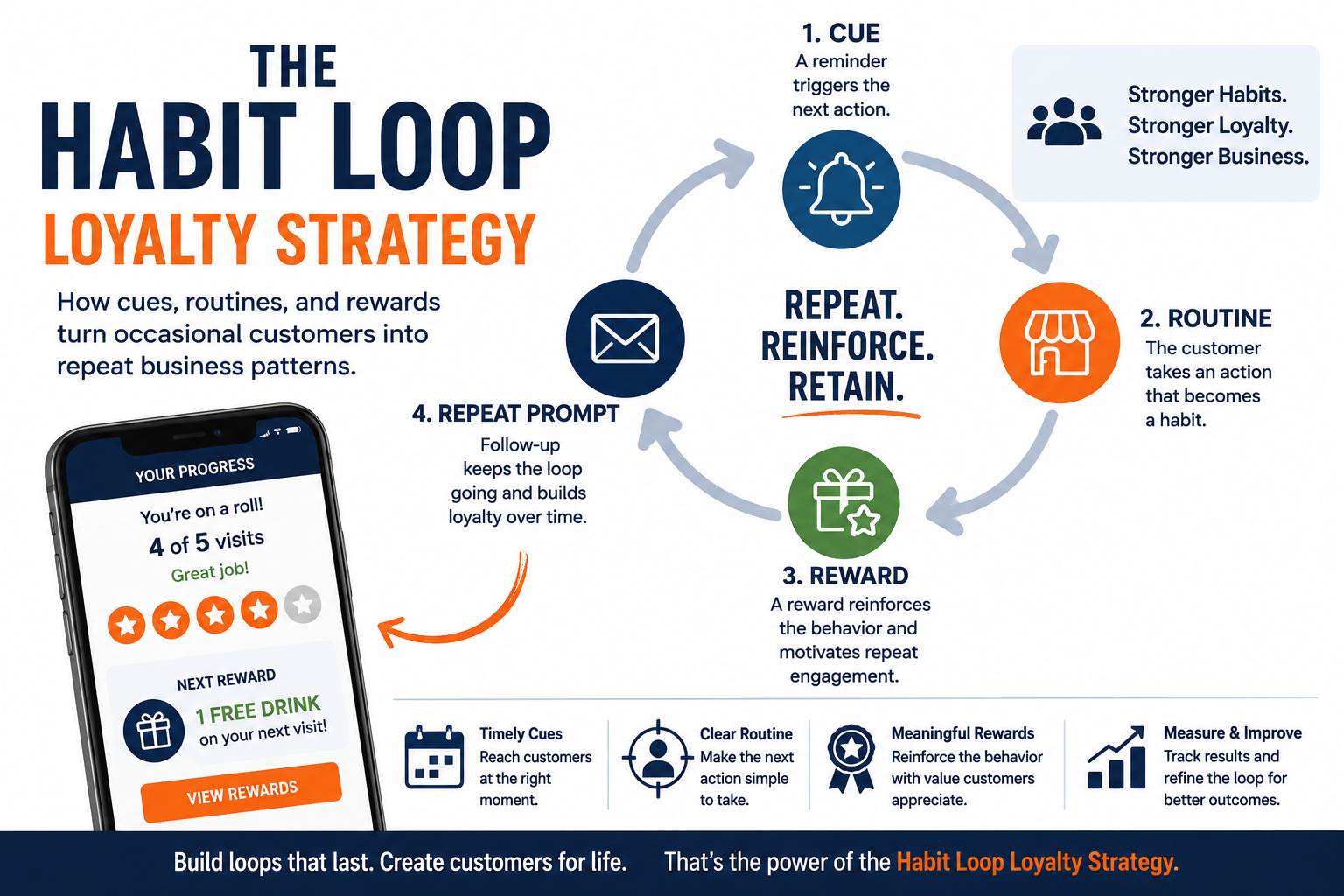
The habit loop loyalty strategy is a customer retention approach that helps businesses turn occasional customer behavior into repeat business patterns.
Many businesses want customers to come back more often, but they treat loyalty as a series of disconnected promotions. They send a coupon, wait for a response, send another offer, and hope the customer remembers to return.
A habit loop approach is more intentional. It asks what cue reminds the customer, what routine the business wants to encourage, what reward reinforces that routine, and what follow-up keeps the behavior repeating.
For a loyalty program, this matters because repeat business is not built from one message alone. It is built from a pattern: reminder, action, reward, progress, and another reason to return.
This article is part of the Preferred Patron Strategy Central series. For the software implementation view, see Habit Loop Loyalty Strategy Software. You may also want to review related strategies such as The Loyalty Timing Map, The Reward Reset Strategy, The Fresh-Start Loyalty Strategy, and The Choice Reduction Strategy.
What Is the Habit Loop Loyalty Strategy?
The habit loop loyalty strategy is the practice of designing loyalty campaigns around a repeated pattern of customer behavior.
In loyalty marketing, the habit loop can be explained in four parts:
- Cue: the reminder, timing signal, visit pattern, need, milestone, or message that prompts the customer to think about returning.
- Routine: the behavior the business wants the customer to repeat, such as visiting, buying, booking, redeeming, reviewing, referring, or checking reward progress.
- Reward: the benefit that reinforces the routine, such as points, stamps, tier progress, recognition, discounts, certificates, cashback, perks, or visible progress toward a goal.
- Repeat prompt: the follow-up that helps the customer continue the pattern instead of stopping after one action.
The goal is not to manipulate customers. The goal is to make useful repeat behavior easier to remember, easier to complete, and more rewarding to continue.
Why Habits Matter in Loyalty Marketing
A loyalty program can reward purchases, visits, referrals, reviews, bookings, profile completion, and other actions. But those actions become more valuable when they are part of a repeat pattern.
For example:
- A cafe wants the morning visit to become part of the customer’s routine.
- A car wash wants the customer to return after road salt, pollen, rain, or a monthly reset.
- A salon wants the client to rebook before the appointment cycle breaks.
- A retailer wants customers to return before category interest fades.
- A restaurant wants a guest to come back enough times that it becomes a familiar choice.
The habit loop loyalty strategy helps the business move beyond one-time promotions. It creates a structure for reinforcing the behavior that produces long-term value.
The Research Behind Habit Formation
Habit research supports the idea that repeated behavior becomes stronger when it is connected to consistent cues and contexts.
In A New Look at Habits and the Habit-Goal Interface, Wendy Wood and David Neal describe habits as learned associations between responses and the contexts in which those responses have repeatedly occurred.
Research by Phillippa Lally, Cornelia van Jaarsveld, Henry Potts, and Jane Wardle in How are habits formed: Modelling habit formation in the real world also supports the idea that automaticity develops through repeated behavior over time.
For business owners, the practical lesson is straightforward: repeat behavior should not be left to chance. The business should design cues, rewards, progress signals, and follow-up that help customers repeat the desired action.
The Four-Part Habit Loop Framework
1. Identify the Cue
A cue is the signal that reminds the customer to act.
In loyalty marketing, cues may include:
- A time of day
- A day of the week
- A visit interval
- A new month or season
- A birthday or anniversary
- A product or service cycle
- A point balance reminder
- A stamp progress update
- A reward expiration reminder
- A message after inactivity
- A weather or local event trigger
Without a cue, customers may still like the business but forget to return.
2. Define the Routine
The routine is the behavior the business wants to encourage repeatedly.
That routine should be specific. A business should not simply say, “We want more engagement.” It should define the action.
Examples include:
- Visit once per week
- Book the next appointment before leaving
- Return before a reward expires
- Make one more visit to complete a stamp card
- Use an earned reward
- Try a new category
- Complete a customer profile
- Respond to a feedback request
- Refer a friend after a positive experience
If the business cannot define the routine, the customer probably cannot recognize the next step.
3. Reinforce the Routine With a Reward
The reward gives the customer a reason to continue.
That reward may be immediate, such as a discount or bonus points. It may also be progressive, such as moving closer to a stamp, tier, certificate, or future reward.
In many loyalty programs, visible progress is part of the reward. Customers are more likely to keep going when they can see that the next visit, next purchase, or next action gets them closer to something meaningful.
4. Create the Repeat Prompt
The loop is incomplete if the customer acts once and then disappears.
The business should decide what happens next:
- Does the customer receive a progress update?
- Is there a next reward goal?
- Should a reminder be sent after a set interval?
- Should the customer receive a different message after redemption?
- Should the customer move into another segment?
- Should the customer receive a survey, review request, or referral prompt?
The repeat prompt connects one action to the next.
Habit Loop Is Not the Same as Fresh-Start Strategy
The habit loop loyalty strategy is related to the fresh-start strategy, but it is not the same.
Fresh-start strategy focuses on meaningful new beginnings, such as a new week, new month, birthday, season, holiday, or milestone.
Habit loop strategy focuses on repeated cue-routine-reward patterns that help customers return again and again.
A fresh start can be one type of cue inside a habit loop. But the habit loop is broader because it is about reinforcing repeat behavior over time.
Habit Loop Is Also Different From Reward Reset
The habit loop loyalty strategy also connects to reward reset, but the two strategies should not be confused.
Reward reset strategy focuses on what happens after a customer earns or redeems a reward. The customer has completed a goal, so the business needs to guide them toward the next one.
Habit loop strategy is broader. It can include post-redemption follow-up, but it also includes cues before the visit, rewards during the routine, progress visibility, and repeat prompts after many types of customer action.
Reward reset can restart one loop. Habit loop strategy designs the full pattern.
Common Habit Loop Loyalty Examples
The Morning Routine
A coffee shop or cafe can use a weekday morning reminder, stamp progress, and a next reward message to encourage customers to make the visit part of their routine.
The Monthly Return Loop
A car wash, retailer, or service business can use a monthly reminder, reward progress, and a simple next step to encourage customers to return before the relationship cools.
The Rebooking Loop
A salon, spa, medspa, or appointment-based business can use service timing, loyalty progress, and rebooking reminders to keep the next appointment from being delayed too long.
The Reward Progress Loop
A business can show customers how close they are to the next reward and send a reminder when one more action would complete the goal.
The Post-Redemption Loop
After a customer uses a reward, the business can immediately show the next goal so the completed reward becomes the start of the next loop.
Where Businesses Break the Habit Loop
Many loyalty programs unintentionally interrupt repeat behavior.
Common mistakes include:
- Waiting too long after a visit to follow up
- Sending messages without a clear routine to repeat
- Hiding points, stamps, or reward progress from the customer
- Failing to restart the loop after a reward is redeemed
- Using discounts without building a repeat pattern
- Sending every customer the same cue at the same time
- Ignoring visit cycles, service cycles, and customer timing
- Failing to measure whether the behavior repeated
A loyalty program should not only reward what already happened. It should help shape what happens next.
Examples by Business Type
Restaurants and Cafes
Restaurants and cafes can use visit streaks, stamp progress, lunch reminders, birthday rewards, post-visit follow-up, and time-of-week campaigns to encourage repeat visits.
Car Washes
Car washes can use weather, pollen, road salt, monthly reminders, unlimited wash membership prompts, and reward progress to encourage recurring wash behavior.
Salons, Spas, and Medspas
Appointment-based businesses can use treatment cycles, rebooking windows, loyalty points, product rewards, birthday recognition, and service reminders to reinforce repeat appointments.
Retail Stores
Retailers can use category interest, seasonal needs, point balance reminders, reward progress, tier status, and personalized offers to bring customers back before the relationship cools.
Automotive Service
Automotive service businesses can use mileage windows, seasonal maintenance, inspection timing, service reminders, and loyalty rewards to support recurring service behavior.
How Loyalty Software Supports Habit Loop Strategy
Loyalty software helps businesses turn repeat behavior into a measurable system.
A loyalty platform can help identify the cue, deliver the reminder, track the customer action, issue or update the reward, and trigger the next follow-up. Without software, habit-building often becomes manual, inconsistent, or too generic.
For example, loyalty software can support habit loop strategy by helping a business:
- Track visits, purchases, points, stamps, tiers, and redemptions
- Send email or SMS reminders based on customer timing
- Show reward progress and next reward goals
- Trigger campaigns after inactivity, redemption, birthdays, or milestones
- Segment customers by behavior, lifecycle stage, or reward status
- Measure whether customers returned after a cue or campaign
The purpose is not to automate random promotions. The purpose is to make repeated customer behavior easier to recognize, reinforce, and improve.
For the practical implementation guide, visit Habit Loop Loyalty Strategy Software.
How This Strategy Connects to Other Loyalty Strategies
The habit loop loyalty strategy works best when paired with other retention strategies that help the business identify the right cue, clarify the customer’s next action, reinforce progress, and restart the loop after important moments.
It connects with The Loyalty Timing Map because timing helps determine when a customer should receive the next cue.
It connects with The Reward Reset Strategy because a customer who just completed a reward needs a clear next goal.
It connects with The Fresh-Start Loyalty Strategy because new beginnings can act as useful cues inside a repeat behavior loop.
It connects with The Choice Reduction Strategy because the customer needs one clear next action, not too many competing choices.
Final Thought
The habit loop loyalty strategy helps businesses think beyond one-time promotions.
A strong loyalty program should not only ask customers to return. It should make return behavior easier to remember, easier to repeat, and more rewarding over time.
When a business understands the cue, routine, reward, and repeat prompt, loyalty becomes less random. The program becomes a system for reinforcing the behaviors that create long-term customer value.
That is why habit loops belong in a modern customer retention strategy.
See how Preferred Patron helps implement the Habit Loop Loyalty Strategy.
Author note: Christopher Silvestri is Managing Partner and CTO of Preferred Patron Loyalty, a customer loyalty and marketing automation platform used by businesses to manage rewards, customer engagement, retention campaigns, and loyalty technology. His work focuses on helping businesses turn customer data, rewards, and automated messaging into measurable repeat business.
Frequently Asked Questions About the Habit Loop Loyalty Strategy
What is the habit loop loyalty strategy?
The habit loop loyalty strategy is a customer retention approach that uses cues, routines, rewards, and follow-up prompts to reinforce repeat customer behavior.
What are the parts of a loyalty habit loop?
A loyalty habit loop usually includes a cue, a routine, a reward or progress signal, and a repeat prompt that encourages the next action.
How is habit loop strategy different from fresh-start strategy?
Fresh-start strategy focuses on meaningful new beginnings such as birthdays, seasons, holidays, or new months. Habit loop strategy focuses on repeated cue-routine-reward patterns that help customers return again and again.
What are examples of habit loop loyalty campaigns?
Examples include visit streaks, stamp card progress, next reward reminders, rebooking prompts, monthly return reminders, post-redemption next-goal messages, and inactivity follow-up campaigns.
Does a habit loop loyalty strategy always require discounts?
No. A habit loop can use points, stamps, tier status, recognition, progress visibility, reminders, rewards, service benefits, experiences, or other non-discount incentives.
How can loyalty software support habit loop strategy?
Loyalty software can track customer behavior, identify timing cues, send reminders, show reward progress, trigger follow-up campaigns, and measure whether customers repeat the desired behavior.