
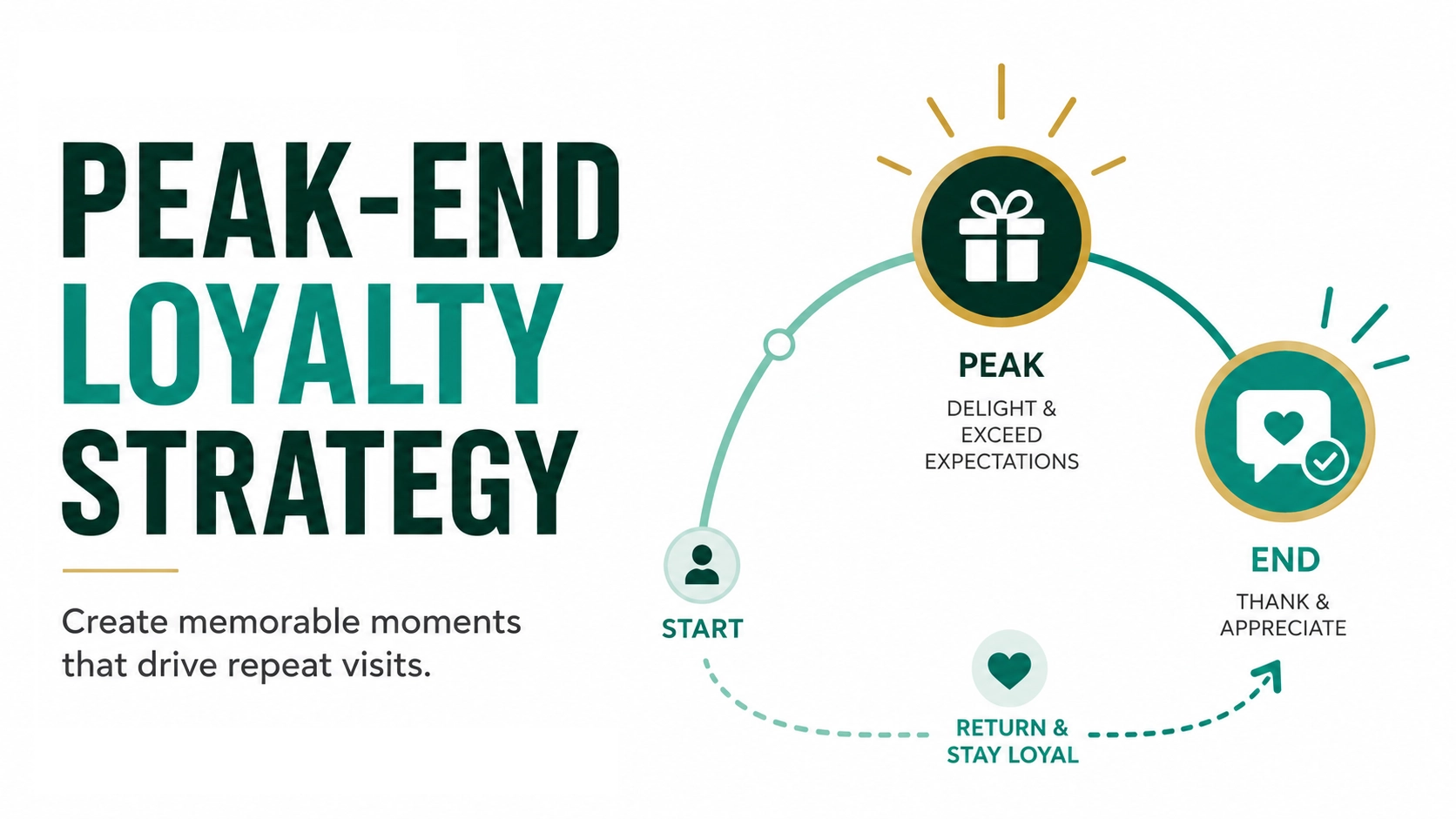
The peak-end loyalty strategy is a customer retention approach based on a simple idea: customers do not remember every part of an experience equally. They tend to remember the most intense moment and the way the experience ended.
That matters for loyalty marketing because many businesses spend most of their attention on acquisition, discounts, and transactions. But the customer may remember something different: the reward moment, the personal recognition, the final message, the thank-you, the survey, the follow-up, or the way the visit ended.
When a business understands this, loyalty becomes more than a points program. It becomes a way to shape the moments customers remember.
This article is part of our customer retention strategy series. You may also want to review our related articles on third visit customer retention strategy, customer preference discovery, return trigger marketing, the loyalty timing map, and the reward reset strategy.
What Is the Peak-End Loyalty Strategy?
The peak-end loyalty strategy is the practice of designing customer loyalty moments around the parts of the experience customers are most likely to remember.
In simple terms, a business should ask:
- What is the strongest positive moment in the customer journey?
- How does the customer feel at the end of the visit, purchase, service, or reward experience?
- What message or reward should happen immediately after that moment?
The goal is not to manipulate customers. The goal is to make the loyalty experience more memorable, useful, and emotionally clear.
A customer may forget the exact details of a transaction. But they may remember being recognized, earning a reward, receiving a thoughtful thank-you, getting a helpful follow-up, or feeling appreciated after the visit.
The Research Behind the Peak-End Rule
The peak-end rule is commonly associated with the work of Daniel Kahneman and other researchers who studied how people remember experiences. In the classic paper When More Pain Is Preferred to Less: Adding a Better End, Kahneman, Fredrickson, Schreiber, and Redelmeier examined how people evaluated experiences after they were over.
The broader research idea is that remembered experience is not always the same as the full experience. Kahneman, Wakker, and Sarin also discussed the difference between experienced utility and remembered utility in Back to Bentham? Explorations of Experienced Utility.
For business owners, the practical lesson is important: customers may not remember every step of a visit, purchase, appointment, or service interaction. They are more likely to remember standout moments and the ending.
That makes the final moments of the customer experience extremely important for customer retention.
Why This Matters for Loyalty Programs
Many loyalty programs are built around transactions:
- Spend money
- Earn points
- Receive a coupon
- Redeem a reward
That structure is useful, but it may miss the bigger opportunity.
A loyalty program should not only track what customers do. It should help shape what customers remember.
For example, a customer may not remember that they earned 47 points during a purchase. But they may remember a message that says:
Thanks for visiting again. You are now only one visit away from your next reward.
They may remember a birthday offer that arrived at the right time. They may remember being thanked after a redemption. They may remember a survey that made them feel heard. They may remember a reward moment that felt personal instead of generic.
Those memories can influence whether the customer returns.
The Peak Moment in a Loyalty Program
The peak moment is the part of the customer experience that feels most important, rewarding, surprising, or emotionally noticeable.
In a loyalty program, peak moments may include:
- Earning a reward
- Redeeming a reward
- Reaching a VIP tier
- Receiving a birthday or anniversary offer
- Getting a surprise bonus
- Being recognized as a repeat customer
- Receiving a personalized offer based on past behavior
- Being asked for feedback after a meaningful visit
These moments should not be treated as background system events. They should be treated as customer relationship moments.
If a customer earns a reward and the business says nothing, the peak moment may be lost. If the customer redeems a reward and receives no follow-up, the business may miss one of the best opportunities to reinforce the relationship.
The End Moment Is Often Overlooked
The ending of the experience may be even more important than many businesses realize.
For a restaurant, the ending may be the checkout, the receipt, the thank-you message, or the next-visit offer.
For a salon or spa, the ending may be the rebooking conversation, the post-appointment follow-up, or the reminder to maintain results.
For a car wash, the ending may be the finished vehicle, the thank-you message, or the next wash reminder.
For an automotive service department, the ending may be the pickup experience, service summary, survey, or maintenance reminder.
For a retail store, the ending may be the receipt, coupon, email follow-up, or reward progress update.
The customer may not remember every detail of the experience. But the end can shape how the whole experience feels in memory.
The Loyalty Mistake Most Businesses Make
Many businesses focus on getting the sale and then stop communicating at the exact moment when the relationship could be strengthened.
That creates a gap. The customer finishes the transaction, leaves, and hears nothing until the next generic promotion.
A better approach is to use the end of the experience to create a clear next step.
That next step might be:
- A thank-you message
- A reward progress update
- A bounce-back offer
- A short satisfaction survey
- A review request, when appropriate and compliant
- A next appointment reminder
- A product or service recommendation
- A return trigger based on timing or behavior
The business should not overwhelm the customer. The message should feel timely, relevant, and connected to what just happened.
How the Peak-End Loyalty Strategy Works
The peak-end loyalty strategy can be applied in four practical steps.
1. Identify the Peak Moment
First, identify the moments customers are most likely to value.
These may include reward earning, reward redemption, a milestone visit, a VIP upgrade, a birthday reward, a completed service, or a positive survey response.
The business should ask: What moment would make the customer feel recognized?
2. Strengthen the Ending
Next, decide how the experience should end.
A strong ending does not need to be complicated. It can be as simple as:
- Thanking the customer
- Showing progress toward the next reward
- Offering a reason to return
- Asking for feedback
- Reminding the customer of an upcoming milestone
The key is to avoid a cold ending. Do not let the customer complete the visit, purchase, or reward moment without a meaningful next step.
3. Connect the Moment to the Next Action
A peak moment should not stand alone. It should guide the customer toward the next useful action.
For example:
You earned your reward. Come back within 14 days and start earning double points toward your next one.
Or:
Thanks for visiting again. You are one visit away from your next member reward.
Or:
We hope you enjoyed your visit. Tell us how we did in this quick one-question survey.
This connects customer memory to customer momentum.
4. Automate the Follow-Up
The peak-end loyalty strategy works best when it is automated.
Manual follow-up is easy to forget. A loyalty platform can help businesses trigger the right message based on customer behavior, reward status, visit timing, redemption activity, survey response, or purchase history.
That is where strategy becomes operational.
Examples of the Peak-End Loyalty Strategy by Business Type
Restaurants and Cafes
A restaurant can create a stronger ending by sending a thank-you message after the visit and showing the customer how close they are to the next reward.
Example:
Thanks for joining us today. You are only two visits away from your next reward.
This gives the customer a clear reason to come back.
Car Washes
A car wash can use the clean vehicle as the peak moment and follow it with a next-wash reminder or reward progress update.
Example:
Your wash is complete. Come back within 10 days and earn a bonus stamp toward your next free wash.
The ending reinforces the fresh result and encourages repeat behavior.
Salons, Spas, and Medical Aesthetics
For appointment-based businesses, the end of the visit is a natural time to encourage rebooking, request feedback, or send aftercare information.
Example:
Thank you for visiting. Book your next appointment within 30 days and keep earning toward your next member reward.
This turns the end of the appointment into the beginning of the next visit cycle.
Retail Stores
A retailer can use the checkout moment as the ending and follow it with a reward status message or product-related offer.
Example:
Thanks for shopping with us. Your next member bonus is waiting in your account.
This makes the loyalty program feel active after the sale.
Automotive Service Departments
For service departments, the ending may include a service summary, satisfaction survey, or maintenance reminder.
Example:
Thank you for servicing your vehicle with us. We added points toward your next maintenance reward.
This helps the customer remember the service relationship instead of only the repair cost.
Where Surveys Fit Into the Peak-End Loyalty Strategy
Surveys can be especially useful when they are timed around the end of an experience.
A short survey after a visit, purchase, appointment, or service event can help the business understand whether the ending was positive or negative.
The survey should be simple. A one-question rating or short feedback request is often enough.
For example:
How was your visit today?
or:
How likely are you to return?
This gives the business a chance to respond while the experience is still fresh.
If the customer had a good experience, the business can thank them and invite the next action. If the customer had a poor experience, the business can follow up before the negative memory becomes permanent.
Where Review Requests Fit
Review requests can also fit into the peak-end loyalty strategy, but they must be handled carefully.
A business should never buy reviews, pressure customers, or offer rewards in exchange for reviews. Review requests should be neutral, compliant, and based on genuine customer experiences.
When done properly, a review request can be part of a strong ending. The customer had a positive experience, the business thanks them, and the business invites honest feedback.
That is different from offering a reward for a review.
A safer message might be:
Thank you for visiting. If you would like to share your experience, we would appreciate your honest feedback.
This keeps the focus on authenticity.
How Loyalty Software Helps Put the Peak-End Strategy Into Action
The peak-end loyalty strategy works best when the business can respond while the customer experience is still fresh. Loyalty software can help identify important moments such as a completed visit, reward earned, reward redeemed, VIP milestone, birthday, anniversary, survey response, or signs of inactivity.
Those moments can then guide a more relevant follow-up, such as a thank-you message, reward progress update, survey, next-visit offer, or rebooking reminder.
For a more practical implementation view, see our strategy implementation page: Peak-End Loyalty Strategy Software.
How This Strategy Connects to Other Loyalty Strategies
The peak-end loyalty strategy works especially well with several other retention strategies.
It connects with the reward reset strategy because reward redemption is often one of the strongest moments in the loyalty journey.
It connects with return trigger marketing because the end of one experience should often become the trigger for the next visit.
It connects with the loyalty timing map because timing determines whether a follow-up feels useful or random.
It also connects with customer preference discovery because the more a business understands the customer, the more relevant the peak and ending moments can become.
Common Mistakes to Avoid
The peak-end loyalty strategy works best when it feels natural. Businesses should avoid making the ending feel like a hard sell.
Common mistakes include:
- Ending every experience with the same generic coupon
- Sending too many messages after a visit
- Ignoring reward redemption as a follow-up opportunity
- Failing to thank customers after important actions
- Using surveys that are too long
- Asking for reviews in ways that feel pressured or noncompliant
- Letting negative experiences end without follow-up
The goal is not more communication. The goal is better communication at moments customers remember.
A Simple Peak-End Loyalty Framework
Businesses can apply this strategy with a simple framework:
- Find the peak. Identify the moments customers care about most.
- Improve the ending. Make the final interaction feel helpful and intentional.
- Guide the next action. Give the customer a clear reason to continue.
- Automate the timing. Use loyalty software to deliver the message consistently.
- Measure the response. Track whether the customer returns, redeems, responds, or engages.
This framework helps businesses move beyond one-time rewards and toward more memorable customer relationships.
Final Thought
The peak-end loyalty strategy gives businesses a better way to think about customer retention.
Customers may not remember every detail of a purchase, visit, appointment, or service interaction. But they are more likely to remember the moments that felt important and the way the experience ended.
That is why loyalty programs should do more than issue points and coupons. They should help businesses create stronger customer memories, better endings, and clearer reasons to return.
When a customer has a good experience, end it well. When a customer earns a reward, make it memorable. When a customer redeems, follow up. When a customer provides feedback, respond. When a visit ends, guide the next one.
That is the real value of the peak-end loyalty strategy.
Learn more about Preferred Patron loyalty software and how it helps businesses turn customer activity, rewards, messaging, and retention strategy into measurable repeat business.
Author note: Christopher Silvestri is Managing Partner and CTO of Preferred Patron Loyalty, a customer loyalty and marketing automation platform used by businesses to manage rewards, customer engagement, retention campaigns, and loyalty technology. His work focuses on helping businesses turn customer data, rewards, and automated messaging into measurable repeat business.
Frequently Asked Questions About the Peak-End Loyalty Strategy
What is the peak-end loyalty strategy?
The peak-end loyalty strategy is a customer retention approach that focuses on the most memorable parts of the customer experience: the emotional high point and the ending. In loyalty marketing, this can include reward moments, redemption moments, thank-you messages, surveys, and follow-up offers.
Why does the peak-end rule matter for loyalty programs?
The peak-end rule matters because customers may not remember every detail of an experience equally. A loyalty program can help businesses make important moments more memorable and create stronger endings that encourage customers to return.
What are examples of peak moments in a loyalty program?
Examples include earning a reward, redeeming a reward, reaching a VIP tier, receiving a birthday offer, getting a surprise bonus, being recognized as a repeat customer, or receiving a personalized follow-up.
How can a business improve the ending of a customer experience?
A business can improve the ending by sending a thank-you message, showing reward progress, offering a next-visit incentive, asking for feedback, sending a survey, or reminding the customer of a future benefit.
How does loyalty software help with the peak-end loyalty strategy?
Loyalty software can track visits, purchases, reward status, redemptions, customer groups, survey responses, and engagement history. This allows the business to automatically send the right follow-up at the right time.
Is the peak-end loyalty strategy only for points programs?
No. The strategy can be used with points, digital stamps, cash-back, coupons, VIP tiers, birthday rewards, surveys, review requests, service reminders, and post-redemption campaigns.