
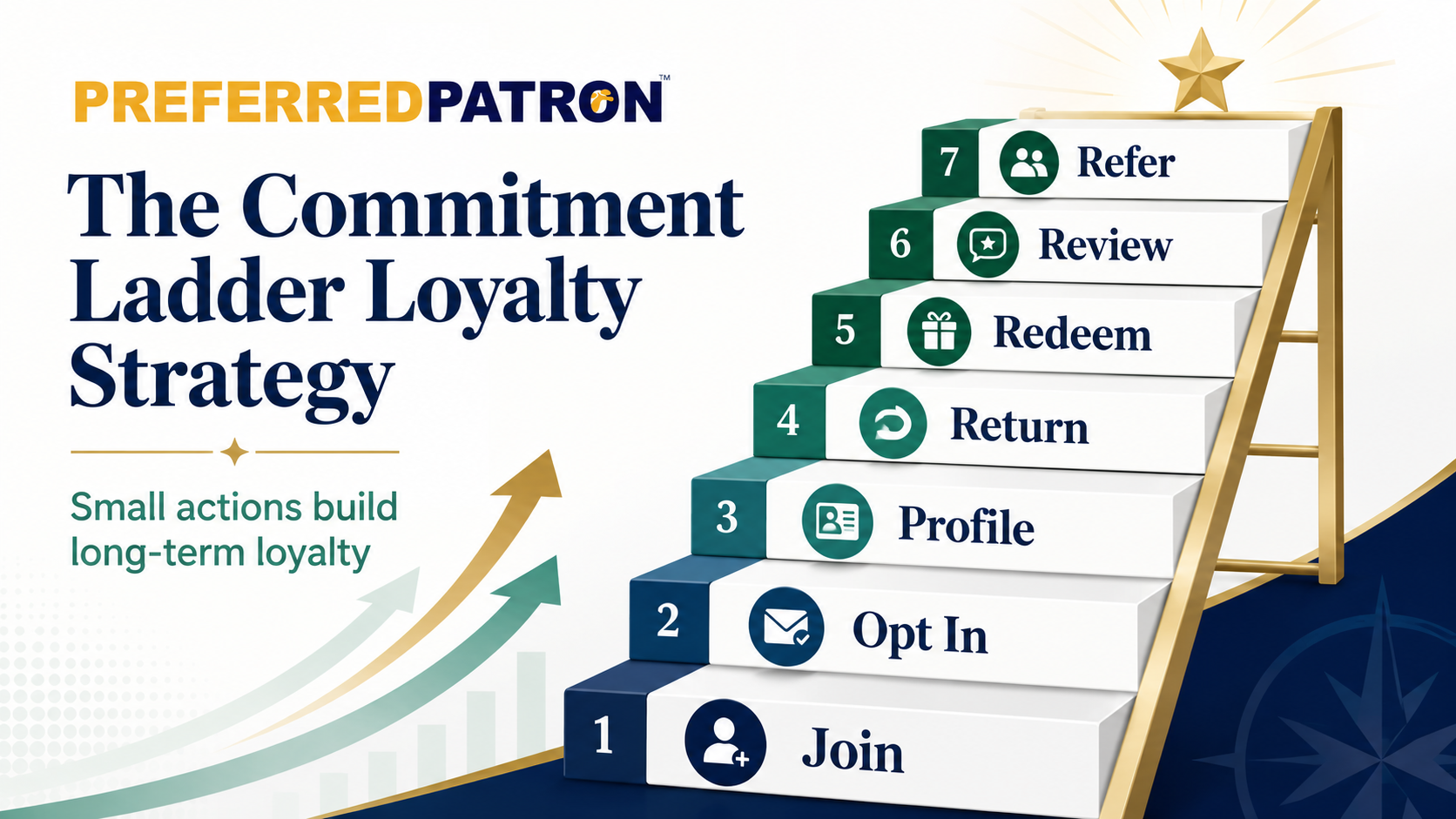
The commitment ladder loyalty strategy is a customer retention approach that turns one large request into a series of smaller, useful customer actions.
Many businesses ask too much too soon. A new customer may be asked to join, provide several personal details, opt into email and text messages, download an app, complete a profile, write a review, and refer a friend—all before the customer has built much trust.
A better approach is to guide the customer one step at a time. Joining can lead to an opt-in. An opt-in can lead to profile completion. A first reward can lead to redemption. A good redemption experience can lead to a review. A strong relationship can lead to a referral.
This is the commitment ladder: each completed action makes the next meaningful action easier to understand and more natural to consider.
This article is part of the Preferred Patron Strategy Central series. For the practical software workflow, visit the implementation page: Commitment Ladder Loyalty Strategy Software.
What Is the Commitment Ladder Loyalty Strategy?
The commitment ladder loyalty strategy is the practice of building customer participation through a sequence of small, related actions.
Each step should be:
- Easy to understand
- Appropriate for the customer’s current relationship
- Useful to both the customer and the business
- Connected to a clear next step
- Voluntary and respectful
The goal is not to force every customer through a rigid funnel. Customers move at different speeds. Some may skip a step. Others may pause for weeks or months. The business should simply recognize the customer’s current level of participation and present the next reasonable action.
Why One Large Loyalty Ask Often Fails
A customer who just made a first purchase may like the business, but that does not mean the customer is ready to make a large commitment.
Consider a checkout screen that asks for:
- Full name
- Email address
- Mobile number
- Birthday
- Home address
- Communication permission
- App download
- Preference survey
The business may want this data for good reasons. But the customer sees a long form and a large decision. The customer may decline the entire request even though they would have agreed to a smaller first step.
The commitment ladder loyalty strategy separates those requests. It asks for only what is needed now, then creates a reason to take the next step later.
The Research Behind Small Commitments
The commitment ladder is a practical loyalty framework. It is connected to behavioral research on sequential requests, consistency, and self-perception.
In the classic 1966 study Compliance Without Pressure: The Foot-in-the-Door Technique, Jonathan Freedman and Scott Fraser examined whether agreeing to a small request could increase willingness to agree to a related larger request later.
Later research and reviews, including Jerry Burger’s The Foot-in-the-Door Compliance Procedure: A Multiple-Process Analysis and Review, found that the effect is more complex than a simple persuasion trick. The relationship between the requests, the customer’s sense of choice, the timing, and the meaning of the first action all matter.
A broader meta-analysis of foot-in-the-door research also supports an important caution: small requests do not automatically produce larger commitments. The steps must feel connected, reasonable, and voluntary.
For loyalty marketers, the lesson is not “get customers to say yes once so they must say yes again.” The better lesson is this:
Make the first useful action easy, deliver value, and invite the customer to take the next natural step.
The Seven Rungs of a Customer Commitment Ladder
Every business can design its own ladder. A practical customer loyalty ladder may include seven common rungs.
1. Join
The first commitment is simple recognition. The customer moves from anonymous buyer or visitor to known member.
At this stage, ask for the minimum information needed to create the relationship. That may be a mobile number, email address, membership ID, or another simple identifier.
The customer should understand the immediate value:
- Earn points or stamps
- Receive a welcome reward
- Track purchases or visits
- Access member pricing or benefits
Do not turn a simple enrollment into a long application.
2. Opt In
Joining a program and agreeing to receive marketing messages are not the same action.
The next rung may be permission to receive email, SMS, app messages, or another communication type. The request should explain what the customer will receive and how often messages are likely to arrive.
Examples:
- Get reward updates by email.
- Receive a text when your next reward is ready.
- Turn on app alerts for expiring offers.
This step should be clear and permission-based. Trust grows when customers remain in control.
3. Complete a Profile
Once the customer sees value in the program, the business can ask for more useful information.
Profile completion may include:
- Birthday or anniversary
- Preferred location
- Favorite product or service
- Vehicle, pet, household, or service information
- Communication preferences
- Interests or purchase categories
The request should explain the benefit. Customers are more likely to provide information when they understand how it will improve their experience.
This rung connects closely with the Customer Identity Capture Strategy, but the two ideas are not identical. Identity capture focuses on turning anonymous activity into usable customer data. The commitment ladder focuses on the sequence of actions that deepens participation over time.
4. Return and Participate
The next commitment is behavioral. The customer returns, buys again, books another service, checks in, earns another stamp, or moves closer to a reward.
This is where the relationship begins to move beyond enrollment.
A program should make the next action clear:
- Return within 14 days
- Book the next appointment
- Make one more visit to earn a reward
- Try a related product category
- Complete the next stamp
The commitment ladder works well with the Habit Loop Loyalty Strategy. The ladder defines how participation deepens. The habit loop helps repeat an important action once it has started.
5. Redeem
Earning a reward is not the same as using it.
Redemption is an important commitment because the customer must understand the reward, remember it, return at the right time, and complete the action.
A smooth redemption experience can strengthen trust. A confusing or difficult redemption can weaken it.
Businesses should make redemption:
- Easy to find
- Easy to understand
- Easy for employees to process
- Consistent across locations and channels
- Connected to the next loyalty step
Visible reward progress can help customers reach this rung. See the Progress Visibility Strategy for the role that points, stamps, tiers, and goal distance can play before redemption.
6. Review
A review asks the customer to move from private participation to public feedback.
This is a larger commitment than joining or redeeming. The request should normally come after the customer has had enough experience to form a real opinion.
Good review timing may follow:
- A positive service interaction
- A completed reward redemption
- A successful appointment
- A repeat purchase
- A high satisfaction response
The business should not pressure customers or attempt to control what they say. The purpose is to make it easy for active customers to share honest feedback at an appropriate time.
7. Refer
A referral is one of the highest rungs because the customer is placing personal trust behind the recommendation.
Referral requests work best after the customer has received clear value and has shown signs of satisfaction or repeat engagement.
The request should be simple:
- Refer one friend
- Share a member invitation
- Give a friend a welcome reward
- Earn recognition or a benefit after the friend joins or visits
Do not ask every new member for a referral immediately. A customer who has not yet experienced the program has little reason to recommend it.
The Commitment Ladder Is Not a Rigid Funnel
Customers do not all follow the same path.
A long-time customer may refer a friend before completing a profile. A customer may write a review without redeeming a reward. Another customer may join and return several times without opting into marketing.
The ladder is a planning tool. It helps the business avoid two common mistakes:
- Asking for every action at once
- Sending the same request to every customer
The best next rung depends on what the customer has already done and what would create real value next.
How to Design a Commitment Ladder Loyalty Strategy
Step 1: List the Actions That Matter
Identify the customer actions that support the relationship.
Examples may include enrollment, permission, profile completion, a second visit, rebooking, reward use, app access, survey response, review, and referral.
Step 2: Arrange the Actions by Effort and Trust
Place the easiest, lowest-risk actions near the bottom. Put actions that require more time, information, public support, or social trust near the top.
A mobile number may be a small request for one business but a larger request for another. The ladder should reflect the actual customer experience.
Step 3: Define the Value at Every Rung
Customers should not climb the ladder only because the business wants more data or promotion.
Each step should provide a reason:
- Join to start earning
- Opt in to receive reward alerts
- Complete a profile to receive relevant benefits
- Return to reach the next reward
- Redeem to receive the promised value
- Review to share useful feedback
- Refer to help a friend discover the business
Step 4: Ask for One Clear Next Action
Do not ask the customer to complete a profile, redeem an offer, leave a review, refer a friend, and download an app in the same campaign.
One message should normally have one primary purpose.
This is where the commitment ladder connects with the Choice Reduction Strategy. The customer should see the next step without having to compare several competing requests.
Step 5: Wait for the Right Moment
The next request should follow a relevant event.
Examples:
- Ask for communication permission after enrollment
- Ask for preferences after the customer has received initial value
- Ask for redemption after a reward is earned
- Ask for a review after a successful experience
- Ask for a referral after repeat engagement or positive feedback
Step 6: Measure Movement Between Rungs
A commitment ladder should be measured as customer behavior, not just message activity.
Useful measurements include:
- Enrollment completion rate
- Email and SMS permission rate
- Profile completion rate
- Second-visit and third-visit rate
- Reward earning and redemption rate
- Review request and completed review rate
- Referral request, referral join, and referral visit rate
- Average time between rungs
- Customer retention by highest rung reached
The goal is to find where customers move forward and where they stop.
Commitment Ladder Examples by Business Type
Restaurants and Cafes
A restaurant ladder may move from joining with a mobile number, to receiving reward alerts, to making a second visit, to redeeming a free item, to reviewing the restaurant, and finally to referring a friend.
Retail Stores
A retailer may start with enrollment at checkout, then invite the customer to select favorite categories, return for a member offer, redeem a reward, review a recent purchase, and share a referral invitation.
Car Washes
A car wash may move customers from a first visit to digital enrollment, wash reminders, a repeat wash, package or membership interest, reward redemption, and referral.
Salons, Spas, and Medspas
An appointment-based business may begin with enrollment, ask for birthday or service preferences, encourage rebooking, recognize a treatment milestone, request feedback, and then invite a referral after a positive service history.
Hotels and Resorts
A hotel may move from guest enrollment to communication permission, stay preferences, direct booking, reward redemption, post-stay feedback, and referral or repeat booking.
Automotive Dealerships and Service Departments
An automotive business may begin with customer identification, add vehicle information, send maintenance reminders, encourage a return service visit, recognize service milestones, request a review, and later invite a referral.
Common Commitment Ladder Mistakes
Asking for Too Much at Enrollment
A long enrollment form creates friction before the customer has seen value.
Moving to Advocacy Too Soon
A new member is not automatically ready to review or refer. Advocacy should follow real experience.
Offering No Value for the Next Step
If profile completion only helps the business, customers may ignore it. Explain how the information improves rewards, messages, service, or access.
Treating Every Customer the Same
A customer who already redeemed a reward should not receive the same message as someone who joined yesterday.
Using Pressure Instead of Progress
The ladder should make participation easier. It should not make customers feel trapped, rushed, or misled.
Failing to Recognize Completed Actions
If a customer has already completed a profile or submitted a review, stop asking for the same action. Recognition is part of a respectful customer experience.
How Loyalty Software Supports the Commitment Ladder
A commitment ladder becomes easier to manage when the business can recognize completed actions, customer status, reward activity, communication permission, and the next appropriate step.
Loyalty software can help a business:
- Capture a simple enrollment first
- Track email and SMS permission separately
- Identify missing profile information
- Recognize first, second, and repeat visits
- Track reward earning and redemption
- Segment customers by completed actions
- Trigger a review or referral request at a relevant time
- Stop campaigns after the requested action is completed
- Measure movement from one rung to the next
The software should not simply send more messages. It should help the business make a better next request.
For the implementation workflow, campaign examples, segmentation logic, and measurement approach, visit Commitment Ladder Loyalty Strategy Software.
How This Strategy Connects to Other Loyalty Strategies
The commitment ladder loyalty strategy works best as part of a broader customer journey.
- Customer Identity Capture helps the business begin a known customer relationship.
- Habit Loop Loyalty Strategy helps repeat important actions after they begin.
- Progress Visibility Strategy helps customers see movement toward the next reward or milestone.
- Choice Reduction Strategy helps keep each next request clear and simple.
Together, these strategies help a business recognize the customer, guide the next action, reinforce progress, and build a stronger relationship over time.
Final Thought
Long-term loyalty rarely begins with a large commitment.
It begins with a small action that feels useful and easy. Then another. Then another.
A customer joins. The customer gives permission. The customer shares a preference. The customer returns. The customer redeems. The customer reviews. The customer refers.
Each step should earn the right to ask for the next one.
That is the purpose of the commitment ladder loyalty strategy: not to pressure customers into doing more, but to build trust, value, and participation one meaningful action at a time.
See how Preferred Patron can help implement the Commitment Ladder Loyalty Strategy.
Author note: Christopher Silvestri is Managing Partner and CTO of Preferred Patron Loyalty, a customer loyalty and marketing automation platform used by businesses to manage rewards, customer engagement, retention campaigns, and loyalty technology. His work focuses on helping businesses turn customer data, rewards, and automated messaging into measurable repeat business.
Frequently Asked Questions About the Commitment Ladder Loyalty Strategy
What is the commitment ladder loyalty strategy?
The commitment ladder loyalty strategy is a customer retention approach that guides customers through a series of small, related actions, such as joining, opting in, completing a profile, returning, redeeming, reviewing, and referring.
Why should businesses use small customer commitments?
Small actions are easier to understand and complete than one large request. They also allow the business to deliver value and build trust before asking the customer to take a more involved step.
Does every customer need to follow the same ladder?
No. The ladder is a planning framework, not a fixed path. Customers may skip steps, complete actions in a different order, or pause before taking the next step.
How is the commitment ladder different from a habit loop?
The commitment ladder focuses on increasing levels of customer participation. A habit loop focuses on repeating a behavior through cues, routines, rewards, and follow-up. A business can use both strategies together.
Is the commitment ladder manipulative?
It should not be. The strategy should preserve customer choice, clearly explain value, respect communication permission, and avoid pressure. Each request should be relevant and beneficial to the customer.
How can loyalty software support a commitment ladder?
Loyalty software can track completed actions, identify the customer’s current stage, trigger the next appropriate request, stop messages after completion, and measure movement from one rung to the next. See the planned Commitment Ladder Loyalty Strategy Software implementation page.