Commitment Ladder Loyalty Strategy Software
Use Preferred Patron™ to recognize small customer commitments, guide the next useful action, and build participation from enrollment through referral.
The Commitment Ladder Loyalty Strategy turns one large customer request into a managed sequence of smaller steps. Preferred Patron™ helps businesses track enrollment, channel permission, profile completion, visits, rewards, redemptions, feedback, and referrals so each customer can receive a relevant next request instead of every request at once.
Commitment Ladder Workflow
Preferred Patron™ helps businesses manage:
- Simple enrollment and customer identification
- Email and SMS permission status
- Progressive profile completion
- Visit, purchase, and reward milestones
- Reward issuance and redemption activity
- Survey and review-request timing
- Referral capture and qualifying follow-up
- Customer groups and movement reporting
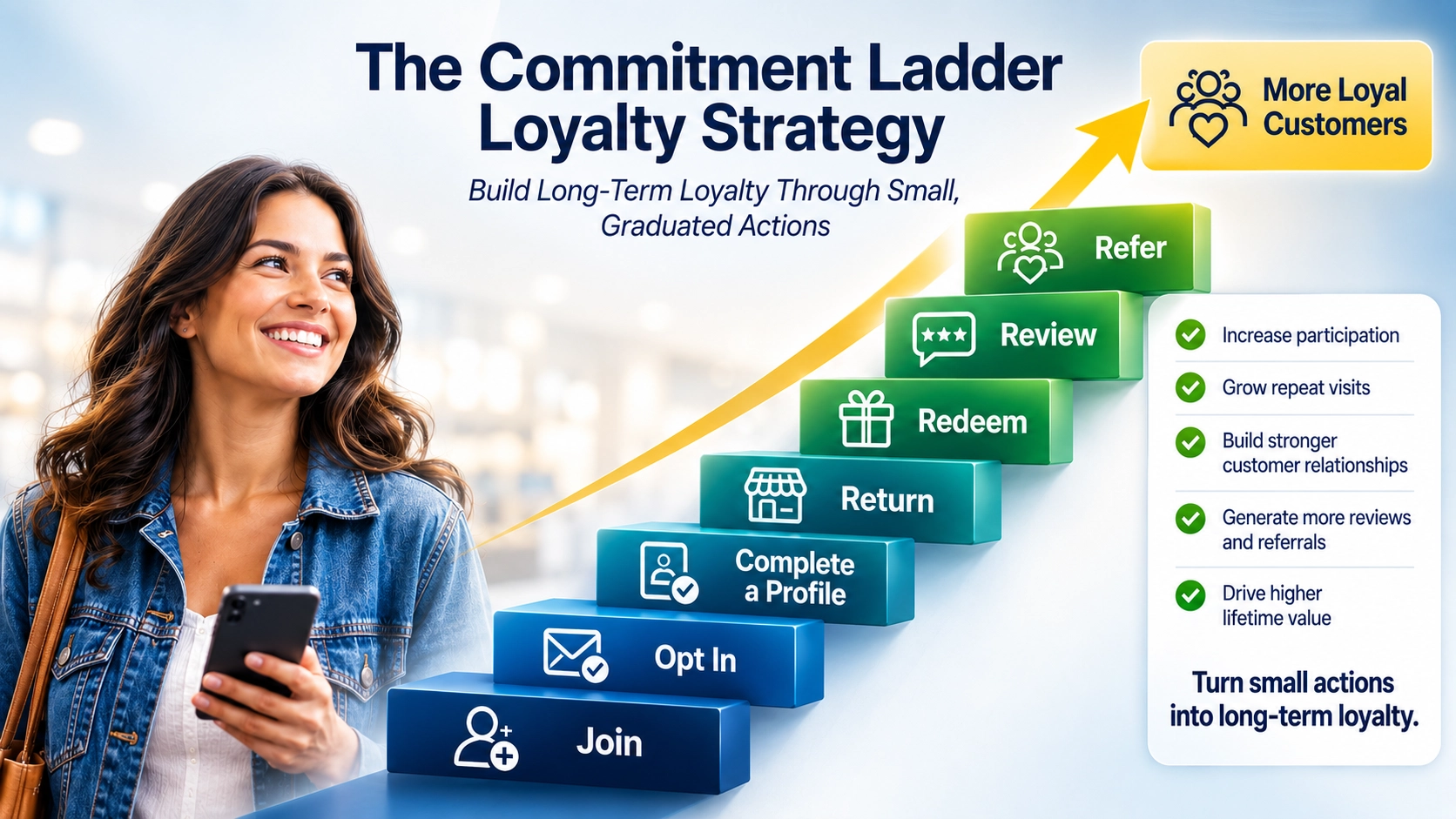
Preferred Patron™ helps businesses recognize each completed customer action and make the next meaningful step easier to understand and complete.
Turn Small Customer Actions Into a Managed Retention Path
The advisory article explains why participation often grows through small, related commitments. This implementation page focuses on the software workflow: recognize the current rung, present one useful next action, stop asking after completion, and measure movement over time.
Recognize the Current Rung
Use member identity, permission status, profile data, visit history, reward activity, survey responses, and referral information to understand what the customer has already completed.
Prompt One Next Action
Use customer groups, campaign rules, email, SMS, member access, rewards, and timed follow-up to present one relevant next step instead of several competing requests.
Measure Advancement
Track completion, visit behavior, reward use, campaign response, review activity, referrals, and time between stages to find where customers progress or stop.
Identify the customer, capture permission, and build enough profile context to make future communication more relevant.
Use timely reminders, rewards, and member access to encourage the next visit and deliver the value the program promised.
Invite honest feedback and referrals only after the customer has received enough value to support a credible recommendation.
What Is Commitment Ladder Loyalty Strategy Software?
Commitment Ladder Loyalty Strategy software helps a business manage increasing levels of customer participation. Instead of treating every customer as ready for the same request, the business uses customer data and activity to determine what has already happened and what action would create value next.
Preferred Patron™ supports this approach with enrollment tools, customer profiles, email and SMS permissions, custom fields, customer groups, visit and transaction history, points, stamps, tiers, coupons, certificates, digital rewards, surveys, campaign automation, referral capture, member access, and reporting.
This implementation page is not a duplicate of the advisory article. It focuses on how the platform can organize the seven rungs, trigger appropriate follow-up, recognize completed actions, and measure progression toward stronger customer participation.
Strategy Source
This implementation page is paired with the Preferred Patron™ advisory article, The Commitment Ladder Loyalty Strategy: How Small Customer Actions Build Long-Term Loyalty.
The advisory article explains the behavioral reasoning and customer experience principles. This page focuses on Preferred Patron™ implementation workflows, permissions, profile building, segmentation, rewards, automation, feedback, referrals, and measurement.
Related Preferred Patron™ pages include Customer Identity Capture Strategy Software, Marketing Automation, and Customer Loyalty Software Features.
How Preferred Patron™ Supports Each Commitment Rung
Each rung uses different customer signals, software actions, and measurements. Customers may skip stages or complete them in a different order, so the ladder should guide rather than restrict.
| Commitment Rung | Customer State | Preferred Patron™ Use | Measurement |
|---|---|---|---|
| 1. Join | The customer moves from anonymous activity to a known member record. | Use staff-assisted signup, branded enrollment forms, member access, QR enrollment, kiosk or tablet flows, imported records, or supported POS workflows. | Enrollment starts, completed enrollments, usable contact records, and first identified activity. |
| 2. Opt In | The member chooses whether email, SMS, or another communication channel may be used. | Track email and SMS permission, subscription status, opt-outs, DNC preferences, channel availability, and campaign eligibility separately from membership. | Permission rate by channel, opt-out rate, deliverable contacts, and message engagement. |
| 3. Complete a Profile | The member adds useful information after understanding the program value. | Collect birthdays, anniversaries, preferred location, interests, custom fields, household or service details, preferences, and survey responses over time. | Profile completion rate, fields completed, preference coverage, and campaign response by profile depth. |
| 4. Return and Participate | The member returns, buys, books, checks in, earns, or reaches another tracked milestone. | Use visit and transaction history, points, stamps, tiers, customer groups, milestone rules, return reminders, and progress messages to reinforce participation. | Second and third visit rates, repeat purchase or booking rate, visit frequency, spend, and time to return. |
| 5. Redeem | The member uses a reward, coupon, certificate, digital reward, discount, service benefit, or stored-value offer. | Track reward issuance, availability, expiration, redemption, post-redemption state, and the next reward or milestone. | Earn-to-redeem rate, redemption delay, unused reward rate, post-redemption return, and next-goal progress. |
| 6. Review | The customer is ready to provide feedback or share an honest public review after a relevant experience. | Use surveys, satisfaction responses, service follow-up, customer groups, and timed messaging to request feedback after qualifying activity. Do not condition rewards on positive reviews. | Survey response, satisfaction trends, review-request completion, service recovery, and retention after feedback. |
| 7. Refer | The customer is willing to introduce another person after receiving meaningful value. | Capture referral codes or source information, identify referred members, assign customer groups, and trigger recognition or benefits after the defined qualifying action. | Referral invitations, referred enrollments, first qualifying visits or purchases, repeat activity, and referral value. |
Preferred Patron™ Features That Operationalize the Ladder
The strategy becomes manageable when customer identity, permissions, behavior, rewards, messaging, and reporting work together.
Enrollment Tools
Start with a simple member record through branded forms, staff-assisted enrollment, QR codes, kiosk or tablet flows, member access, imported records, and supported transaction workflows.
Permission Management
Track email and SMS permission, subscription status, opt-outs, channel availability, and campaign eligibility without treating loyalty enrollment as blanket marketing consent.
Progressive Profiles
Collect birthdays, anniversaries, preferred locations, interests, service details, custom fields, preferences, and survey answers after the member has a reason to provide them.
Customer Groups
Build groups such as new members, opted-in members, incomplete profiles, second-visit customers, near reward, post-redemption, satisfied respondents, or referral-ready members.
Campaign Automation
Trigger welcome messages, profile prompts, reward progress updates, return reminders, redemption follow-up, surveys, review requests, and referral invitations based on eligibility.
Rewards and Redemptions
Connect points, stamps, tiers, coupons, certificates, digital rewards, discounts, gift cards, issued benefits, and redemptions to each customer record.
Surveys and Feedback
Use survey responses and satisfaction signals to enrich profiles, route service follow-up, identify appropriate feedback timing, and avoid asking every customer at the same moment.
Referral Capture
Capture referral source or codes during enrollment, identify referred customers, and connect qualifying referral activity to customer groups and follow-up.
Movement Reporting
Measure enrollment, permission, profile completion, repeat visits, redemptions, survey activity, referrals, campaign response, and the time customers take to move between stages.
Example Commitment Ladder Campaign Sequence
Each campaign should ask for one primary action and stop when that action is complete.
| Trigger | Next Request | Automation Example | Stop Condition |
|---|---|---|---|
| New member enrolled | Confirm the immediate program value and invite appropriate communication permission. | Send a welcome email or SMS based on available permission, show the starting balance or welcome benefit, and explain the next earning action. | Permission is recorded, the welcome sequence ends, or the defined response window closes. |
| Member has permission but an incomplete profile | Request one useful field or preference with a clear customer benefit. | Ask for a birthday, preferred location, service interest, vehicle, pet, or other relevant field rather than presenting a long form. | The requested field is completed or the customer becomes ineligible. |
| Profile completed but no return activity | Encourage the next visit, purchase, booking, or check-in. | Use a return reminder, reward progress message, next-visit benefit, appointment prompt, or service-cycle message. | A qualifying visit, purchase, booking, or other tracked action occurs. |
| Reward earned but not redeemed | Explain the available reward and how to use it. | Send a reward-ready message, expiration reminder, portal link, barcode, or employee-facing redemption instruction. | The reward is redeemed, expires, or becomes unavailable. |
| Successful redemption or positive service event | Request honest feedback at an appropriate time. | Send a survey or review invitation after the qualifying experience, without requiring a positive response or exchanging a reward for a favorable review. | Feedback is submitted, a review link is used, a service issue is detected, or the request window closes. |
| Repeat engagement or positive feedback | Invite the customer to refer one person. | Provide a referral code, invitation link, shareable offer, or member benefit tied to a defined qualifying referral action. | A referral is captured, the qualifying action occurs, or the campaign window closes. |
Commitment Ladder Examples by Business Type
The same seven-rung framework can be adapted to the actions that matter in different customer journeys.
Restaurants and Cafes
Join, opt into reward alerts, choose a favorite location or dining preference, return for another visit, redeem a menu reward, share feedback, and refer a friend.
Retail Stores
Enroll at checkout, select communication preferences, identify favorite categories, return for a member offer, redeem a reward, review a purchase, and share a referral invitation.
Car Washes
Identify the customer, collect permission, record vehicle or wash preference, encourage a repeat wash, redeem a wash benefit, request feedback, and refer another driver.
Salons, Spas, and Medspas
Enroll, opt into reminders, record service preferences, rebook, redeem a treatment or product benefit, complete a satisfaction survey, and refer a friend.
Hotels and Resorts
Enroll the guest, obtain permission, collect stay preferences, encourage direct booking, redeem a guest benefit, request post-stay feedback, and invite a referral or return stay.
Automotive Sales and Service
Identify the customer, collect communication permission, add vehicle details, return for service, redeem a maintenance benefit, review the experience, and refer another vehicle owner.
Measure Progress Without Turning the Ladder Into Pressure
The implementation should improve customer relevance, not simply increase the number of requests sent.
Recommended Measurements
- Enrollment completion and first identified activity
- Email and SMS permission rates by source
- Profile completion by field and customer group
- Second visit, third visit, and repeat booking rates
- Reward issuance, unused reward, and redemption rates
- Survey response, satisfaction, and service recovery
- Referral enrollment and qualifying referral activity
- Average time between commitment stages
- Retention by highest meaningful rung reached
Customer Experience Guardrails
- Preserve customer choice at every stage.
- Keep loyalty membership separate from marketing permission.
- Explain the customer benefit behind profile requests.
- Use one primary action per message or campaign.
- Stop asking after the action is completed.
- Allow customers to skip or complete stages in a different order.
- Do not reward or pressure customers for positive reviews.
- Use referral benefits only after clearly defined qualifying activity.
Related Strategy Central Implementations
The commitment ladder works best when identity, behavior, clarity, progress, and repeat action are coordinated.
Ready to Build a More Progressive Customer Journey?
Preferred Patron™ can help connect enrollment, permissions, profile completion, visits, rewards, redemptions, feedback, referrals, automation, and reporting into a practical commitment ladder workflow.
Commitment Ladder Loyalty Strategy Software FAQs
What is commitment ladder loyalty strategy software?
Commitment ladder loyalty strategy software helps a business recognize completed customer actions, identify an appropriate next step, automate relevant follow-up, and measure movement from enrollment through stronger participation and referral.
How does Preferred Patron™ support the commitment ladder?
Preferred Patron™ supports enrollment, customer profiles, email and SMS permissions, custom fields, customer groups, visits, transactions, points, stamps, tiers, rewards, redemptions, surveys, referral capture, campaign automation, member access, and reporting.
Must every customer complete all seven rungs in order?
No. The ladder is a planning and segmentation framework. Customers may skip stages, complete them in a different order, or pause before taking another action.
Should all profile fields be collected during enrollment?
Not necessarily. Many businesses benefit from simple enrollment first and progressive profile building later, when the customer understands why the additional information is useful.
Can the strategy include review and referral requests?
Yes, when the timing is appropriate and the customer has received enough value. Review requests should invite honest feedback without rewarding a positive review, and referral benefits should use clearly defined qualifying rules.
How should a business measure a commitment ladder?
Measure completion at each stage, time between stages, repeat visits or bookings, reward redemptions, survey response, referral activity, campaign response, and retention by the highest meaningful commitment reached.