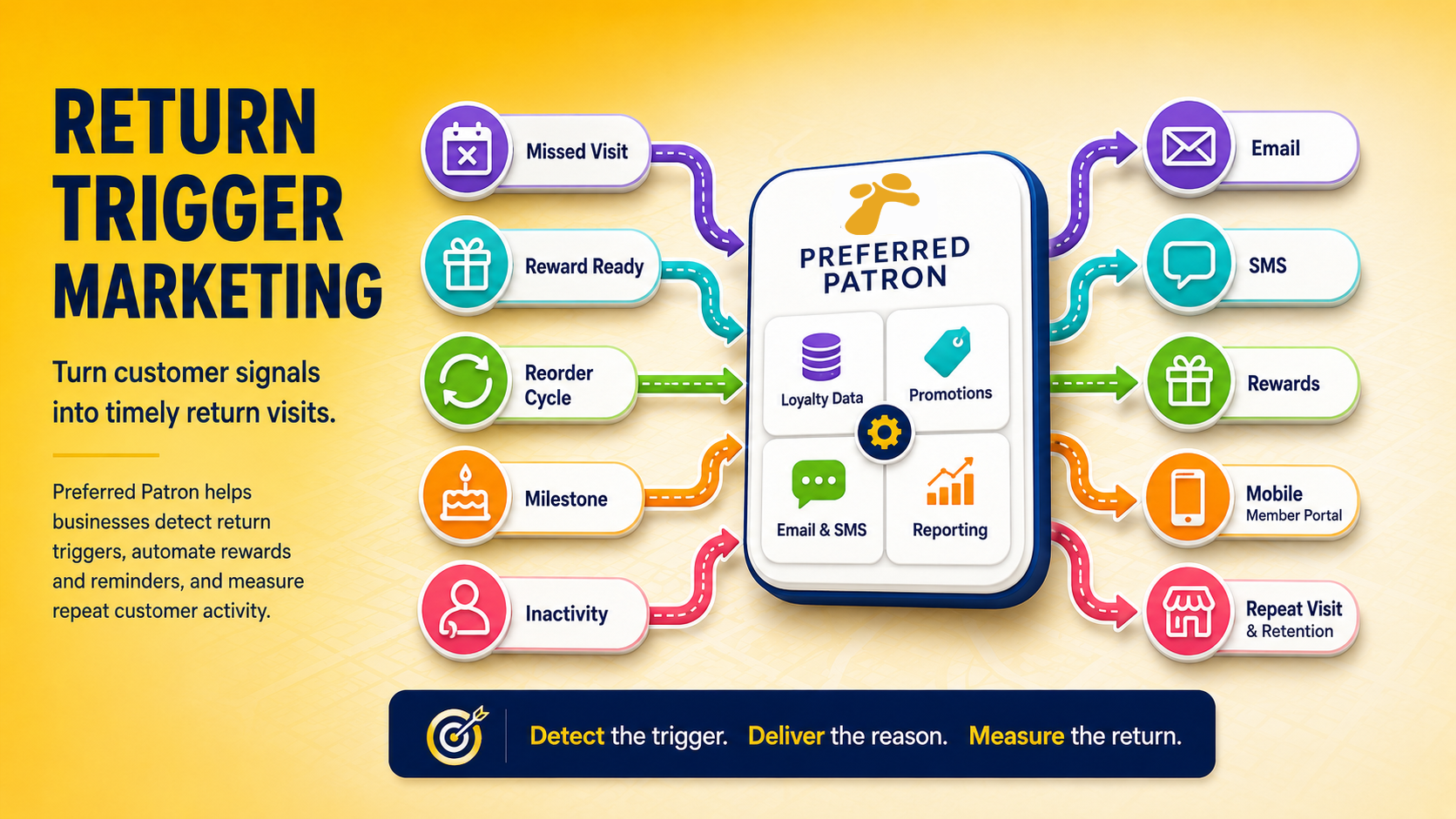
Use Preferred Patron™ to identify the customer moments that should cause the next visit, then automate the reward, reminder, email, SMS, or follow-up that brings the customer back.
Return trigger marketing is not about sending more campaigns. It is about recognizing when a customer has a practical reason to return, such as a refill cycle, service interval, reward balance, missed visit window, seasonal need, or next-step purchase opportunity.
The blog post explains why return trigger marketing matters. This page explains how Preferred Patron™ helps businesses put that marketing strategy into operation with loyalty data, automated promotions, rewards, messaging, segmentation, and reporting.
Use loyalty history, last visit date, purchase behavior, reward status, and customer-defined tracking to identify when a customer has a reason to return.
Deliver a relevant message through email, SMS, mobile app access, member portal, coupon, reward, bonus points, or personal milestone campaign.
Track visits, redemptions, spend, reward use, offer response, repeat behavior, and the campaigns that actually moved customers back into activity.
Return trigger marketing is a customer retention strategy built around one practical question: what should cause this customer to come back? The trigger may be time-based, behavior-based, purchase-based, reward-based, seasonal, or related to a lapse in activity.
Preferred Patron™ helps businesses operationalize this strategy by connecting loyalty activity, customer profiles, rewards, promotions, purchase history, POS-style tracking, email, SMS, surveys, and reporting in one platform.
This creates a more useful alternative to generic coupon blasts. The message is tied to a customer moment, so the outreach can feel like a timely reminder, next-step suggestion, reward nudge, or helpful invitation instead of another broad promotion.
Most businesses can start with a few high-value triggers, then expand into more advanced timing rules as they learn which moments create the strongest return behavior.
| Trigger Type | Customer Moment | Preferred Patron Implementation | Example Campaign |
|---|---|---|---|
| Time Trigger | A customer normally returns on a predictable cycle but has not come back yet. | Use last visit date, visit frequency, customer groups, and automated email or SMS follow-up. | "It may be time for your next visit. Come back this week and earn bonus points." |
| Product or Service Trigger | A customer bought, booked, or redeemed something that suggests a next step. | Use purchase history, POS integration, item tracking, SKU tracking, or a platform-defined service menu. | "You tried lunch. Join us for dinner and earn double points." |
| Reward Trigger | A customer is close to earning a reward or has a reward waiting. | Use points, stamps, cashback, certificates, expiration rules, reward reminders, and mobile access. | "Your reward is ready. Use it on your next visit." |
| Season Trigger | A customer is likely to need something because of a season, event, or local condition. | Use segments, product categories, weather-aware campaigns, customer preferences, and scheduled promotions. | "Spring project season is here. Members earn bonus rewards this weekend." |
| Silence Trigger | A customer stops visiting, booking, redeeming, opening, or engaging. | Use lapse detection, win-back rules, member groups, surveys, review requests, and progressive reactivation offers. | "We have not seen you in a while. Here is a member bonus for your next visit." |
Start with a business outcome, such as more second visits, faster reward redemption, higher service rebooking, increased repeat retail purchases, or fewer quiet lapses.
Select the signal that matters most: last visit, purchase item, service type, reward balance, points progress, membership tier, campaign response, birthday, anniversary, or missed activity.
Use customer groups, segments, preferences, home store, location, spend, visit behavior, item history, and engagement data to reach the members most likely to respond.
Use the lightest useful motivator, such as a reminder, reward nudge, bonus points, stamp credit, cashback, member-only offer, survey request, or limited-time campaign.
Send the message through email, SMS, mobile app, mobile wallet, member portal, printed offer, POS prompt, or staff-assisted customer service workflow.
Measure actual behavior after the message, including return visits, redemptions, spend, offer use, reward status, customer activity, and campaign comparison results.
The strategy becomes practical when the loyalty platform can connect the customer profile, the trigger, the offer, the message, and the result.
Group customers by visits, spend, recency, frequency, reward status, offer usage, customer attributes, location, and engagement patterns.
Trigger points, stamps, cashback, coupons, certificates, instant rewards, birthday offers, win-back campaigns, and next-visit incentives.
Send customer messages through loyalty email, SMS text marketing, mobile access, and member-facing reward communications.
Use POS integrations, SKU or item-level tracking, product categories, or a defined service menu to build triggers around what customers actually buy or book.
Use surveys, review requests, service recovery notes, and customer preference data to improve follow-up messages and identify at-risk relationships.
Track campaign results by return visit, reward redemption, spending behavior, member activity, trigger type, location, and promotional performance.
Return triggers work best when they reflect the customer's real reason to return. Preferred Patron™ can support different triggers by industry, location, offer type, and customer behavior.
Invite lunch guests to dinner, bring first-time visitors back for a second visit, remind members to use rewards, and target slow-day customers with relevant member bonuses.
Use replenishment cycles, product categories, related-item recommendations, seasonal needs, loyalty balances, VIP access, and reward reminders.
Follow up on oil changes, tire rotations, inspections, declined services, maintenance intervals, customer-pay repair visits, and post-service review requests.
Support rebooking cycles, treatment follow-ups, package progress, skincare replenishment, membership usage, birthday campaigns, and referral prompts.
Connect lawn and garden cycles, seasonal weather needs, home projects, weekend shopping behavior, contractor categories, and related product groups.
Apply return trigger rules across locations while still supporting local promotions, home-store behavior, regional segments, and brand-level reporting.
Use return triggers to prompt reorder activity, account follow-up, sales rep reminders, product education, customer milestones, employee recognition, training participation, internal contests, and incentive-based engagement across business accounts, teams, or locations.
When businesses wait too long to act, they often resort to larger discounts to pull customers back. Return trigger marketing can help by reaching customers earlier, while the reason to return is still fresh.
Use these pages to connect return trigger marketing with the broader Preferred Patron loyalty, retention, and automation platform.
Explore the broader Preferred Patron platform for rewards, promotions, marketing, reporting, customer engagement, and retention.
Create targeted offers, reward campaigns, coupons, member incentives, and automated promotions that support return behavior.
Deliver timely reminders, reward notifications, win-back campaigns, and return triggers through compliant text messaging workflows.
Give members no-download mobile access, reward visibility, offer reminders, and a faster path back to the next visit.
Use early return behavior to build stronger habits before the customer relationship becomes quiet.
Review customer feedback and third-party listings that support Preferred Patron's market presence and credibility.
Preferred Patron™ can help your business connect loyalty rewards, purchase history, email, SMS, customer segments, mobile access, and reporting into a practical return trigger marketing system.
Return trigger marketing is a customer retention strategy that sends a relevant message when a customer has a real reason to come back, such as a missed visit window, reward balance, purchase cycle, service interval, seasonal need, or next-step opportunity.
Preferred Patron™ supports return trigger marketing through loyalty rewards, promotions, customer profiles, segmentation, purchase and service tracking, email, SMS, mobile member access, surveys, and reporting.
No. A POS integration can make triggers more precise, but businesses can also use Preferred Patron to track key items, services, packages, categories, visits, rewards, and customer actions directly in the loyalty platform.
No. Win-back marketing usually waits until a customer is already inactive. Return trigger marketing can act earlier by identifying the point where a customer should be ready to return.
Yes. Better timing can reduce the need to rely on deep discounts. A reward reminder, service reminder, bonus points offer, member recognition message, or next-step suggestion may be enough when the timing is right.
Restaurants, retailers, salons, medspas, automotive service centers, hardware stores, fitness businesses, golf courses, franchises, multi-location brands, B2B dealer networks, and B2E internal engagement programs can use return trigger marketing to improve repeat visits, reorders, participation, and retention.