Customer Momentum Marketing Software
Preferred Patron™ turns each customer's personal visit rhythm into a complete retention workflow built around five Visit Cadence stages, seven coordinated campaigns, and a Rebuilding pattern status after a lapsed customer returns.
Instead of waiting for every customer to cross the same inactivity threshold, Preferred Patron™ recalculates each established member's Visit Cadence, identifies the current Visit Cadence stage, triggers the matching email and SMS campaign, escalates offers only when needed, and stops later steps as soon as a qualifying visit restores momentum.
A Complete Strategy of Coordinated Campaigns
Preferred Patron™ implements the strategy with:
- Five Visit Cadence stages tied to each member's own visit rhythm
- Seven coordinated campaigns, including two campaigns within Needs Reminder
- Recognition before discounting
- Automatic escalation from no offer to the strongest win-back offer
- Email and SMS triggered by stage entry or sequence timing
- Current-stage checks that suppress later offers after a return
- A Rebuilding pattern status and reactivation logic that recognize a lapsed customer's return
- Reporting that connects messages, offers, visits, and stage movement
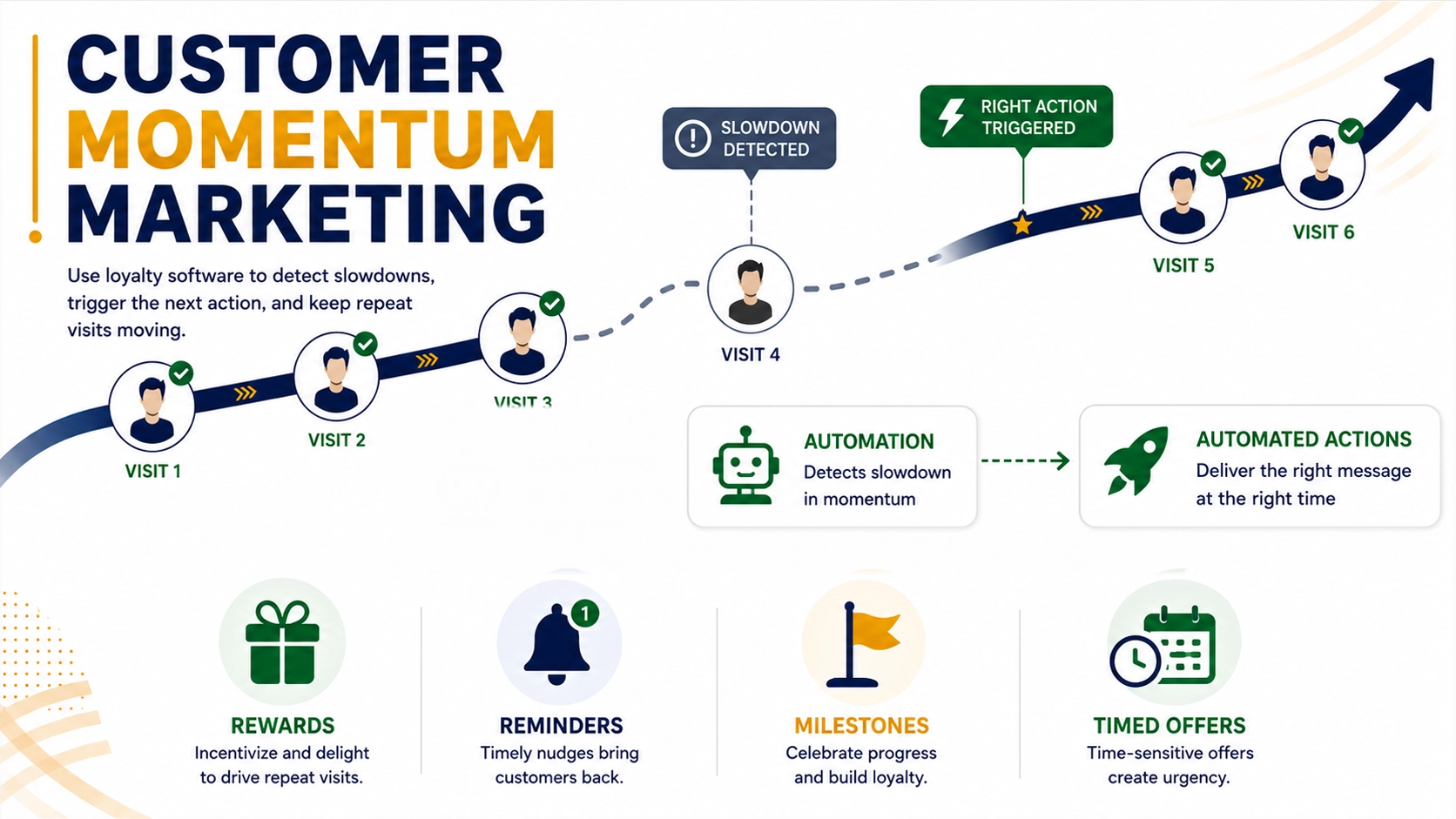
Preferred Patron™ helps businesses detect a change in customer pace and coordinate progress, reminders, milestones, offers, and measurement around the next meaningful action.
What Is Customer Momentum Marketing Software?
Customer Momentum Marketing software detects where each established customer sits in relation to their own expected visit rhythm and automatically applies the appropriate retention response.
Preferred Patron™ implements the strategy with production Visit Cadence processing, five Visit Cadence stages, seven coordinated campaigns, a separate Rebuilding pattern status, stage-entry events, two campaigns within the Needs Reminder stage, email and SMS delivery, escalating promotions, current-stage suppression, reactivation, member views, and response reporting.
The result is a closed-loop retention workflow: calculate the customer's Visit Cadence stage, communicate at the right level, stop escalation when the customer returns, recognize reactivation and Rebuilding, and measure whether momentum was restored.
Strategy Source
This implementation page is paired with the Preferred Patron™ advisory article, Customer Momentum Marketing: How to Keep Early Customer Activity From Slowing Down.
The advisory article explains the customer behavior, research, momentum states, and strategic reasoning. This page focuses on Preferred Patron™ implementation workflows, customer groups, rewards, messaging, timing, stop rules, and measurement.
Related Preferred Patron™ pages include Third Visit Customer Retention, Progress Visibility Strategy Software, and Marketing Automation.
Why This Is More Precise Than a Standard Win-Back Campaign
Most loyalty platforms begin with a fixed rule such as “no visit in 60 or 90 days.” Preferred Patron™ can still support fixed windows, but Customer Momentum Marketing adds a personalized behavioral layer and a coordinated intervention ladder.
Typical Competitor Approach
- One inactivity threshold applied to every customer
- Communication begins only after a broad calendar window expires
- The first outreach often includes a discount
- Limited distinction between mild delay, serious risk, and full lapse
- Win-back activity commonly ends when the customer returns once
- Campaigns may continue unless manually suppressed or separately filtered
Preferred Patron™ Implementation
- Expected timing is calculated from each established member's recent visit pattern
- Five Visit Cadence stages distinguish healthy behavior, early delay, slowdown, high risk, and lapse; a separate Rebuilding status tracks recovery after return
- Seven campaigns coordinate progressively stronger interventions, with promotions added only when needed
- The Needs Reminder stage includes a true two-step drip sequence
- Current-stage eligibility suppresses later offers after a processed return visit
- Reactivation continues the journey after return and helps rebuild the habit
Behavior Changes the Campaign Automatically
When a qualifying visit is processed, Preferred Patron™ recalculates the customer's latest activity date, expected cadence, current stage, next stage date, and pattern status. A customer who returns during Needs Reminder normally moves back to Healthy Momentum, so the day-seven offer no longer matches. The same principle prevents unnecessary Slowing Down, High Risk, or Lapsed messages after a return.
Five Visit Cadence Stages. Seven Coordinated Campaigns. One Rebuilding Status.
Preferred Patron™ does more than label customers as active or inactive. It maintains a personalized Visit Cadence, advances established members through five Visit Cadence stages, coordinates seven purpose-built campaigns, and uses a separate Rebuilding pattern status after a lapsed customer returns.
Calculate Personal Visit Cadence
Recent qualifying purchase and redemption activity is used to calculate each established member's expected return interval and the widening boundaries for Needs Reminder, Slowing Down, High Risk, and Lapsed.
Trigger the Matching Campaign
Stage-entry events, prior campaign history, and current Visit Cadence determine which automated campaign may run: recognition, reminder, modest offer, stronger recovery offer, final win-back, or post-lapse reactivation.
Stop Escalation When They Return
A qualifying visit updates the member's activity and cadence. Because later campaigns recheck current eligibility, customers who return are automatically excluded from unnecessary follow-up offers.
Healthy Momentum
Reinforces an established customer who is visiting on pace without introducing an unnecessary discount.
- Trigger: Entered Healthy Momentum on the prior day
- Offer: None
- Purpose: Recognition and habit reinforcement
Needs Reminder
Starts with a message-only reminder. Seven days later, a modest offer is sent only when the customer still remains in Needs Reminder.
- Campaign 1: No offer after stage entry
- Campaign 2: 10% off after 7 days if still eligible
- Purpose: Restore pace before deeper decline
Slowing Down
Uses a tangible but moderate incentive after the customer has moved materially beyond the expected visit rhythm.
- Trigger: Entered Slowing Down on the prior day
- Offer: $5 toward the next visit
- Purpose: Encourage return before High Risk
High Risk
Introduces a stronger, time-limited recovery incentive when earlier interventions have not restored momentum.
- Trigger: Entered High Risk on the prior day
- Offer: $10 toward the next visit
- Purpose: Recover before lapse
Lapsed
Delivers the strongest win-back offer after the customer has moved through the earlier decline stages without returning.
- Trigger: Entered Lapsed on the prior day
- Offer: $15 toward the next visit
- Purpose: Final win-back opportunity
Reactivation / Rebuilding
A qualifying return after Lapsed moves the customer back into an active cadence while the separate Rebuilding pattern status tracks whether the visit habit has stabilized again.
- Trigger: Previously Lapsed customer returns
- Offer: Double points on the next visit
- Purpose: Turn one return into renewed habit
Offers shown are for illustration purposes only and may be customized.
The Seven Preferred Patron™ Campaign Records
Each campaign is independently configured, but together they form one coordinated customer journey. Campaign history, current Visit Cadence stage, and stage-entry timing determine which campaign may run. In Preferred Patron™, each campaign is configured through a promotion record that controls eligibility, messaging, offers, and delivery.
| Journey Point | Campaign Name | Campaign Trigger and Objective | Promotion or Offer |
|---|---|---|---|
| Healthy Momentum | We Love Seeing You! | An established customer entered Healthy Momentum on the prior day. Recognize positive behavior without discounting. | None |
| Needs Reminder | Come Back Soon | The customer entered Needs Reminder on the prior day. Send a gentle message before deeper slowdown occurs. | None |
| Needs Reminder Follow-Up | A Little Something for You | The customer received the first reminder seven days earlier and still remains in Needs Reminder. Add a modest offer before momentum begins to slow. | Save 10% on the next order |
| Slowing Down | We Miss You | The customer entered Slowing Down on the prior day. Use a tangible incentive before risk deepens. | $5 toward the next visit |
| High Risk | Exclusive Return Reward | The customer entered High Risk on the prior day. Deliver a stronger, time-limited recovery offer before lapse. | $10 toward the next visit |
| Lapsed | Come Back - Return Offer | The customer entered Lapsed on the prior day after earlier interventions did not restore the visit. Deliver the strongest win-back offer. | $15 toward the next visit |
| Reactivation / Rebuilding | Welcome Back | A previously Lapsed customer completes a qualifying return visit. Reinforce the return and encourage another visit while the customer rebuilds a healthy visit pattern. | Double points on the next visit |
How the Automated Sequence Behaves
Each customer stage has a specific entry condition, economic purpose, and stop or next condition. A customer does not have to progress through every stage.
| Journey Point | Entry / Trigger Condition | Automated Action | Why It Is Appropriate | Stop or Next Condition |
|---|---|---|---|---|
| Healthy Momentum | An established customer enters Healthy Momentum based on their current visit pattern. The campaign is triggered after the customer entered the stage on the prior day. | Send "We Love Seeing You!" with no offer. | Recognition reinforces desired behavior without training the customer to wait for a discount. | No repeat while the customer remains in this stage. Continue only when customer behavior changes. |
| Needs Reminder | The customer enters Needs Reminder as their visit interval begins to exceed the expected pattern. The initial reminder is triggered after the customer entered the stage on the prior day. | Send "Come Back Soon" by email and/or SMS with no offer. | A light prompt may be enough to restore the expected visit pattern, so discounting is premature. | If the customer visits, they normally return to Healthy Momentum. If the customer remains in Needs Reminder for seven days, evaluate the Needs Reminder Follow-Up campaign. |
| Needs Reminder Follow-Up | The customer received the initial "Come Back Soon" reminder seven days earlier and still remains in Needs Reminder. | Send "A Little Something for You" with 10% off the next order. | This provides measured escalation after the message-only reminder did not restore the expected visit pattern. | Requires both prior reminder history and continued Needs Reminder status. Stop after a qualifying return or continue only if behavior later progresses to Slowing Down. |
| Slowing Down | The customer's visit gap widens enough to move from Needs Reminder into Slowing Down. The campaign is triggered after the customer entered the stage on the prior day. | Send "We Miss You" with $5 toward the next visit. | The visit gap is materially wider, so a tangible but moderate incentive is appropriate. | Stop after a qualifying return or advance only if the customer later enters High Risk. |
| High Risk | The customer's visit behavior deteriorates further and the customer enters High Risk. The campaign is triggered after the customer entered the stage on the prior day. | Send "Exclusive Return Reward" with $10 toward the next visit. | A stronger, time-limited incentive is appropriate because earlier interventions did not restore the expected visit pattern. | Stop after a qualifying return or advance only if the customer later enters Lapsed. |
| Lapsed | The customer enters Lapsed after the expected visit pattern has deteriorated beyond the earlier reminder and recovery stages. The campaign is triggered after the customer entered Lapsed on the prior day. | Send "Come Back - Return Offer" with $15 toward the next visit. | The strongest win-back incentive is reserved for customers who have reached the Lapsed stage after earlier interventions did not restore the visit. | When the customer returns, move to Reactivation / Rebuilding and trigger the "Welcome Back" campaign. |
| Reactivation / Rebuilding | A previously Lapsed customer completes a qualifying return visit and begins rebuilding their normal visit pattern. | Send "Welcome Back" with double points on the next visit. | One return does not yet reestablish the customer's normal visit pattern. Reinforcing the next visit helps rebuild momentum. | The customer remains in Reactivation / Rebuilding until the visit pattern is sufficiently reestablished, then returns to the appropriate momentum stage. |
Preferred Patron™ Features That Operationalize Customer Momentum
The strategy becomes practical when timing, Visit Cadence stage, pattern status, rewards, messaging, and results are connected within one loyalty workflow.
Visit and Transaction History
Use customer-level visit dates, transaction activity, spend, purchase history, reward activity, and location behavior to understand the pace of the relationship.
Visit Cadence and Preset Views
Classify established members as Healthy Momentum, Needs Reminder, Slowing Down, High Risk, or Lapsed based on their personal visit pattern. A separate Rebuilding pattern status identifies customers who returned after lapse but have not yet reestablished a stable cadence.
Points, Stamps, and Tiers
Use points, digital stamps, loyalty cash, tiers, badges, spend levels, visit thresholds, and reward matrices to give customer activity a visible path.
Milestones and Bonuses
Recognize early visits, spend thresholds, profile completion, tier progress, service cycles, tenure, referrals, and other actions with proportional bonuses or benefits.
Email and SMS Automation
Send progress reminders, reward-ready messages, appointment prompts, milestone updates, return triggers, and timed offers based on customer eligibility and permission.
Member Progress Access
Show customers balances, available rewards, digital stamps, tier status, goal distance, wallet items, profile information, and other next-step cues through member-facing access.
Reward Event Follow-Up
Respond when a reward is earned, remains unused, approaches expiration, is redeemed, or is followed by a longer-than-expected gap.
Campaign and Offer Escalation
Apply a deliberate offer ladder: no offer for Healthy Momentum and the first Needs Reminder, 10% for the second reminder, then $5, $10, and $15 rewards as risk increases. After a lapsed customer returns, use double points to reinforce the next visit.
Response and Retention Reporting
Measure delivery, opens, clicks, redemptions, visits, purchases, bookings, reward use, segment movement, and the time customers take to complete the next action.
Clear Operational Advantages
The strongest differentiation is not a single feature. It is the way Preferred Patron™ connects cadence calculation, customer stage, pattern status, communications, offers, suppression, reactivation, and reporting.
Personalized Timing
Frequent customers can be recognized as slowing before a generic 60- or 90-day rule would react, while naturally infrequent customers are not contacted prematurely.
Seven Purpose-Built Campaigns
Each stage or sequence point has a distinct campaign objective, message, incentive level, and purpose rather than relying on one generic win-back campaign. Some campaigns deliver recognition or reminders without a promotion.
Relationship Before Discount
Healthy customers and first-stage reminder customers receive recognition or a prompt without an offer, protecting margin and customer expectations.
Behavior-Based Suppression
Later campaigns check the customer's current Visit Cadence stage. A processed return visit normally removes the customer from the declining stage and prevents unnecessary follow-up.
Post-Return Reinforcement
The workflow does not end at redemption. A lapsed customer's return triggers a separate Welcome Back campaign and a rebuilding period designed to create another visit.
Measurable Stage Movement
Campaign performance can be evaluated against actual return visits, offer use, stage transitions, reactivation, and whether the customer's visit pattern becomes established again.
Measure Restored Movement, Not Just Message Activity
The Customer Momentum Marketing strategy is successful when customer behavior improves, not merely when a message is sent, opened, or clicked.
Recommended Measurements
- Time from first visit to second, second to third, and third to fourth
- Average and median visit interval by customer group
- Percentage of customers reaching the next milestone
- Return, purchase, booking, or redemption after a reminder
- Reward progress, completion, unused reward, and redemption rates
- Movement from new to active, slowing, overdue, or inactive groups
- Incremental response compared with customers not receiving the intervention
- Revenue, margin, and retention value relative to incentive cost
- Whether the following customer interval also improved
Customer Experience and Margin Guardrails
- Do not treat every normal pause as a retention problem.
- Compare the customer with an appropriate rhythm or segment.
- Use progress and clarity before escalating to discounts.
- Do not send incentives to customers already returning naturally.
- Use one primary next action per campaign.
- Stop the campaign after the qualifying action occurs.
- Respect channel permission, frequency, opt-outs, and customer preferences.
- Measure customer return behavior in addition to opens and clicks.
- Evaluate margin and incremental lift before expanding an offer.
Related Strategy Central Implementations
Customer momentum works best when early milestones, visible progress, repeat behavior, and timely return triggers are coordinated.
Ready to Keep Promising Customer Activity Moving?
Preferred Patron™ can help connect visit timing, purchases, rewards, milestones, customer groups, email, SMS, member access, automation, and reporting into a practical Customer Momentum Marketing workflow.
Customer Momentum Marketing Software FAQs
What is Customer Momentum Marketing software?
Customer Momentum Marketing software uses each established member's personal Visit Cadence to place the customer into one of five momentum stages, coordinate the matching recognition, reminder, recovery, or win-back campaign, and use a separate Rebuilding status after a lapsed customer returns.
How does Preferred Patron™ detect customer momentum?
Preferred Patron™ processes recent qualifying visit activity, calculates expected return timing and widening risk boundaries, advances Visit Cadence stages as time passes, and recalculates the customer immediately when a new visit is processed.
Does Customer Momentum Marketing require predictive artificial intelligence?
No. A business can begin with practical rules based on expected visit timing, early visit sequence, reward progress, service cycles, booking dates, customer groups, and changes in the customer's prior behavior.
Does every slowing customer need a discount?
No. Healthy Momentum and the first Needs Reminder communication intentionally use no offer. Preferred Patron™ escalates only when the customer does not return: 10% off, then $5, $10, and finally $15 as risk increases.
How is Customer Momentum Marketing different from inactivity marketing?
Inactivity marketing normally responds after every customer crosses the same fixed absence threshold. Customer Momentum Marketing can use personalized Visit Cadence to identify when an individual member begins falling behind their own established return pattern, often before a broad calendar rule would react.
What does the Visit Cadence: Lapsed stage mean?
Lapsed is the final declining Visit Cadence stage, reached only after the customer has moved well beyond their personal return rhythm. It triggers the strongest win-back campaign. When the customer returns, Preferred Patron™ can return the customer to an active cadence while applying a separate Rebuilding pattern status and triggering the Welcome Back reactivation campaign.
Does Visit Cadence replace traditional win-back campaigns?
No. Fixed inactivity windows remain useful for broad business rules and seasonal campaigns. Visit Cadence adds a personalized behavioral signal so a business can intervene earlier for frequent customers and avoid acting too soon for naturally infrequent customers.
How do the two Needs Reminder campaigns work?
The first campaign sends a message-only reminder when the customer enters Needs Reminder. Seven days later, the second campaign includes a 10% promotion only if the first communication was received and the customer still remains in Needs Reminder. A processed qualifying visit normally returns the customer to Healthy Momentum and suppresses the second campaign.
How should a business measure customer momentum?
Measure visit intervals, early visit progression, milestone completion, reward progress, return after reminders, rebooking, redemption, movement between customer groups, incremental response, and whether the customer's following interval also improved.