From First Purchase to Lasting Loyalty
The psychology and practice of retail loyalty
Explore customer recognition, timely offers, reward margins, shopping cycles, and the operational detail needed for a dependable retail loyalty promise.
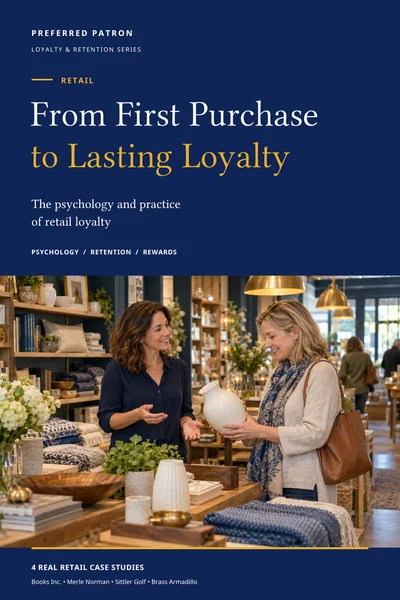
Building a stronger reason to return
Explore customer recognition, timely offers, reward margins, shopping cycles, and the operational detail needed for a dependable retail loyalty promise.
Give shoppers reasons to remember and revisit a store. The book works through decisions about the customer experience, communications, operations and program measurement rather than prescribing a single reward formula.
Examples are illustrative unless they are expressly presented in the manuscript as documented client cases; reported research does not guarantee an outcome for any business.
- Second-purchase motivation
- Reward and margin balance
- Customer purchase cycles
- Cross-counter consistency
Written for operators and marketers who want usable retention approaches.
From the introduction
The last customer has left, the front door is locked, and Maya is walking through Harbor & Pine with the day's sales report on her phone. The store looks like a good day happened. A display of small gifts needs replenishing. Two lamps have gone to new homes. The table near the window has gaps where books and ceramics sat that morning. The till confirms that people bought. It says much less about whether they will choose the store again.
One customer came for a birthday present and discovered a useful neighborhood shop. Another needed a replacement for a broken mug. A third had waited for a promotion on an item she already intended to buy. Each purchase increased the day's revenue. Yet the relationships behind those purchases are different, and so are their possible futures. Sending the same coupon to all three would be easy. Understanding what might deserve their attention takes more care.
That distinction is the subject of this book. Retail loyalty develops when a business becomes a credible choice for the next relevant occasion. Rewards can help. So can recognition, convenience, discovery, advice, and a well-timed invitation. None works in isolation from the merchandise, the service, or the economics of the store. A loyalty program is most useful when it connects these parts of the business instead of becoming another promotion layered on top.
Inside the book
The complete edition includes an introduction, 13 chapters and sources for further reading.
- The purchase is only one moment
- Make the store worth choosing again
- Give the next purchase a reason
- Why progress and recognition matter
- A reward promise shoppers understand
- Protect the margin behind the reward
- Recognize people without making assumptions
- Work with the customer's calendar
- Help the relationship grow
- When a familiar shopper goes quiet
- One promise across every counter
- Measure the purchase you actually added
- Become the store they think of first
Research sources discussed in this book
These are examples from the publication's own source list. Their findings inform the discussion but do not establish a guaranteed retention or revenue result.
- Daniel Kahneman, Barbara L. Fredrickson, Charles A. Schreiber, and Donald A. Redelmeier (1993). When More Pain Is Preferred to Less: Adding a Better End.
- Ran Kivetz, Oleg Urminsky, and Yuhuang Zheng (2006). The Goal-Gradient Hypothesis Resurrected: Purchase Acceleration, Illusionary Goal Progress, and Customer Retention.
- Joseph C. Nunes and Xavier Drèze (2006). The Endowed Progress Effect: How Artificial Advancement Increases Effort.
Get the complete ebook, free
Register once for access to the full online reader and your choice of PDF or EPUB. You can explore the public preview above before sharing your information.
- Read online on phone, tablet, PC or Mac
- View or download the PDF
- Download EPUB for compatible reading apps
Get Your Free Ebook
Required fields are marked *. After verification and successful submission, your ebook will unlock in this browser.