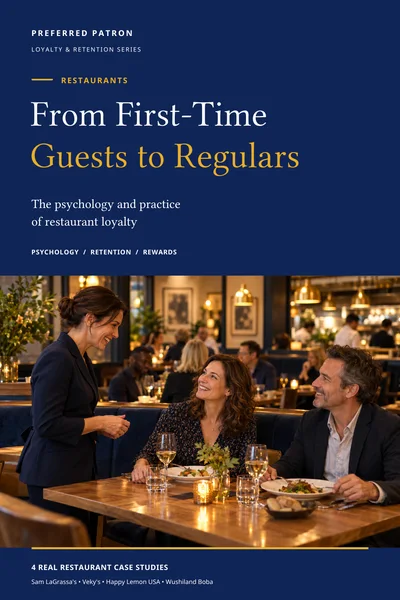
From First-Time Guests to Regulars
The psychology and practice of restaurant loyalty
Study the path from first dinner to repeat visits, reward economics, meaningful recognition, dining-room capacity, and communication that respects the guest relationship.
Building a stronger reason to return
Study the path from first dinner to repeat visits, reward economics, meaningful recognition, dining-room capacity, and communication that respects the guest relationship.
Turn first-time guests into returning regulars. The book works through decisions about the customer experience, communications, operations and program measurement rather than prescribing a single reward formula.
Examples are illustrative unless they are expressly presented in the manuscript as documented client cases; reported research does not guarantee an outcome for any business.
- First-to-third visit journey
- Reward economics
- The guest experience peak and end
- Off-peak offer design
Written for operators and marketers who want usable retention approaches.
From the introduction
The last guests have gone, the chairs are being straightened, and the restaurant has finally become quiet enough for its owner to think. The evening looked successful. There was a wait at the door, several large parties, and a steady procession of plates leaving the kitchen. The sales report will say whether the night was busy. It will say much less about what the night has done for the restaurant's future.
Some of those guests will return. Others will remember the meal pleasantly and never find another occasion to visit. A few left disappointed without saying so. Someone discovered a new favorite place. Someone else decided the restaurant was fine but inconvenient. All of these experiences can sit behind the same reassuring revenue total.
This book is about that distance. It explores how restaurants earn a place in their guests' lives, how a first meal becomes a second, and how a series of visits can grow into a relationship that both sides value. Loyalty programs belong in that story, but the story begins before a guest encounters a point balance or birthday offer. It begins with the reason the guest chose the restaurant, the experience they received, and the next occasion on which choosing it again would make sense.
Inside the book
The complete edition includes an introduction, 13 chapters and sources for further reading.
- The business of being chosen again
- What guests actually come back for
- The path from first visit to third
- Why progress changes the decision
- A promise guests can understand
- The price of being generous
- Recognition without presumption
- The right message has a moment
- Empty tables and a full dining room
- When a regular goes quiet
- The people behind the program
- What a return visit can prove
- A restaurant worth returning to
Research sources discussed in this book
These are examples from the publication's own source list. Their findings inform the discussion but do not establish a guaranteed retention or revenue result.
- Daniel Kahneman, Barbara L. Fredrickson, Charles A. Schreiber, and Donald A. Redelmeier (1993). When More Pain Is Preferred to Less: Adding a Better End.
- Ran Kivetz, Oleg Urminsky, and Yuhuang Zheng (2006). The Goal-Gradient Hypothesis Resurrected: Purchase Acceleration, Illusionary Goal Progress, and Customer Retention.
- Joseph C. Nunes and Xavier Drèze (2006). The Endowed Progress Effect: How Artificial Advancement Increases Effort.
Get the complete ebook, free
Register once for access to the full online reader and your choice of PDF or EPUB. You can explore the public preview above before sharing your information.
- Read online on phone, tablet, PC or Mac
- View or download the PDF
- Download EPUB for compatible reading apps
Get Your Free Ebook
Required fields are marked *. After verification and successful submission, your ebook will unlock in this browser.