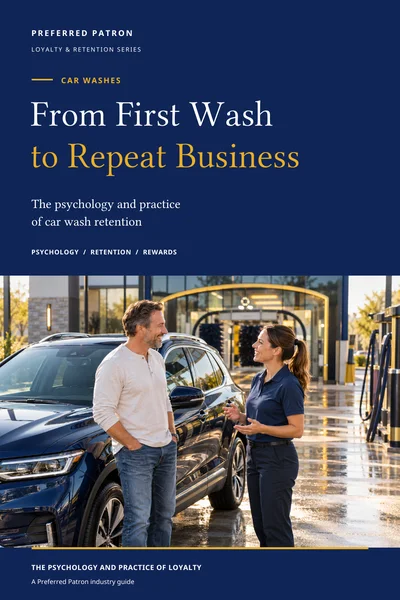
From First Wash to Repeat Business
The psychology and practice of car wash retention
Learn how wash operators can use simple reward promises, visible progress, membership value, weather-aware offers, and service recovery without disrupting daily operations.
Building a stronger reason to return
Learn how wash operators can use simple reward promises, visible progress, membership value, weather-aware offers, and service recovery without disrupting daily operations.
Turn a successful wash into a reason to return. The book works through decisions about the customer experience, communications, operations and program measurement rather than prescribing a single reward formula.
Examples are illustrative unless they are expressly presented in the manuscript as documented client cases; reported research does not guarantee an outcome for any business.
- First-return experiences
- Digital stamps and progress
- Recurring wash plans
- Weather and capacity-aware offers
Written for operators and marketers who want usable retention approaches.
From the introduction
A driver leaves your wash with a clean vehicle and no complaint. The service went well, the payment was accepted, and the line moved at a reasonable pace. From the operator's side, the transaction is complete. From the customer's side, another decision is already taking shape: when the car needs attention again, will this be the place that comes to mind?
That future choice is the subject of this book. Car wash retention lives in the space between a service delivered today and a business chosen again later. Convenience matters. So do the result, the price, the ease of the visit, and the confidence that a problem will receive attention. Rewards can help customers notice and use the value of returning, provided the operation gives those rewards a dependable foundation.
The industry contains different businesses under one familiar name. An express exterior wash, a full-service operation, an in-bay automatic, a self-service site, and a detail business do not ask customers to make identical decisions. Some visits are quick and spontaneous. Others require more time, a particular service, or a planned appointment. A useful program reflects that difference rather than assuming every customer should return on the same schedule.
Inside the book
The complete edition includes an introduction, 13 chapters and sources for further reading.
- Earn the next choice
- Make the first visit count
- Give progress a clear destination
- Make flexibility understandable
- Make the value visible
- Deliver recurring value
- Know what the reward really costs
- Match the offer to the day
- Give each message a useful job
- Make returning comfortable again
- Keep one promise across the operation
- Measure what changed
- Build a program that lasts
Research sources discussed in this book
These are examples from the publication's own source list. Their findings inform the discussion but do not establish a guaranteed retention or revenue result.
- Richard M. Ryan and Edward L. Deci (2000). Self-Determination Theory and the Facilitation of Intrinsic Motivation, Social Development, and Well-Being.
- Ran Kivetz, Oleg Urminsky, and Yuhuang Zheng (2006). The Goal-Gradient Hypothesis Resurrected: Purchase Acceleration, Illusionary Goal Progress, and Customer Retention.
- Joseph C. Nunes and Xavier Drèze (2006). The Endowed Progress Effect: How Artificial Advancement Increases Effort.
Get the complete ebook, free
Register once for access to the full online reader and your choice of PDF or EPUB. You can explore the public preview above before sharing your information.
- Read online on phone, tablet, PC or Mac
- View or download the PDF
- Download EPUB for compatible reading apps
Get Your Free Ebook
Required fields are marked *. After verification and successful submission, your ebook will unlock in this browser.