
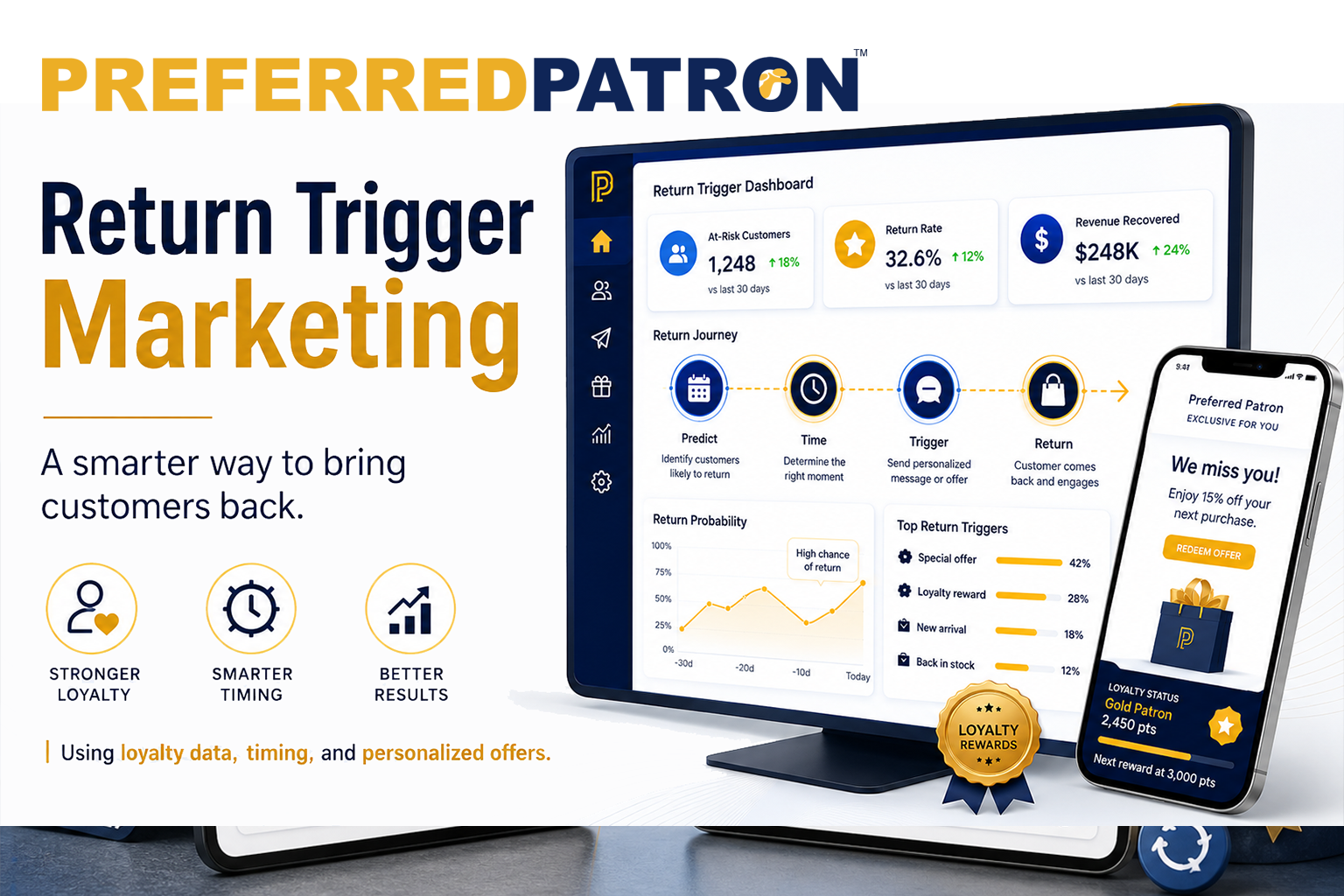
Return trigger marketing is a better way to bring customers back because it focuses on the moment when a customer has a real reason to return.
Most businesses do not lose customers all at once. They lose them in small, quiet moments.
A customer meant to come back, but got busy. A client needed the next service, but forgot. A guest liked the visit, but no one gave them a clear next step. A shopper bought once, but never heard a useful reason to return.
That is not always a loyalty problem. It is often a timing problem.
This is where return trigger marketing can help.
Return trigger marketing means looking for the events, habits, seasons, needs, and moments that should cause a customer to come back. Then you build simple campaigns around those moments.
A loyalty program can support this strategy because it can help the business understand visits, purchases, rewards, offers, customer groups, surveys, and messages in one place.
The goal is not to send more marketing. The goal is to send marketing at a better time.
What Is Return Trigger Marketing?
Return trigger marketing is a customer timing strategy.
It asks one simple question:
What should cause this customer to come back?
That cause is the return trigger.
A return trigger may be a date, a purchase, a service cycle, a reward balance, a season, a milestone, or a missed visit.
For example:
- A salon client is due for a follow-up service.
- A restaurant guest has not visited since trying lunch.
- A car wash customer usually returns every two weeks, but has not come back.
- A retail shopper bought a product that pairs well with another item.
- A medspa client finished one treatment and may be ready for the next step.
- A golf customer booked tee times but has not tried lessons or events.
- A customer earned a reward but has not used it yet.
Each of these moments gives the business a better reason to send a message.
That is why return trigger marketing is more useful than a random coupon blast.
Why Return Trigger Marketing Is Different
Many businesses plan marketing by the calendar.
They send a spring sale, a holiday offer, a slow-day coupon, or a monthly email.
Those campaigns can work. But they often focus on what the business wants to sell.
Return trigger marketing focuses on what the customer may need next.
That shift is important.
A customer does not wake up thinking, “I hope this business sends me a promotion today.”
The customer thinks about their own life. They need a service, a refill, a meal, a gift, a repair, a night out, a self-care visit, or an easy reason to return.
Good marketing connects to that real-life moment.
The Problem With Always Discounting
Many businesses use discounts when sales feel slow.
That is easy to understand. Discounts are quick to create and easy to explain.
But too many discounts can train customers to wait for a deal.
Return trigger marketing gives the business another option.
Instead of asking, “What discount should we send?” the better question is, “What customer moment should we act on?”
That may lead to better offers such as:
- A reminder to use an earned reward.
- Bonus points for returning within a normal buying cycle.
- A service reminder based on past purchase history.
- A member-only offer for a related product or service.
- A thank-you reward after a high-value visit.
- A win-back message after a missed return window.
These offers still give value. But they do not always need to be deep discounts.
They are tied to a reason the customer may already have to come back.
How Customer Timing Signals Support Return Trigger Marketing
Return trigger marketing works best when the business can recognize customer behavior before the relationship goes quiet.
Without customer timing signals, a business may only see total sales. It may know that Tuesday was slow or that one product sold well, but it may not know which customers should have returned and did not.
Useful return signals may include:
- When the customer last visited.
- What the customer bought or booked.
- Which offer the customer used.
- Whether the customer earned or redeemed a reward.
- How often the customer normally returns.
- Which messages the customer responds to.
- Whether the customer gave feedback.
This turns marketing into a more useful system.
The business is not just shouting louder. It is listening better.
Why Purchase History Makes Return Triggers Stronger
Purchase history makes return trigger marketing stronger because it helps explain what the customer may need next.
If a business only knows that a customer visited, it has some useful information.
But if the business knows what the customer bought, booked, or redeemed, the next message can be more relevant.
For example:
- A customer who buys the same item every month may be ready for a reminder before they run out.
- A client who books one service may be a good candidate for a related service.
- A seasonal shopper may be ready for a timely category message.
- A customer who earned a reward but did not redeem it may need a reminder.
- A customer who has not purchased a key item in a while may need a helpful nudge.
Now the business can build return triggers around real buying behavior.
A pet store can remind a customer when it may be time to buy food again. A salon can send a follow-up message when a client may be ready for the next service. A restaurant can invite a lunch guest to try dinner. A retailer can introduce a related product category.
This is useful because the message feels timely and connected to the customer.
Return Trigger Marketing Does Not Need to Be Complicated
Some businesses worry that return trigger marketing requires complex data, expensive integrations, or a large marketing team.
That is not always true.
A business can start by tracking a few key actions that matter most. Those actions may be visits, appointments, purchases, service categories, product groups, rewards earned, rewards redeemed, survey responses, or missed return windows.
The point is not to track everything. The point is to identify the customer moments that create the strongest reason to return.
For example:
- A salon may focus on haircuts, color, treatments, products, and upgrades.
- A medspa may focus on consults, treatments, skincare, and packages.
- A restaurant may focus on lunch, dinner, catering, drinks, and events.
- A golf course may focus on tee times, lessons, pro shop sales, and events.
- An auto service center may focus on oil changes, tires, inspections, and service plans.
- A fitness business may focus on classes, personal training, challenges, and member visits.
This gives the business a practical way to create return triggers without making the program too complex.
The 5 Return Triggers Every Business Should Look For
Every business is different, but most can start with five simple return triggers.
1. The Time Trigger
The time trigger is based on when a customer usually returns.
If a customer usually comes back every 30 days, a message on day 25 may be helpful. A message on day 90 may be too late.
Return trigger marketing helps the business reach the customer before the habit breaks.
2. The Product or Service Trigger
This trigger is based on what the customer bought or booked.
A customer who bought one item may need a refill, a related item, or a follow-up service.
This is where purchase history and tracked customer activity can be very useful.
3. The Reward Trigger
This trigger is based on loyalty activity.
A customer may be close to earning a reward. Or the customer may have earned a reward but not used it.
A simple reminder can bring the customer back without needing a new discount.
4. The Season Trigger
Some businesses have strong seasonal needs.
Customers may need winter service, summer items, holiday gifts, back-to-school products, spring cleaning, event planning, or seasonal self-care.
Return trigger marketing helps the business connect seasonal campaigns to customer behavior instead of sending the same seasonal message to everyone.
5. The Silence Trigger
The silence trigger happens when a customer stops doing what they used to do.
They stop visiting. They stop redeeming. They stop opening messages. They stop booking.
This is often the first sign of quiet churn.
Return trigger marketing helps the business notice the silence and act before the customer is fully gone.
Why Return Trigger Marketing Feels More Helpful
Customers do not want random messages.
They want messages that make sense.
A BCG study on personalization found that many consumers are comfortable with personalized experiences when those experiences provide real value. That is the key lesson for business owners: relevance must feel useful to the customer.
Return trigger marketing works because it connects the message to a real customer need, habit, or moment.
The message is not, “Buy from us because we said so.”
The message is closer to, “This may be the right time for you.”
That feels more helpful.
Simple Return Trigger Marketing Campaigns
Here are a few simple campaign ideas a business can use. These are examples of the strategy, not a requirement to launch every campaign at once.
The “You May Be Due” Campaign
This works well for services, refills, repairs, treatments, and routine visits.
Example: “It may be time for your next service. Book this week and earn bonus points.”
The “You Are Close” Campaign
This works when a customer is close to a reward.
Example: “You are almost at your next reward. Visit this week to unlock it.”
The “Try the Next Step” Campaign
This works when a customer has tried one product or service but not a related one.
Example: “You tried lunch. Join us for dinner and earn double points.”
The “Use What You Earned” Campaign
This works when a customer has a reward waiting.
Example: “Your reward is ready. Use it on your next visit.”
The “We Miss You Before It Is Too Late” Campaign
This works when a customer is just starting to lapse.
Example: “It has been a little while. Come back this week and enjoy a member bonus.”
How to Start Return Trigger Marketing
Start small.
Do not try to build 20 campaigns at once.
Pick one return trigger that matters most to your business.
Use these steps:
- Pick one customer behavior you want to change.
- Choose the trigger that shows when to act.
- Write a short message that gives a clear reason to return.
- Use a reward or bonus only when it supports the behavior.
- Track whether customers come back after the message.
- Improve the campaign over time.
For many businesses, the best first trigger is a missed return window.
For example, if customers should return every 30 days, create a message for customers who have not returned by day 35.
That one campaign can teach the business a lot.
What to Measure
Return trigger marketing should be measured by real behavior.
Do not only look at opens or clicks.
Those numbers can be useful, but they are not the main goal.
The main goal is getting customers to act.
Track simple numbers such as:
- How many customers received the message.
- How many came back.
- How many used the reward.
- How much they spent.
- How soon they returned.
- Which trigger worked best.
Measurement matters because a return trigger should prove that it changed behavior, not just that it created attention.
How Loyalty Software Helps Support Return Trigger Marketing
Return trigger marketing works best when a business can recognize customer timing signals before the relationship goes quiet. Loyalty software can help identify useful signals such as last visit date, purchase history, reward activity, unused rewards, missed return windows, survey responses, service cycles, seasonal needs, and customer engagement.
Those signals can guide a more relevant follow-up, such as a reward reminder, service reminder, replenishment message, next-step offer, survey invitation, or early win-back campaign.
For a more practical implementation view, see our strategy implementation page: Return Trigger Marketing Strategy.
What Business Owners Often Get Wrong
The biggest mistake is waiting too long.
Many businesses do not act until a customer is already gone.
They send a win-back offer after 90 days, 120 days, or even longer.
Sometimes that works. But by then, the customer may have built a new habit somewhere else.
Return trigger marketing is better because it acts earlier.
It looks for the point where the customer should return, then sends a helpful reason before the relationship goes cold.
The second mistake is making every trigger a discount.
Not every message needs a coupon.
Some customers need a reminder. Some need a reward reminder. Some need a bonus. Some need a helpful suggestion. Some need to be invited to the next step.
The best trigger should match the customer moment.
The Main Lesson
Most customers do not need more noise.
They need the right reason at the right time.
Return trigger marketing helps a business find that moment.
It helps the business ask better questions:
- When should this customer come back?
- What did this customer do last time?
- What should this customer try next?
- What reward or message would make sense now?
- Is this customer starting to drift away?
Those questions lead to better marketing.
They also lead to better customer experiences.
Final Thought
A good loyalty program does not just reward the past.
It helps guide the next visit.
That is the value of return trigger marketing.
When a business can spot the right moment, send the right message, and measure the result, customer retention becomes easier to manage.
The result is simple: better timing, better offers, and more reasons for customers to come back.
Author note: Christopher Silvestri is Managing Partner and CTO of Preferred Patron Loyalty, a customer loyalty and marketing automation platform used by businesses to manage rewards, customer engagement, retention campaigns, and loyalty technology. His work focuses on helping businesses turn customer data, rewards, and automated messaging into measurable repeat business.
FAQ
What is return trigger marketing?
Return trigger marketing is a strategy that sends customers a message when they have a real reason to return, such as a service date, reward balance, missed visit, purchase cycle, or seasonal need.
How does a loyalty program help with return trigger marketing?
A loyalty program helps by tracking customer visits, purchases, rewards, redemptions, surveys, and messages. This gives the business better timing for follow-up campaigns.
Is return trigger marketing only for big businesses?
No. Small businesses can use return trigger marketing too. They can start with one simple trigger, such as a missed visit window or an unused reward.
Does return trigger marketing require a POS integration?
No. A POS integration can make it stronger, but businesses can also track key items, services, or customer actions inside the loyalty platform when that fits their workflow better.
Why is return trigger marketing better than sending coupons?
Coupons can work, but they are often too broad. Return trigger marketing is based on customer timing, so the message is more relevant and may not require a deep discount.