
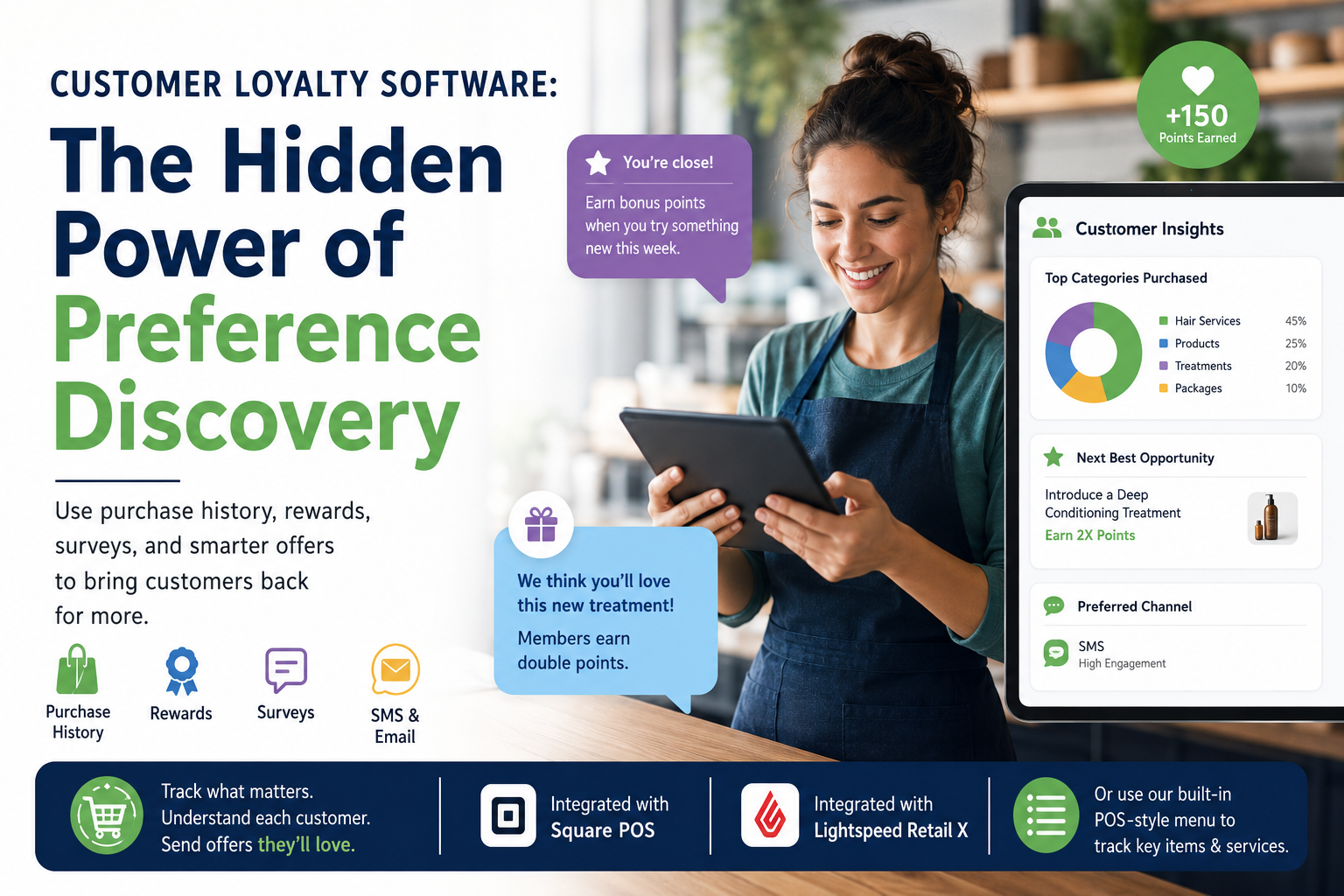
Customer preference discovery helps a business learn what each customer may want next. A loyalty program can help collect those clues and turn them into better offers.
Most loyalty programs are built to reward customers. That is good. But a smart loyalty program can do more.
It can help a business learn what customers like, what they buy, what they have not tried, and what may bring them back.
Customer preference discovery is the strategy of using real customer actions to guide future marketing.
Your customers leave clues every time they buy, visit, redeem a reward, answer a survey, or respond to a message. Preferred Patron helps businesses use those clues in a simple and useful way.
What Is Customer Preference Discovery?
Customer preference discovery means learning what a customer likes based on what they do.
For example, a customer may always buy one type of product. A client may book the same service every month. A guest may visit only at lunch. A shopper may redeem bonus point offers but ignore coupons.
Each action tells a small story.
When you put those actions together, you can learn what the customer may want next.
This is not guessing. It is using real behavior to guide your marketing.
Why Customer Preference Discovery Is a Hidden Loyalty Strategy
Most people think loyalty programs are about points, rewards, and discounts.
Those things are important. But they are not the whole story.
A loyalty program can also help answer questions like these:
- What products does this customer buy most often?
- What services has this customer tried?
- What has this customer never tried?
- Does this customer like bonus points, discounts, free items, or special access?
- Does this customer respond better to email or text messages?
- Is this customer ready for an upgrade, package, or add-on?
- What should we promote to this customer next?
These answers can help a business send better offers.
Instead of saying, “Here is the same deal for everyone,” the business can say, “Here is an offer that fits what you seem to like.”
Why Generic Marketing Wastes Money
Many businesses send the same offer to every customer.
That is easy, but it is not always smart.
Some customers may already be ready to come back. They do not need a big discount.
Other customers may need a reminder, but not the same reminder as everyone else.
Some customers may be interested in a product they have never tried. Others may need a reward for coming back sooner. Some may need a message about a related service.
When every customer gets the same message, many offers are missed, ignored, or wasted.
Customer preference discovery helps fix this.
It helps you send offers based on what the customer has done before.
How Customer Preference Discovery Uses Purchase History
Visit tracking is useful. Points tracking is useful too.
But purchase history is even more powerful.
Preferred Patron can track purchase history and order details when it is integrated with systems such as Square POS or Lightspeed Retail X. This gives a business a better view of what each customer bought, not just that the customer visited.
That means the business may be able to see which items, services, packages, or categories matter to each customer.
For example, a business may learn that a customer:
- Buys the same product each time.
- Books one service but never tries a related service.
- Responds to bonus point offers.
- Uses rewards quickly.
- Shops one category but not another.
- Visits during certain times or seasons.
This gives the business a better way to plan its next offer.
A basic loyalty message may say:
Come back and earn points.
A smarter message may say:
You earned points on your last service. Try this related service and unlock a bonus reward.
That message feels more useful because it is based on real behavior.
Customer Preference Discovery Without a Full POS Integration
Some businesses do not want to track every item from a POS system.
Others may not use a POS system that sends detailed order data.
Preferred Patron can still help.
The loyalty platform supports defining a POS-style menu inside the loyalty program. This lets a business track key items, services, packages, categories, or actions of interest.
This is helpful because not every business needs to track every small detail. Many businesses only need to track the things that matter most for marketing.
For example:
- A salon may track haircuts, color, treatments, products, and upgrades.
- A medspa may track consults, treatments, skincare, and packages.
- A restaurant may track lunch, dinner, catering, drinks, and special events.
- A golf course may track tee times, lessons, events, pro shop sales, and food.
- An auto service center may track oil changes, inspections, tires, and service packages.
- A fitness business may track classes, personal training, challenges, and member visits.
This helps the business learn what customers care about.
It also helps the business build campaigns around the products or services that lead to more repeat visits.
Customer Preference Discovery in Real Life
Here is a simple example.
A customer joins a loyalty program at a salon. She books a haircut twice. She earns points both times.
A basic loyalty program may only know that she visited twice.
A better loyalty setup can show that she booked haircuts, but has not tried color, treatments, products, or upgrades.
Now the salon can send a better offer.
For example:
- Earn bonus points when you try a deep conditioning treatment.
- Book your next haircut and unlock a member-only product reward.
- Try a color consult and receive extra loyalty points.
The salon is not just giving away a discount.
It is using loyalty data to help the customer discover another service.
Customer Preference Discovery Is Not Just Upselling
Upselling can feel pushy when it is done the wrong way.
Customer preference discovery is different.
The goal is not to push random products or services. The goal is to make useful offers based on what the customer already likes.
If a customer buys pet food, a pet store may offer bonus points on treats or grooming.
If a guest visits a restaurant for lunch, the restaurant may invite the guest to try dinner.
If a golf player books tee times, the course may offer bonus rewards for lessons or pro shop purchases.
If a customer buys skincare, a medspa may invite the customer to try a related treatment or package.
The message should feel helpful, not forced.
How Loyalty Software Helps Support Customer Preference Discovery
Customer preference discovery works best when a business can connect customer behavior to future marketing decisions. Loyalty software can help identify useful signals such as purchases, visits, reward activity, survey answers, offer response, email engagement, SMS engagement, and product or service interests.
Those signals can guide more relevant follow-up, such as a related-service offer, reward reminder, survey invitation, replenishment message, channel preference campaign, or product category promotion.
For a more practical implementation view, see our strategy implementation page: Customer Preference Discovery Strategy.
Use Loyalty Rewards to Learn
A reward should do more than lower the price.
A reward can help you learn what a customer values.
For example, a business can test different offers:
- Bonus points on a related item.
- A reward for trying a new service.
- A free upgrade after a purchase.
- A survey reward for sharing preferences.
- A member-only offer on a new product.
- A special perk for returning sooner.
When customers respond, the business learns something.
If customers use bonus point offers more than coupons, that matters.
If customers try a new service after a reward, that matters.
If customers answer a survey and share what they want, that matters too.
This turns the loyalty program into a simple learning system.
Customer Preference Discovery Through Surveys
Purchase history tells you what customers did.
Surveys can help tell you why.
Preferred Patron can help businesses use surveys as part of their loyalty strategy. This can help a business learn more about customer needs, likes, and future interests.
A business can ask simple questions like:
- What would you like to try next?
- Which reward would you like most?
- How was your last visit?
- Do you prefer email or text messages?
- What would bring you back sooner?
- Which products or services interest you most?
A reward can help more customers answer.
For example:
Take this short survey and earn 100 bonus points.
Now the business is not guessing. It is asking, learning, and rewarding the customer for helping.
Customer Preference Discovery and the Right Message
Even a good offer can fail if the customer does not see it.
Some customers read email. Others respond faster to text messages. Some like using a mobile loyalty account.
Preferred Patron supports customer communication tools such as email and SMS, along with mobile loyalty engagement.
This helps the business reach customers in the way they are more likely to notice.
A longer message may work better by email. A short reminder may work better by text. A reward balance or offer may work well through a mobile loyalty experience.
The channel matters.
Customer preference discovery should include what customers like to buy and how they like to hear from you.
Why This Loyalty Strategy Helps Many Businesses
This strategy can help many types of businesses.
A small business can use it to learn more about regular customers and bring them back more often.
A franchise can use it to keep marketing more consistent across locations.
A multi-location business can use it to find patterns across stores, regions, or customer groups.
An enterprise brand can use it to support more advanced customer segments and campaigns.
The main idea is the same for all of them.
Use loyalty data to make better marketing choices.
Why Customers Like Better Offers
Customers do not want random messages.
They want offers that make sense.
A consumer study from BCG found that many shoppers are comfortable with personalized experiences when they provide real value. That is the key point. Personalization should help the customer, not just help the business.
That is why customer preference discovery works best when the offer is useful.
A customer should feel like the business understands them better, not like the business is watching them too closely.
Good loyalty marketing should feel simple, helpful, and fair.
Simple Customer Preference Discovery Campaigns
Here are a few simple ways to use this strategy in a loyalty program.
1. The Related Service Offer
Send an offer for a service that connects to what the customer already buys.
Example: A customer books haircuts. Offer bonus points for a conditioning treatment.
2. The New Category Offer
Invite customers to try a product category they have not bought before.
Example: A customer buys apparel. Offer double points on accessories.
3. The Reward Reminder
Remind customers when they have earned rewards but have not used them.
Example: “You have a reward waiting. Use it this week and earn bonus points on your next visit.”
4. The Survey Reward
Give customers points for sharing what they want.
Example: “Tell us what you want to try next and receive 100 bonus points.”
5. The Channel Preference Campaign
Ask customers how they want to hear from you.
Example: “Update your message preference and unlock a member-only reward.”
6. The One-Category Customer Campaign
Find customers who only buy one type of item or service. Then introduce them to something related.
Example: “You love our lunch menu. Try dinner this week and earn double points.”
What to Track for Customer Preference Discovery
To use this strategy, a business does not need to track everything.
Start with the key actions that matter most.
These may include:
- Visit dates.
- Purchase history.
- Order details from POS integrations.
- Key menu items or services inside the loyalty platform.
- Rewards earned.
- Rewards redeemed.
- Offer responses.
- Survey answers.
- Email or SMS engagement.
- Customer groups or segments.
Start simple.
Then build better campaigns over time.
The Main Lesson
A loyalty program should not only reward what customers did yesterday.
It should help you understand what they may want tomorrow.
That is the power of customer preference discovery.
When Preferred Patron is used with purchase history, POS integrations, customer-defined menu tracking, rewards, surveys, email, SMS, and customer groups, it can help businesses create smarter marketing campaigns.
The business can learn what customers like, what they have not tried yet, and what may bring them back sooner.
That makes loyalty more than a points program.
It becomes a smarter way to grow repeat business.
Final Thought
Customers leave clues every time they buy, visit, redeem, answer, or click.
Do not ignore those clues.
Use your loyalty program to learn from them.
Then send better offers that match what each customer is more likely to want next.
That is how customer preference discovery can help turn simple customer activity into smarter customer retention.
Author note: Christopher Silvestri is Managing Partner and CTO of Preferred Patron Loyalty, a customer loyalty and marketing automation platform used by businesses to manage rewards, customer engagement, retention campaigns, and loyalty technology. His work focuses on helping businesses turn customer data, rewards, and automated messaging into measurable repeat business.