
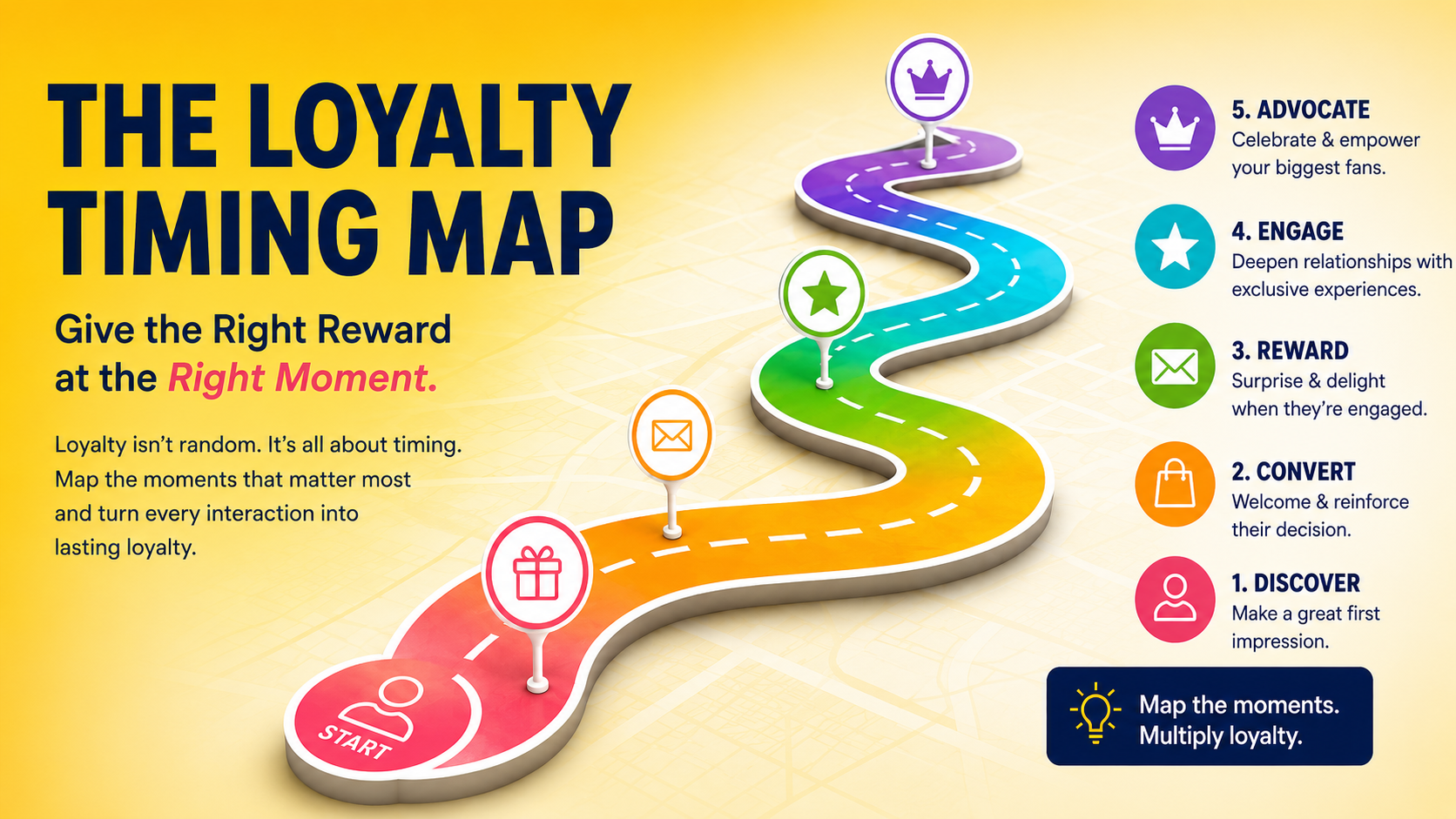
The loyalty timing map is a smarter way to think about customer retention. Instead of asking only who should receive an offer, a business should ask when that customer is most likely to care, act, return, redeem, or buy again.
That small shift changes the whole loyalty strategy.
Many businesses already understand the basics. They know they should collect customer data. They know repeat customers matter. They know birthday offers, points, rewards, and win-back campaigns can work. But there is a hidden problem that keeps many loyalty programs from reaching their full potential.
The offer may be right. The customer may be right. The reward may be valuable. But the timing may be wrong.
A customer who ignores a $15 offer on Monday morning may have acted on a $5 reward Friday afternoon. A member who does not respond to a generic coupon may return quickly when reminded that they are one visit away from a reward. A customer who seems inactive may not be lost at all. They may simply be between buying cycles.
This is where the loyalty timing map becomes powerful. It helps businesses stop marketing by calendar habit and start marketing by customer readiness.
Table of Contents
- What is a loyalty timing map?
- Why timing matters more than most businesses realize
- The six customer clocks every business should understand
- How to build a loyalty timing map
- Examples by business type
- Common timing mistakes
- Putting the loyalty timing map into practice
- FAQ
What Is a Loyalty Timing Map?
A loyalty timing map is a practical framework for matching loyalty messages, rewards, reminders, and offers to the moments when a customer is most likely to respond.
Traditional loyalty marketing often starts with segments:
- New customers
- VIP customers
- Lapsed customers
- Birthday customers
- High spenders
- Low-frequency customers
Those segments are useful, but they are incomplete. They describe the customer. They do not always describe the customer’s moment.
A loyalty timing map adds a second layer. It looks at the customer’s place in the journey, their likely buying rhythm, their reward progress, their recent behavior, and their likely decision window.
In simple terms, customer segmentation answers this question:
Who is this customer?
A loyalty timing map answers a better question:
What moment is this customer in right now?
That difference matters because people do not make buying decisions in a fixed, rational, always-ready state. They move through moments of need, habit, attention, budget, urgency, satisfaction, distraction, and forgetfulness.
Businesses that learn to recognize those moments can market with more precision and less waste.
For more background on using customer behavior to guide marketing, see Customer Preference Discovery: A Smarter Loyalty Strategy.
Why Timing Matters More Than Most Businesses Realize
There is a reason timing keeps showing up in marketing and loyalty research.
Research published in the Journal of Marketing Research on mobile coupon redemption found that where and when mobile coupons are delivered can significantly influence redemption. The study also found that mobile coupons often have shorter redemption windows than traditional coupons, which means urgency and timing both matter. You can review the research summary from Monash University.
Another well-known loyalty study, The Goal-Gradient Hypothesis Resurrected, found that people tend to accelerate their behavior as they get closer to a reward. The research was published in the Journal of Marketing Research and is available through the University of Chicago. Columbia Business School also summarizes the work here.
The lesson for businesses is direct. Customers are not equally ready to act at all times. Their motivation changes as they move closer to a goal, closer to a need, closer to a decision, or closer to forgetting you.
Email timing research points in the same direction. A study on email send-time prediction found that firms can influence open rates and engagement by predicting when customers are more likely to open messages. That research used time-to-open modeling and is available through arXiv.
The practical takeaway is not that every business needs a complex data science team. The takeaway is simpler:
The same message can perform very differently depending on when it reaches the customer.
This is why loyalty timing should be treated as a serious business strategy, not just a campaign setting.
The Six Customer Clocks Every Business Should Understand
A loyalty timing map works because customers operate on different clocks. These clocks are not literal clocks. They are patterns that help predict readiness.
Most businesses only look at one clock: how long it has been since the last visit. That is useful, but it is not enough.
A stronger timing strategy looks at six customer clocks.
1. The Habit Clock
The habit clock measures the customer’s normal rhythm.
Some customers buy every Friday. Some visit every three weeks. Some return every 90 days. Some buy seasonally. Some come in only before holidays, events, appointments, school breaks, birthdays, or home projects.
The mistake many businesses make is treating every inactive customer the same. A customer who normally visits every seven days is in danger after 21 days. A customer who normally visits every 90 days may still be perfectly on schedule after 45 days.
The habit clock helps a business avoid sending the wrong message too early or too late.
For example:
- A weekly restaurant guest may need a reminder after 10 to 14 days.
- A car service customer may need a maintenance reminder after several months.
- A hardware customer may need seasonal project reminders, not weekly coupons.
- A salon client may need timing based on normal appointment cycles.
This is where loyalty marketing becomes smarter. The business is no longer asking, “Who has not been here lately?” It is asking, “Who is late according to their own pattern?”
2. The Need Clock
The need clock measures when the customer is likely to need the product or service again.
This is different from habit. A customer may not have a fixed habit, but the business may know the likely replacement, replenishment, maintenance, or return window.
Examples include:
- Pet food, supplements, and household supplies
- Oil changes, tire rotations, and vehicle service
- Skincare treatments and wellness services
- Dental, orthodontic, and medical aesthetic follow-ups
- Lawn, pool, garden, and seasonal maintenance products
A need-based message does not feel random. It feels useful.
Instead of saying, “Here is 10% off,” the business can say, “It may be time to restock,” “Your next service window is coming up,” or “This is the right time to prepare for the next season.”
That kind of timing feels less like advertising and more like service.
3. The Reward Progress Clock
The reward progress clock measures how close the customer is to earning something.
This is one of the most powerful clocks in loyalty marketing because it connects directly to motivation. The goal-gradient research mentioned earlier supports the idea that people often become more motivated as they approach a reward.
In business terms, that means a member who is 80% of the way to a reward may be more responsive than a member who just started.
Examples include:
- One visit away from a reward
- $12 away from a cashback threshold
- 50 points away from a reward
- One stamp away from completing a card
- One purchase away from maintaining VIP status
This is not just a reminder. It is a moment of psychological momentum.
A strong loyalty timing map should identify these near-reward moments and act on them quickly. The message does not need to be aggressive. It can simply make the progress visible.
For example:
You are one visit away from your next reward. Stop in this week and finish it.
That message is more personal than a blanket coupon because it is tied to the customer’s own progress.
For related thinking, see The Psychology Behind Loyalty Programs and Why They Work.
4. The Attention Clock
The attention clock measures when the customer is most likely to notice and process a message.
This is where many campaigns fail. A business may send a good offer at a bad attention moment. The customer may be working, driving, sleeping, rushing, or mentally unavailable.
That does not mean the customer disliked the offer. It may mean the customer never gave it a real chance.
Attention timing can vary by business type:
- A restaurant may see stronger response before lunch, before dinner, or near weekend planning.
- A retailer may see stronger response around payday, evenings, or seasonal planning windows.
- A service business may see stronger response after work hours or shortly after a completed appointment.
- A family-focused business may see stronger response before weekends or school breaks.
The important point is that attention is not universal. “Tuesday at 10 AM” is not a strategy. It is a guess.
A loyalty timing map encourages the business to learn from actual response patterns. Which customers open quickly? Which customers redeem within hours? Which customers respond only on weekends? Which customers tend to act after payday? Which customers click but do not visit?
Over time, those clues create smarter timing.
5. The Relationship Clock
The relationship clock measures where the customer is in the relationship with the business.
A first-time customer should not always receive the same message as a 10-year customer. A customer who just had a great experience should not receive the same message as a customer who has been silent for six months.
The relationship clock includes moments like:
- Immediately after enrollment
- After the first purchase
- Before the second visit
- Before the third visit
- After a reward redemption
- After a long absence
- After a complaint or service recovery
- After a referral or review
This is why the second and third visits matter so much. A new customer is still deciding whether the business becomes a habit or a one-time transaction.
Preferred Patron has covered this idea in more detail in Why Smart Businesses Market for the Third Visit.
The loyalty timing map builds on that idea by treating each relationship stage as a timing opportunity.
6. The Risk Clock
The risk clock measures when the customer is most likely to drift away.
Many businesses wait too long to act. They call a customer lapsed only after the relationship has gone cold. By then, the customer may have already formed a new habit with a competitor.
A better strategy is to identify early risk signals.
Examples include:
- The customer skipped their normal return window.
- The customer stopped opening messages.
- The customer earned a reward but did not redeem it.
- The customer redeemed once but did not come back again.
- The customer’s spend dropped over several visits.
- The customer visited a different location less often than usual.
Risk timing matters because retention is easier before the customer is fully gone.
This connects closely to Return Trigger Marketing for Customer Loyalty, which focuses on using real customer behavior to prompt the next visit.
How to Build a Loyalty Timing Map
A loyalty timing map does not need to be complicated at the start. A business can begin with a few high-value timing moments and improve over time.
Step 1: Identify the business outcome
Do not start with the campaign. Start with the behavior you want.
Examples:
- Get more second visits
- Increase third visits
- Reduce customer lapse
- Increase reward redemption
- Increase visit frequency
- Increase average ticket
- Move customers into higher-value categories
- Bring customers back before they switch to competitors
Each outcome has a different timing window.
A second-visit campaign may need to happen quickly. A service reminder may need to wait until the expected need window. A near-reward reminder should happen when progress is high. A win-back campaign should happen before the customer is fully inactive.
Step 2: Find the timing signal
A timing signal is any customer action or pattern that tells the business when to act.
Useful timing signals include:
- Last visit date
- Average days between visits
- Last purchase category
- Reward progress
- Points balance
- Unredeemed rewards
- Coupon expiration
- Birthday or anniversary window
- Survey response
- Review activity
- Referral activity
- Email or SMS engagement
This is why first-party data is so valuable. It gives the business the clues needed to time outreach around customer behavior instead of guesswork. For more detail, see First-Party Data and Loyalty Programs.
Step 3: Match the message to the moment
Timing alone is not enough. The message must fit the moment.
Here are examples:
| Customer Moment | Better Message Type | Why It Works |
|---|---|---|
| New member after first purchase | Welcome plus progress reminder | Builds early habit and shows value |
| One visit away from reward | Near-reward reminder | Uses existing motivation |
| Past normal return window | Return reminder | Acts before the customer fully lapses |
| Reward earned but unused | Redemption nudge | Turns stored value into a visit |
| Seasonal purchase window | Planning reminder | Feels useful instead of random |
| VIP status at risk | Status protection message | Uses recognition and loss prevention |
The best loyalty messages often feel obvious to the customer. They arrive when the customer already has a reason to care.
Step 4: Choose the right channel
Timing also affects channel choice.
Email works well for richer content, longer explanations, monthly updates, reward summaries, and visual storytelling. SMS works well for shorter, timely, action-focused reminders. A mobile portal or app works well for self-service access, reward lookup, balances, and offers the customer may want to review later.
The channel should match the urgency of the timing moment.
For example, a same-day reminder may work better by SMS. A monthly points statement may work better by email. A reward wallet may work best in a mobile member portal or app.
The goal is not to send more messages. The goal is to reduce missed opportunities.
Step 5: Measure behavior, not just opens
Open rates and clicks can be useful, but they are not the final measure of loyalty success.
A loyalty timing map should be judged by business outcomes:
- Did the customer return?
- Did the customer redeem?
- Did visit frequency improve?
- Did average ticket increase?
- Did second and third visits improve?
- Did more customers stay active?
- Did discount dependency decrease?
This connects to the broader issue of measuring retention correctly. See Customer Retention Metrics: Which KPIs Matter Most?.
Examples of Loyalty Timing Maps by Business Type
The loyalty timing map can work across many industries, but the right timing windows depend on the business model.
Restaurant or cafe
A restaurant may build a timing map around daypart, visit frequency, weekday versus weekend behavior, reward progress, and post-visit follow-up.
Possible timing moments:
- First visit follow-up within 24 hours
- Second visit encouragement within 7 to 10 days
- Lunch reminder before the normal lunch decision window
- Weekend dinner reminder on Thursday or Friday
- Near-reward reminder when the customer is one visit away
- Review request after a positive visit pattern
The point is not to blast every customer every week. The point is to learn the customer’s rhythm and speak at the right time.
Retail store
A retailer may build a timing map around purchase category, replenishment, seasonality, gift-giving windows, reward progress, and local events.
Possible timing moments:
- Replenishment reminder based on product type
- Seasonal category reminder before peak need
- Reward reminder before a weekend shopping window
- VIP early access before public promotion
- Post-purchase cross-sell after enough time has passed
Preferred Patron has a retail-focused loyalty overview here: Customer Loyalty Programs for Retailers.
Automotive service department
An automotive service business may build a timing map around service intervals, mileage assumptions, declined services, warranty windows, inspection timing, and customer-pay retention.
Possible timing moments:
- Post-service thank-you and review request
- Maintenance reminder before expected need
- Declined service follow-up after a short delay
- Warranty-to-customer-pay transition reminder
- Reward or credit reminder before the next service interval
The timing should feel helpful. A service reminder sent at the right interval feels responsible. A random coupon may feel like noise.
Hardware store or home improvement business
A hardware store may build a timing map around weather, season, project cycles, category behavior, and local needs.
Possible timing moments:
- Spring lawn and garden preparation
- Storm preparation reminders
- Paint project follow-up
- Grill, patio, and outdoor living season
- Winterization reminders
- Near-reward reminders before weekend project planning
For this type of business, the timing map should not only ask when the customer last visited. It should ask what project the customer may be entering next.
Medical aesthetics, wellness, salon, or spa
A service-based personal care business may build a timing map around appointment cycles, treatment plans, package usage, birthdays, event preparation, and post-visit satisfaction.
Possible timing moments:
- Post-appointment care message
- Next-appointment reminder based on service type
- Package progress reminder
- Birthday or anniversary treatment offer
- Event-season planning reminder
- Referral request after a positive repeat pattern
This approach respects the customer relationship. It is not just selling. It is helping the customer stay on track.
Common Loyalty Timing Mistakes
A loyalty timing map also helps businesses avoid common mistakes that weaken loyalty performance.
Mistake 1: Sending the same offer to everyone at the same time
This is easy, but it wastes opportunity. Customers are not in the same buying moment. A blanket campaign may reach some customers too early, some too late, and some at exactly the wrong time.
Mistake 2: Waiting until customers are fully lapsed
Win-back campaigns matter, but the best recovery often happens before the customer becomes fully inactive.
A customer who is slightly late according to their own rhythm may only need a gentle reminder. A customer who has been gone for six months may require a stronger incentive.
This is why timing can reduce discount pressure. Earlier action may require less incentive.
Mistake 3: Treating reward earning as the finish line
Earning a reward is not the end of the loyalty cycle. It is a new timing moment.
If the customer does not redeem, the business may not get the return visit. If the customer redeems but does not come back again, the business may have created a one-time discount event instead of a repeat behavior loop.
A strong loyalty timing map includes:
- Before the reward
- At the reward
- After the reward
Mistake 4: Ignoring individual rhythm
Many businesses use fixed timing rules, such as 30 days inactive or 60 days inactive. Those rules can be useful, but they are blunt.
A better approach compares the customer to their own normal pattern when possible.
If a customer normally visits every 10 days, 30 days may be too late. If a customer normally visits every 90 days, 30 days may be too early.
Mistake 5: Measuring campaign activity instead of customer movement
The goal of loyalty marketing is not to send campaigns. The goal is to move customers toward stronger behavior.
That means the business should measure customer movement:
- First visit to second visit
- Second visit to third visit
- Occasional customer to active customer
- Active customer to VIP customer
- Reward earner to reward redeemer
- Lapsing customer to returning customer
This is where customer segmentation and timing should work together.
Why the Loyalty Timing Map Can Reduce Discount Dependency
One of the biggest benefits of better timing is that it can reduce the need for bigger discounts.
When a business sends untimed campaigns, it often tries to compensate with stronger offers. If the timing is wrong, the business may assume the offer was not rich enough. So the next offer gets larger.
That can create a dangerous cycle:
- The business sends an offer at the wrong time.
- The customer ignores it.
- The business increases the discount.
- The customer learns to wait for better deals.
- The business loses margin while training discount dependence.
A loyalty timing map offers a better path. It asks whether the message could be more relevant, more timely, or more connected to the customer’s actual behavior before increasing the incentive.
Sometimes the best next message is not a bigger coupon. It may be:
- A progress reminder
- A points balance reminder
- A reward expiration reminder
- A personalized category reminder
- A VIP recognition message
- A useful service reminder
- A post-visit thank-you
That is a more profitable way to think about loyalty.
Preferred Patron’s own positioning supports this idea. The platform is designed to help businesses grow repeat business without turning marketing into always discounting. You can learn more on the About Preferred Patron Loyalty page.
Putting the Loyalty Timing Map Into Practice
The loyalty timing map is not just a theory. It becomes more powerful when customer data, rewards, messaging, automation, and reporting work together.
Businesses should look for timing signals such as first visit, second visit, reward progress, reward expiration, birthday windows, last visit date, purchase history, customer preferences, and early signs of customer drift.
A business should be able to act on moments like:
- A customer joined but has not returned.
- A customer is one purchase away from a reward.
- A customer earned a reward but has not used it.
- A customer is drifting past their normal return pattern.
- A customer’s birthday or anniversary is approaching.
- A customer recently purchased from a specific category.
- A customer responded to one type of offer but ignored another.
For businesses that want to turn this strategy into action, Preferred Patron’s Loyalty Timing Map Software helps connect these customer moments to rewards, email, SMS, segmentation, automation, and loyalty reporting.
Preferred Patron’s loyalty program features are built around this kind of connected customer retention work. The platform brings rewards, promotions, messaging, branding, integrations, and reporting into one system so businesses can do more than collect members. They can act on customer behavior.
For growing organizations, this also matters at scale. Multi-location, franchise, and enterprise teams need timing strategies that can be consistent across the brand while still responding to local and customer-level behavior. Preferred Patron’s enterprise loyalty program software supports more advanced loyalty structures, including points, rewards, tiers, cashback, SMS and email automation, and multi-brand or multi-location orchestration.
The Future of Loyalty Is Not More Messages. It Is Better Moments.
Customers are surrounded by marketing. They see emails, texts, ads, notifications, social posts, apps, and offers every day.
The businesses that win will not simply be the ones that send the most messages. They will be the ones that understand customer timing.
The loyalty timing map gives businesses a more advanced way to think about retention. It helps them identify when customers are most likely to need, notice, value, redeem, return, or drift away.
That is the future of loyalty marketing.
Not more noise.
Better moments.
For businesses that want to move beyond generic campaigns, Preferred Patron provides the loyalty, rewards, automation, messaging, and reporting tools needed to turn customer timing into repeat business. Explore the platform at preferredpatron.com.
FAQ: The Loyalty Timing Map
What is a loyalty timing map?
A loyalty timing map is a framework that helps businesses send loyalty messages, rewards, reminders, and offers when customers are most likely to act. It uses customer behavior, reward progress, visit patterns, purchase timing, and engagement signals to improve marketing relevance.
Why is timing important in loyalty marketing?
Timing is important because customers are not always equally ready to respond. A message sent at the wrong time may be ignored even if the offer is valuable. Better timing can improve redemption, repeat visits, reward use, and customer retention.
How is a loyalty timing map different from customer segmentation?
Customer segmentation groups customers by traits or behaviors. A loyalty timing map adds another layer by asking what moment the customer is in right now. The strongest loyalty strategies use both segmentation and timing together.
Can a small business use a loyalty timing map?
Yes. A small business can start with simple timing moments, such as first visit follow-up, second visit encouragement, birthday rewards, near-reward reminders, and win-back campaigns. The strategy can become more advanced as the business collects more customer data.
Does better timing reduce the need for discounts?
Often, yes. When messages are more relevant and timely, the business may not need to rely on larger discounts to get attention. Progress reminders, reward nudges, service reminders, and recognition messages can sometimes motivate customers without increasing discount pressure.
How can Preferred Patron help with loyalty timing?
Preferred Patron helps businesses connect loyalty data, rewards, promotions, email, SMS, mobile member access, and reporting. That makes it easier to identify customer moments and send timely messages based on real behavior instead of guesswork.
Author note: Christopher Silvestri is Managing Partner and CTO of Preferred Patron Loyalty, a customer loyalty and marketing automation platform used by businesses to manage rewards, customer engagement, retention campaigns, and loyalty technology. His work focuses on helping businesses turn customer data, rewards, and automated messaging into measurable repeat business.