
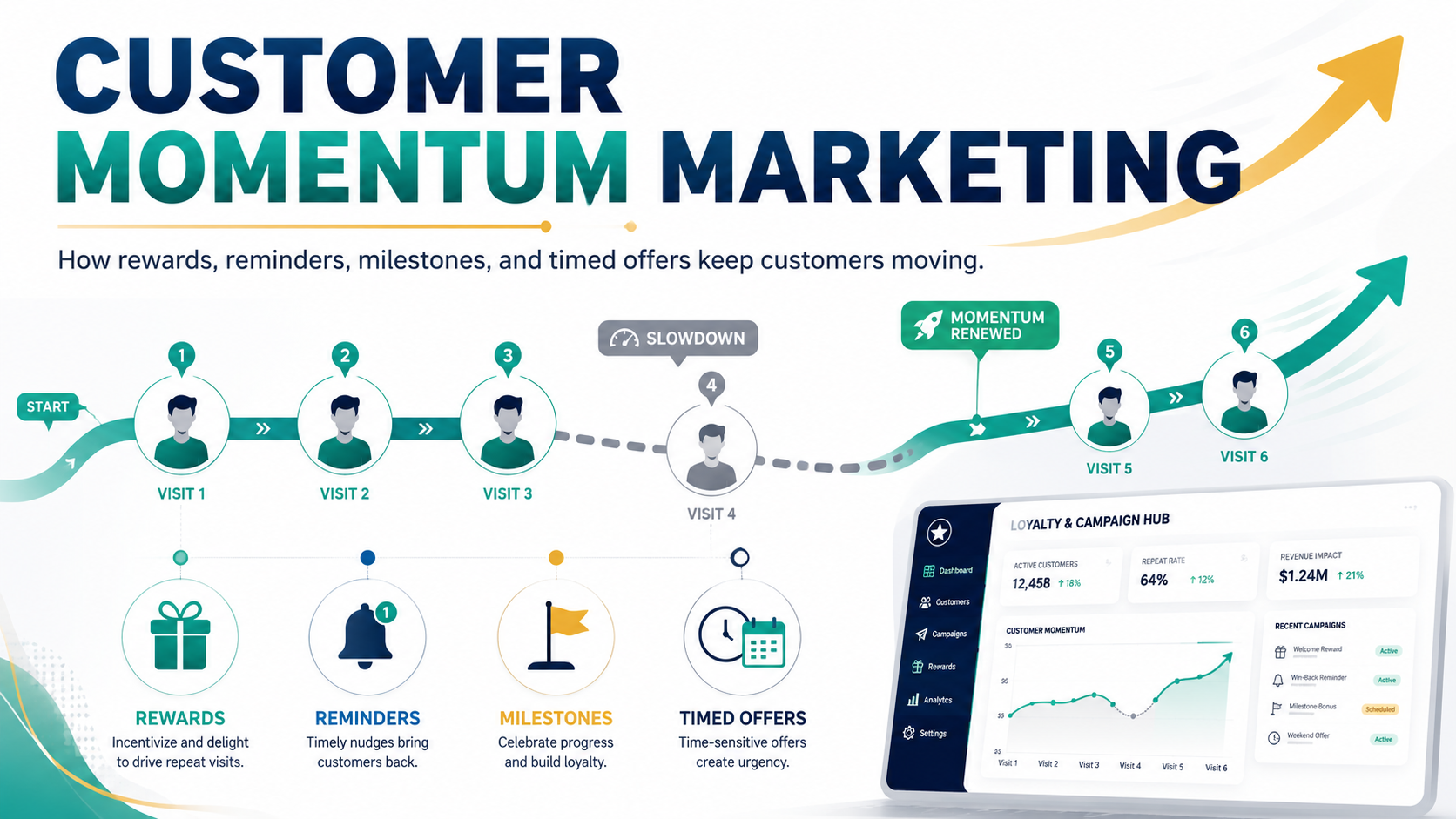
Customer momentum marketing is a retention strategy focused on preserving the forward movement that begins when a customer first discovers, joins, buys from, or returns to a business.
Early customer activity can look promising. A new customer may visit twice in a short period, join the loyalty program, earn points, open a message, or begin moving toward a reward. Then the pace changes. The next visit takes longer. Reward progress stalls. A reminder is ignored. The relationship has not ended, but it is no longer moving with the same energy.
That slowing matters because a customer can be satisfied and still drift away. Customer momentum marketing helps a business recognize deceleration before it becomes inactivity, then use rewards, reminders, milestones, and timed offers to keep the next action clear and worthwhile.
This article is part of the Preferred Patron™ Strategy Central series. For the software implementation view, see Customer Momentum Marketing Software. Related strategies include Third Visit Customer Retention, The Progress Visibility Strategy, The Habit Loop Loyalty Strategy, and Return Trigger Marketing.
What Is Customer Momentum Marketing?
Customer momentum marketing is the practice of monitoring whether a customer relationship is moving forward, holding steady, or beginning to slow, then using an appropriate retention action to support the next step.
Momentum can appear in many forms:
- A second visit that happens sooner than expected
- A third purchase that confirms growing interest
- Steady progress toward a reward or tier
- A customer responding to a reminder and returning
- A member completing a profile or opting into another channel
- A customer expanding into another product or service category
- A reward redemption followed by another qualifying visit
- An appointment customer rebooking before the normal cycle breaks
The opposite is deceleration. Visit intervals begin to widen. Progress stops. A customer who previously responded becomes quiet. An earned benefit remains unused. The customer may still like the business, but the relationship is losing forward motion.
Momentum is not the same as loyalty. Momentum is the movement that can eventually produce loyalty. A business should protect that movement while the relationship is still forming.
Why Early Customer Activity Often Slows
Businesses sometimes assume that a strong first or second visit means the customer relationship is secure. It does not.
Early activity may be driven by novelty, immediate need, a convenient location, an opening promotion, a referral, a special event, or simple curiosity. Those reasons can create a burst of activity without creating a lasting pattern.
Momentum may slow when:
- The customer does not understand what to do next
- The next reward feels too far away
- The business stops communicating after enrollment
- The customer forgets the points, stamps, or benefits already earned
- The normal purchase or service cycle is missed
- A competing business becomes more convenient
- The original promotion ends without a follow-up path
- The customer receives too many generic messages and begins ignoring them
- The business waits for full inactivity instead of noticing a widening visit gap
The important lesson is that customer relationships rarely move from active to lost in one instant. The pace often changes first.
The Research Behind Customer Momentum
Customer momentum marketing is a practical Strategy Central framework rather than a formal academic label. However, several areas of customer and behavioral research help explain why forward movement, progress, and early intervention matter.
Research by Ran Kivetz, Oleg Urminsky, and Yuhuang Zheng on the goal-gradient effect in customer reward programs found that customers accelerated their activity as they moved closer to a reward. The research also connected stronger acceleration with greater retention and faster re-engagement. The practical implication is not merely that rewards motivate customers. It is that the pace of customer activity can reveal whether the goal is creating meaningful forward motion.
Yuping Liu’s longitudinal study, The Long-Term Impact of Loyalty Programs on Consumer Purchase Behavior and Loyalty, found different effects among different customer groups. Customers who began as light or moderate buyers gradually purchased more and became more loyal, while initially heavy buyers were less likely to change their behavior. This supports a central principle of customer momentum marketing: different customers need different levels of intervention, and the strongest incentive should not automatically go to customers who are already moving on their own.
Research on identifying downward trends earlier in the customer lifecycle also argues for acting before full churn. For a business owner, this means the widening gap between visits may be more actionable than waiting until the customer has been absent for months.
The Three Customer Momentum States
A practical customer momentum strategy can begin by placing customers into three broad states.
1. Building Momentum
The customer is taking meaningful steps and the relationship is advancing. Visits may be occurring at a healthy pace, reward progress is increasing, messages are producing action, or the customer is completing new milestones.
The business should reinforce this movement without interrupting it with unnecessary discounts. Recognition, visible progress, a helpful next step, or a small bonus may be enough.
2. Holding Momentum
The customer is following a stable pattern that fits the business. A weekly cafe customer, monthly car wash member, six-week salon client, seasonal retailer, or scheduled automotive service customer may all have different healthy rhythms.
Holding momentum does not mean forcing more visits than the customer needs. It means protecting the natural cycle and preventing avoidable gaps.
3. Losing Momentum
The customer’s pace is slowing compared with their own prior behavior or the expected cycle for the business. Visit intervals may be widening, reward progress may have stopped, an appointment may be overdue, or a previously responsive customer may no longer act.
This is the moment for a carefully matched reminder, milestone, incentive, or return trigger. The goal is to restore useful movement before the relationship becomes dormant.
How to Recognize Customer Deceleration
A business does not need a complicated predictive model to begin noticing momentum. It needs to compare recent customer behavior with expected behavior.
Useful momentum signals include:
- Visit interval: Is the time between visits stable, shortening, or widening?
- Early visit progression: How long did it take to move from the first visit to the second, third, and fourth?
- Reward progress: Is the customer continuing to earn, or has progress stalled?
- Milestone movement: Is the customer approaching the next visit, spend, tier, or engagement milestone?
- Message response: Did the customer return, click, redeem, book, or update a profile after a reminder?
- Reward use: Are earned rewards being redeemed while they are still relevant?
- Category expansion: Is the customer deepening the relationship or repeating only one promotional purchase?
- Cycle compliance: Is an appointment, service, replenishment, or seasonal need becoming overdue?
The customer’s own history is often more useful than a single universal inactivity rule. A ten-day gap may signal deceleration for a weekly customer but be perfectly normal for a monthly customer.
The Customer Momentum Marketing Framework
1. Define the Next Meaningful Action
Momentum must move toward something specific. The next action may be a return visit, another purchase, a rebooking, reward redemption, profile completion, tier advancement, referral, review, or response to a service reminder.
Do not begin with the message. Begin with the customer action that would strengthen the relationship.
2. Identify the Expected Customer Rhythm
Estimate how often the desired behavior normally occurs. This rhythm may be based on business type, product cycle, service interval, membership cadence, season, or the customer’s own prior pattern.
A momentum strategy becomes more accurate when the business knows the difference between a normal pause and a meaningful slowdown.
3. Give the Customer an Intermediate Milestone
A distant reward may not provide enough motivation during the early relationship. Intermediate milestones make progress feel more immediate.
Examples include:
- Complete a second visit and unlock a small bonus
- Reach the third visit and receive member recognition
- Finish half of a digital stamp card
- Complete a customer profile to activate a birthday benefit
- Book the next appointment before leaving
- Try a second category and earn bonus points
- Reach a spend or visit threshold before a defined date
Milestones create shorter paths between the first action and the long-term outcome.
4. Connect Each Action to the Next One
After a visit, purchase, booking, enrollment, reward, or milestone, tell the customer what happens next.
A useful follow-up may say:
- You are one visit closer to your first reward.
- Your next service window begins in three weeks.
- You have completed two of four steps toward member status.
- Your reward is ready. Use it before your normal visit cycle passes.
- You are close to the next milestone. Here is the action that completes it.
The customer should not have to reconstruct the loyalty journey from memory.
5. Intervene When the Pace Changes
Do not wait until every customer crosses the same broad inactivity threshold. A momentum intervention should occur when the customer’s expected pattern begins to weaken.
The first response can be light:
- A progress reminder
- A points or stamp balance update
- A rebooking prompt
- A reminder about an earned benefit
- A milestone message
- A helpful seasonal or service reminder
If the customer continues to slow, the business can escalate to bonus points, a limited-time accelerator, a bounce-back reward, or a targeted offer.
6. Measure Whether Momentum Returned
The campaign is not successful merely because the message was delivered. Measure whether the customer took the desired action and whether the next interval improved.
Useful measures include:
- Time from first visit to second, second to third, and third to fourth
- Change in average visit interval
- Percentage of customers reaching the next milestone
- Return rate after a progress reminder
- Reward completion and redemption rate
- Rebooking or replenishment rate
- Movement from new to active customer segments
- Incremental response compared with customers who received no intervention
The Four Main Momentum Levers
Rewards Create Forward Motion
Rewards can give customers a reason to continue, especially when the first meaningful benefit is attainable. The reward should be valuable enough to matter and close enough to feel achievable.
Early rewards do not always need to be large. A small welcome bonus, first milestone reward, bonus stamp, recognition benefit, or category incentive may preserve motion without creating excessive cost.
Reminders Preserve Continuity
Customers often slow down because they become busy, distracted, or unaware of the next step. A timely reminder can reconnect the previous action to the next one.
The strongest reminder contains context. It should explain what the customer has already done, what remains, and why acting now is useful.
Milestones Break a Long Journey Into Achievable Steps
Milestones create evidence that the relationship is advancing. They may recognize visits, spend, tenure, profile completion, tier movement, referrals, service cycles, or reward progress.
A milestone can be motivational even without a discount because it tells the customer that their activity has been noticed and that the next step has meaning.
Timed Offers Restore Momentum Selectively
A timed offer is most useful when the customer needs an additional reason to act. It should not be sent simply because the customer exists in the database.
For example, a business might use a short bonus window when a new member’s second visit is overdue, when reward progress has stalled near a milestone, when an appointment cycle is beginning to slip, or when an earned reward is approaching irrelevance.
The objective is not to buy every visit. It is to use an incentive where it can help restore a valuable customer pattern.
Use the Lightest Intervention That Can Work
Customer momentum marketing should not become a discount escalation system.
A practical intervention ladder may look like this:
- Clarity: Show the customer where they stand and what comes next.
- Recognition: Acknowledge progress, tenure, status, or a completed milestone.
- Reminder: Send a timely message connected to the customer’s expected rhythm.
- Accelerator: Add bonus points, a bonus stamp, extra progress, or a limited challenge.
- Targeted offer: Use a stronger reward or discount when the value of restoring the relationship justifies it.
This approach protects margin and avoids training active customers to wait for discounts they did not need.
Customer Momentum Examples by Business Type
Restaurants and Cafes
A new guest visits twice within ten days, then does not return during the next expected window. The restaurant sends a progress reminder showing that one more visit reaches an early member milestone. If the guest still does not return, a short bonus-point offer can provide an additional reason to act.
Car Washes
A customer completes several washes during pollen season but begins stretching the interval between visits. A weather- or season-aware reminder can reconnect the customer to the normal wash cycle, while a visit milestone keeps the next reward visible.
Salons, Spas, and Medspas
A client leaves without rebooking and passes the normal treatment or service window. The business can send a rebooking reminder first, then add a time-limited loyalty bonus if the cycle continues to slip.
Retail Stores
A new member makes two purchases in one category but never explores another. The retailer can recognize the early activity, show reward progress, and offer bonus points for a relevant second category rather than sending a broad storewide discount.
Automotive Service
A customer completes an initial service but does not return as the next maintenance window approaches. A service reminder, loyalty balance, and milestone toward a future benefit can help preserve the service relationship before the customer becomes overdue.
Golf Courses and Recreation Businesses
A new player visits several times early in the season, then activity slows. The business can use round counts, league milestones, event reminders, or a limited return bonus to maintain participation while the season is still relevant.
How Customer Momentum Differs From Related Loyalty Strategies
Customer momentum marketing works with several Strategy Central concepts, but it has a distinct role.
Customer Momentum vs. Third Visit Retention
Third Visit Customer Retention focuses on a specific early milestone that can help move a customer beyond trial. Customer momentum marketing watches the pace before, during, and after that milestone and responds when movement begins to weaken.
Customer Momentum vs. Progress Visibility
The Progress Visibility Strategy focuses on showing points, stamps, tiers, reward distance, and other evidence of advancement. Customer momentum marketing uses that visible progress as one lever for maintaining the broader pace of the relationship.
Customer Momentum vs. Habit Loop Strategy
The Habit Loop Loyalty Strategy focuses on reinforcing a repeated cue, routine, reward, and repeat prompt. Customer momentum marketing is especially important before that routine becomes established, when the business is still trying to keep early actions connected.
Customer Momentum vs. the Loyalty Dead Zone
The Loyalty Dead Zone focuses on the quiet gap in which a customer has participated but has not become habitual. Customer momentum marketing is the active operating strategy used to detect slowing movement and prevent that quiet gap from becoming permanent.
How Preferred Patron™ Helps Implement Customer Momentum Marketing
Preferred Patron™ loyalty software helps businesses connect customer activity, rewards, milestones, segmentation, messaging, and reporting into a measurable momentum strategy.
A business can use Preferred Patron™ to help:
- Track visits, purchases, points, stamps, rewards, tiers, and redemptions
- Identify new, active, near-milestone, slowing, overdue, or inactive customers
- Create customer groups based on visit timing, reward status, spend, or behavior
- Send email and SMS reminders based on customer activity
- Issue milestone rewards, bonus points, bonus stamps, coupons, or certificates
- Show balances, rewards, and progress through member-facing access
- Trigger follow-up after enrollment, visits, reward events, inactivity, birthdays, or other milestones
- Measure campaign delivery, response, redemption, return activity, and retention results
The goal is not to automate more messages. The goal is to recognize when a valuable customer relationship is losing pace and deliver the most useful next action while the customer is still reachable.
For the practical implementation guide, visit Customer Momentum Marketing Software.
Common Customer Momentum Mistakes
- Assuming loyalty program enrollment equals customer loyalty
- Waiting for full inactivity before responding
- Using one inactivity period for every customer and business cycle
- Sending discounts to customers who are already returning naturally
- Making the first meaningful reward feel too distant
- Failing to connect one completed action to the next action
- Tracking balances without tracking changes in visit pace
- Using reminders without showing progress or relevance
- Celebrating a milestone without creating the next milestone
- Measuring opens and clicks without measuring customer return behavior
A Practical Customer Momentum Checklist
- What is the next meaningful action for this customer?
- What is the normal timing for that action?
- Is the customer’s pace building, stable, or slowing?
- Can the customer see current progress and the next milestone?
- Has the business acknowledged the customer’s most recent action?
- Would a reminder work before an incentive is needed?
- Is the offer proportional to the risk and value of the customer?
- Did the intervention improve the next visit interval or desired behavior?
Final Thought
Customer retention is not only about whether a customer eventually comes back. It is also about whether the relationship continues to move forward at a healthy pace.
A customer may be pleased, enrolled, and partially engaged while still losing momentum. Businesses that notice the slowdown early can respond with a clear next step, visible progress, a useful reminder, an intermediate milestone, or a carefully timed offer.
The objective is not constant pressure. It is continuity. When each customer action leads naturally to the next one, early interest has a better chance of becoming repeat behavior and long-term loyalty.
See how Preferred Patron™ helps implement Customer Momentum Marketing.
Author note: Christopher Silvestri is Managing Partner and CTO of Preferred Patron™ Loyalty, a customer loyalty and marketing automation platform used by businesses to manage rewards, customer engagement, retention campaigns, and loyalty technology. His work focuses on helping businesses turn customer data, rewards, and automated messaging into measurable repeat business.
Frequently Asked Questions About Customer Momentum Marketing
What is customer momentum marketing?
Customer momentum marketing is a retention strategy that monitors whether customer activity is building, holding steady, or slowing, then uses rewards, reminders, milestones, and timed offers to encourage the next meaningful action.
How is customer momentum different from customer loyalty?
Customer momentum describes forward movement in the relationship, such as repeat visits, reward progress, rebooking, or milestone completion. Customer loyalty is a stronger long-term relationship. Momentum can help a customer move toward loyalty, but early activity alone does not prove loyalty.
What are signs that a customer is losing momentum?
Signs may include widening gaps between visits, stalled reward progress, an overdue appointment or service cycle, unused rewards, reduced response to messages, or failure to reach the next expected milestone.
Does customer momentum marketing require discounts?
No. A business can first use progress visibility, recognition, reminders, useful information, milestone messages, bonus points, or bonus stamps. A stronger discount should be reserved for situations in which it is needed and financially justified.
Which customer momentum metrics should a business track?
Useful metrics include visit interval, time between early visits, milestone completion, reward progress, redemption, rebooking, return rate after a reminder, movement between customer segments, and incremental response to targeted campaigns.
How does loyalty software support customer momentum marketing?
Loyalty software can track customer activity, identify changes in timing, segment customers by momentum state, show reward progress, trigger email or SMS reminders, issue milestone incentives, and measure whether customers returned after an intervention.