
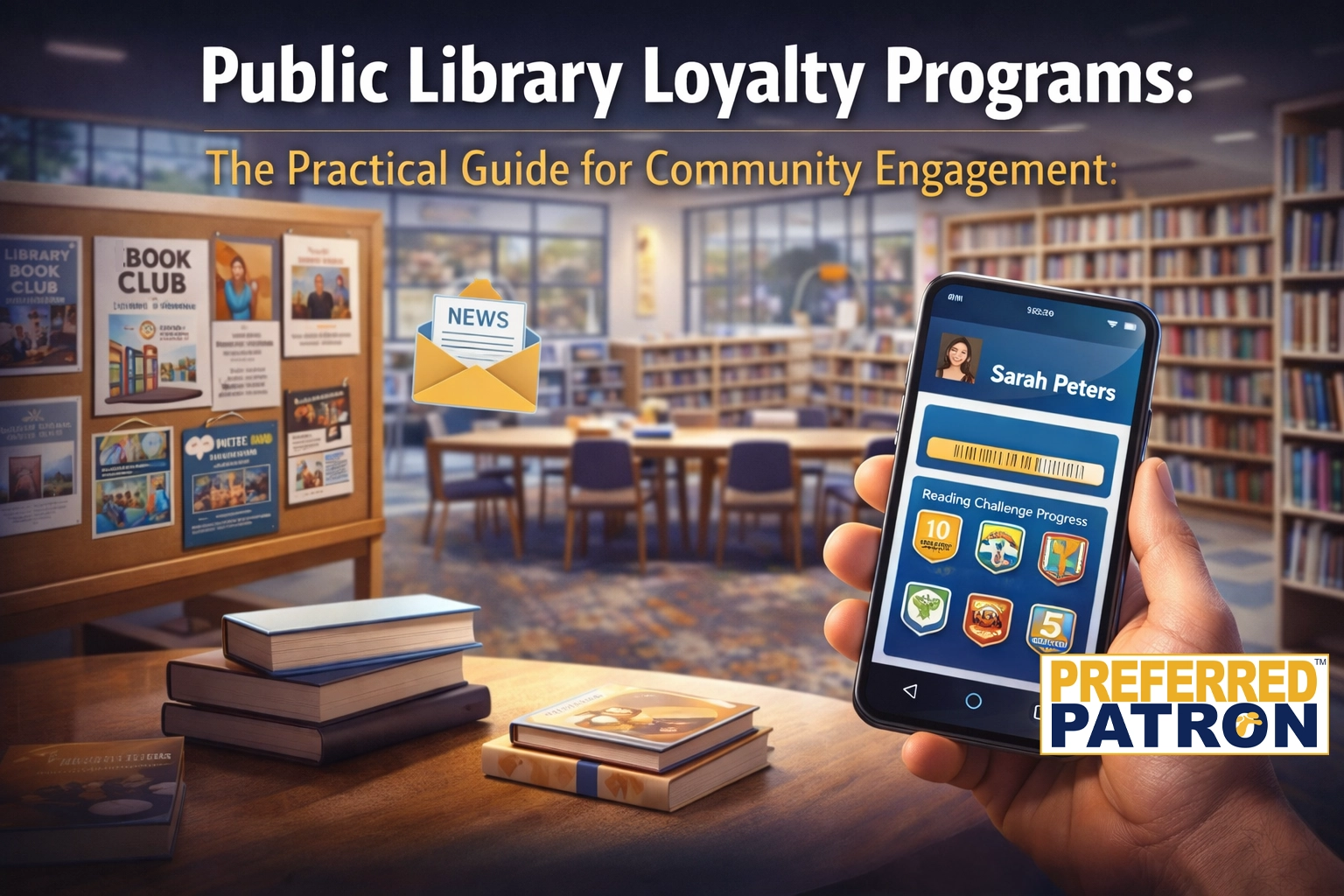
Public library loyalty programs can help libraries strengthen community engagement, increase active memberships, and create more measurable participation across programs and services.
Public libraries are increasingly asked to show measurable community value, not just house a collection.
In many communities, that means demonstrating stronger cardholder engagement, higher program attendance, more active memberships, and better participation in the services the library already offers. National public library benchmarking reinforces why this matters: public library use, financial health, visits, and other engagement indicators are tracked through Institute of Museum and Library Services resources used by policymakers and practitioners. The Institute of Museum and Library Services maintains benchmarking data for public library use and financial health, which is one reason measurable participation matters so much.
That creates an opportunity. A loyalty program for a public library does not need to look like retail points or restaurant punch cards. It can be built as a community engagement system that encourages memberships, promotes recurring visits, supports reading clubs, strengthens newsletter communication, and keeps patrons involved in the life of the library.
That is where Preferred Patron fits surprisingly well. With flexible rewards rules, email and SMS automation, enrollment forms, segmentation, mobile member access, gamification, and API options, Preferred Patron’s loyalty platform features can help libraries build a structured engagement program around the behaviors that matter most.
In this guide, we’ll walk through what makes public library loyalty different, which program structures work best, how libraries can use newsletters and reading clubs more strategically, and why Preferred Patron is a strong fit for libraries that want to grow community engagement in a measurable way.
What are public library loyalty programs?
A public library loyalty program is a structured engagement system that rewards participation and helps the library build stronger, more consistent relationships with patrons over time.
Unlike a traditional retail loyalty program, the goal is not to increase basket size or transactions. The goal is to encourage the kinds of community behaviors that matter to a public library, such as library card sign-ups, active memberships, recurring visits, reading challenge participation, program attendance, book club involvement, newsletter engagement, and community referrals.
A strong library engagement program should help a public library:
- increase active cardholder participation
- encourage repeat branch visits and event attendance
- support summer reading, reading challenges, and book clubs
- grow newsletter subscriptions and campaign engagement
- segment patrons by interests, age groups, or program types
- reactivate inactive members with automated outreach
- show clearer engagement patterns to boards, municipalities, and community stakeholders
In short, public library loyalty programs should help the library turn passive cardholders into active community participants.
Why library loyalty is different from ordinary rewards programs
Libraries have a very different engagement rhythm from businesses that rely on purchases.
A public library often needs to influence behavior such as attending an event, joining a reading club, coming back for a second program, finishing a seasonal challenge, opening a newsletter, or renewing community participation over time. Those are not one-time transactions. They are relationship signals.
That means the best public library loyalty programs usually need to support:
- membership enrollment and re-engagement
- automated email and SMS outreach
- segmentation by reading interest, age group, or branch activity
- newsletter-style communications and drip sequences
- digital member access for cards, messages, and rewards
- gamified reading challenges, badges, raffles, and milestone rewards
- clear reporting on participation, activity, and campaign response
That is why a generic blast-email tool is usually not enough. Libraries often need something more structured than a mailing list and more flexible than a basic event calendar. They need a platform that can combine membership growth, targeted outreach, recurring engagement, and measurable program participation in one place.
What the best public library loyalty programs have in common
1. They make joining easy
If participation feels complicated, most patrons will not take the next step.
The best public library loyalty programs make it easy to enroll through simple web forms, staff-supported sign-up, or mobile-friendly access. That matters because the faster a patron joins, the faster the library can begin nurturing that relationship through reminders, event notices, challenge updates, and targeted messages. Preferred Patron’s marketing automation tools support enrollment forms, campaign automation, and segmentation, which is especially useful for libraries that want to grow their mailing list and club participation without adding administrative burden.
2. They reward participation, not spending
Libraries need a loyalty model built around engagement behavior.
That could mean recognizing patrons for joining a book club, completing a summer reading milestone, attending three author talks, participating in a teen reading challenge, opening newsletter updates consistently, or coming back for a recurring community class. A strong platform should let the library define what meaningful participation looks like and reward those actions accordingly.
3. They support clubs, challenges, and recurring programs
Reading clubs, seasonal campaigns, and community events are where loyalty becomes visible.
A public library can use a structured engagement program to build adult book clubs, children’s reading clubs, teen challenge programs, summer reading campaigns, local history participation, makerspace usage, or multi-event attendance patterns. The key is that loyalty gives those programs continuity instead of leaving each one as a one-off effort.
4. They keep communication organized and consistent
Libraries often have strong programming but inconsistent follow-up.
That is where newsletters, reminder sequences, and targeted communications matter. Preferred Patron is a strong fit for this need because it supports scheduled outreach, drip campaigns, automated texts and emails, and segmentation by behavior or interest. Libraries that want to grow book clubs or reading clubs can use automated campaigns and interest-based messaging to keep those communities active between meetings.
5. They give staff a clearer picture of community engagement
Library engagement should not be measured by attendance alone.
The more useful question is whether people keep coming back, deepen their participation, open communications, complete challenges, renew involvement, and respond to specific types of programming. A structured engagement platform helps libraries move from anecdotal success to measurable community participation.
Which loyalty models work best for public libraries?
There is no one best model for every library. The right structure depends on the size of the system, the types of programs offered, and what the library wants to improve first.
Reading challenge programs
Reading challenges are one of the clearest fits for a library loyalty program. Instead of treating summer reading or year-round literacy campaigns as isolated efforts, the library can create a structured system of milestones, digital progress, badges, surprise rewards, or raffle entries. Preferred Patron’s broader platform supports points, tiers, and gamification elements such as badges, mystery rewards, and raffles, which makes it especially useful for reading clubs and participation campaigns.
Book clubs and recurring groups
Book clubs succeed when people feel continuity between meetings. A loyalty-driven approach can help the library enroll members, send reminders, manage newsletter-style updates, segment by interest, and reward consistent attendance or reading streaks. That makes the club feel like a community, not just an event on a calendar.
Newsletter and campaign engagement programs
Many libraries already send newsletters, but not all newsletters create ongoing engagement.’
When newsletters are paired with segmentation, reading interest groups, automated follow-ups, and member behavior tracking, they become much more useful. Libraries can send different updates to parents, teen readers, local history enthusiasts, adult book club members, makerspace users, or community-class participants instead of sending the same general message to everyone.
Membership activation and reactivation programs
Not every library problem is about acquiring new members. Often the bigger opportunity is activating the people who already have a card but are not participating.
A structured loyalty program can help libraries identify inactive members and bring them back with reading challenges, event invitations, welcome-back campaigns, or targeted reminders about programs that fit their interests.
Branch or system-wide engagement programs
For multi-branch systems, loyalty can help create consistency across locations while still allowing each branch to run its own programming emphasis. That makes it easier to coordinate campaigns across a city or county system without losing local relevance.
How to build a public library loyalty program that actually works
Step 1: Start with the engagement problem you want to solve
Before choosing rewards, define the behavior the library wants to improve.
Do you want more cardholder activation? More repeat event attendance? Better newsletter engagement? Stronger participation in summer reading? More consistent book club attendance? More reactivation of inactive patrons?
The strongest library loyalty programs start with one or two engagement goals and expand from there.
Step 2: Build around library behaviors, not business assumptions
Libraries should not copy retail loyalty structures blindly.
Instead, they should reward the things that matter to a public library: participation, attendance, reading progress, referrals, engagement with newsletters, and recurring involvement with the library’s programs and mission.
Step 3: Use forms, segments, and automation early
One of the biggest wins for libraries is better communication structure.
Preferred Patron supports enrollment forms, automated campaigns, behavior-based messaging, and audience segmentation, which can help libraries build book clubs, reading clubs, volunteer interest groups, and program-specific mailing lists with much less manual work. If your library wants a better way to run newsletters and nurture sequences, the most relevant place to start is Preferred Patron’s marketing automation page.
Step 4: Give patrons a mobile-friendly member experience
Libraries benefit when members can easily see updates, rewards, messages, and participation progress from a phone.
Preferred Patron’s mobile loyalty portal supports digital member access, message history, consent management, and reward visibility, which makes it a strong fit for libraries that want a modern digital member experience without building a custom app from scratch.
Step 5: Add gamification where it actually helps
Gamification is useful when it supports real library goals.
That could mean badges for reading milestones, surprise rewards for challenge participation, raffles tied to event attendance, or tier-based recognition for recurring members. The purpose is not to trivialize the library. It is to create momentum around participation.
Step 6: Report what changed
The final step is measurement.
Track growth in active members, open rates, event participation, challenge completion, recurring attendance, and reactivated patrons. Those numbers help the library show that it is not just offering programs. It is building community engagement in a measurable way.
What libraries should look for in engagement software
Choosing a library loyalty platform should start with community fit, not business jargon.
The right platform should help a public library:
- grow and segment its member database
- support reading clubs, challenges, and recurring programs
- automate newsletters, reminders, and follow-up messages
- offer digital member access on mobile devices
- support points, badges, tiers, raffles, or other flexible rewards
- capture consent and manage communication preferences
- create measurable engagement reporting
- launch without requiring a massive custom build
- grow into deeper website or app integrations when needed
If you are comparing options, start with the broader Preferred Patron loyalty platform overview, then review pricing and editions and the Preferred Patron FAQs to understand how onboarding, features, automation, and support work in practice.
Why Preferred Patron is a strong fit for public libraries
Preferred Patron is a strong fit for public libraries because it is flexible enough to support engagement without forcing the library into a retail mold.
Libraries can use Preferred Patron to build structured participation programs around member enrollment, reading challenges, newsletters, club communication, event attendance, milestone recognition, gamification, and mobile member access. That matters because libraries often need more than a mailing list, but less than a full custom-built community platform.
Preferred Patron also brings together the capabilities that libraries usually end up splitting across multiple tools: rewards rules, audience segmentation, email and SMS outreach, mobile member access, white-label branding, and optional API integration. That creates a more unified system for engaging patrons over time.
For libraries that want to start simple, the platform can support straightforward membership and communications workflows. For libraries that want to go further, it can support branded digital experiences, richer campaign logic, and deeper integration possibilities. Explore the main feature set, review the mobile member portal, and use the FAQ page to evaluate fit.
That combination of flexibility, structure, and communication power is what makes Preferred Patron the right solution for public libraries that want stronger community engagement.
Final thoughts
A practical public library loyalty program is not about turning the library into a retailer. It is about making community engagement more structured, more visible, and more repeatable.
When a library can grow memberships, support reading clubs, improve newsletter engagement, encourage recurring participation, and reactivate inactive patrons through one coordinated system, it becomes much easier to show community value.
That is why Preferred Patron is such a strong fit. It gives public libraries a way to bring together loyalty, automation, messaging, gamification, and mobile engagement without requiring a custom platform from day one.
Want to turn library memberships into stronger community engagement? Start with the Preferred Patron platform overview, explore marketing automation, review the mobile member portal, compare options on the pricing page, and use the FAQ page for rollout questions.
Public library loyalty program FAQ
Can a loyalty program work for a public library if there are no purchases involved?
Yes. A library loyalty program can be built around engagement rather than spending. Libraries can reward behaviors such as membership activation, reading challenge participation, club attendance, newsletter engagement, and recurring program involvement.
How can a library use loyalty software for reading clubs or book clubs?
A structured loyalty platform can help libraries enroll members, segment them by interest, automate reminders, send newsletter-style updates, and reward attendance or milestone completion. That makes reading clubs easier to grow and sustain over time.
Can Preferred Patron help with library newsletters and mailing lists?
Yes. Preferred Patron supports enrollment forms, audience segmentation, email and SMS campaigns, drip sequences, and automated outreach, which makes it a strong fit for library newsletters, reading-club communication, and event reminders.
Does a library need a custom app to offer a digital member experience?
No. Preferred Patron’s mobile portal gives members a mobile-friendly way to access messages, rewards, and participation-related information without forcing the library to build a custom app from scratch.
What should a public library measure in a loyalty program?
Libraries should measure the outcomes that reflect stronger community engagement, such as active memberships, challenge completions, repeat attendance, campaign response, newsletter engagement, and reactivation of inactive patrons.