
Small business marketing works best when it is treated like a portfolio, not a pile of disconnected tactics.
Most owners and marketers do not need to use every possible channel. They need the right mix of channels for their size, budget, customer journey, and profit goals. The U.S. Small Business Administration recommends building a marketing plan around your audience, budget, and execution strategy, which is exactly why channel selection matters so much for small businesses.
To make this guide more practical, we replaced local newspaper ads with local SEO and Google Business Profile because they are usually cheaper, more measurable, and have much higher intent for local businesses. We also replaced traditional broadcast TV with streaming and connected TV because the entry cost is far lower. Lastly, we modernized local radio into digital audio because self-serve buying makes it more accessible than traditional terrestrial radio for most small businesses.
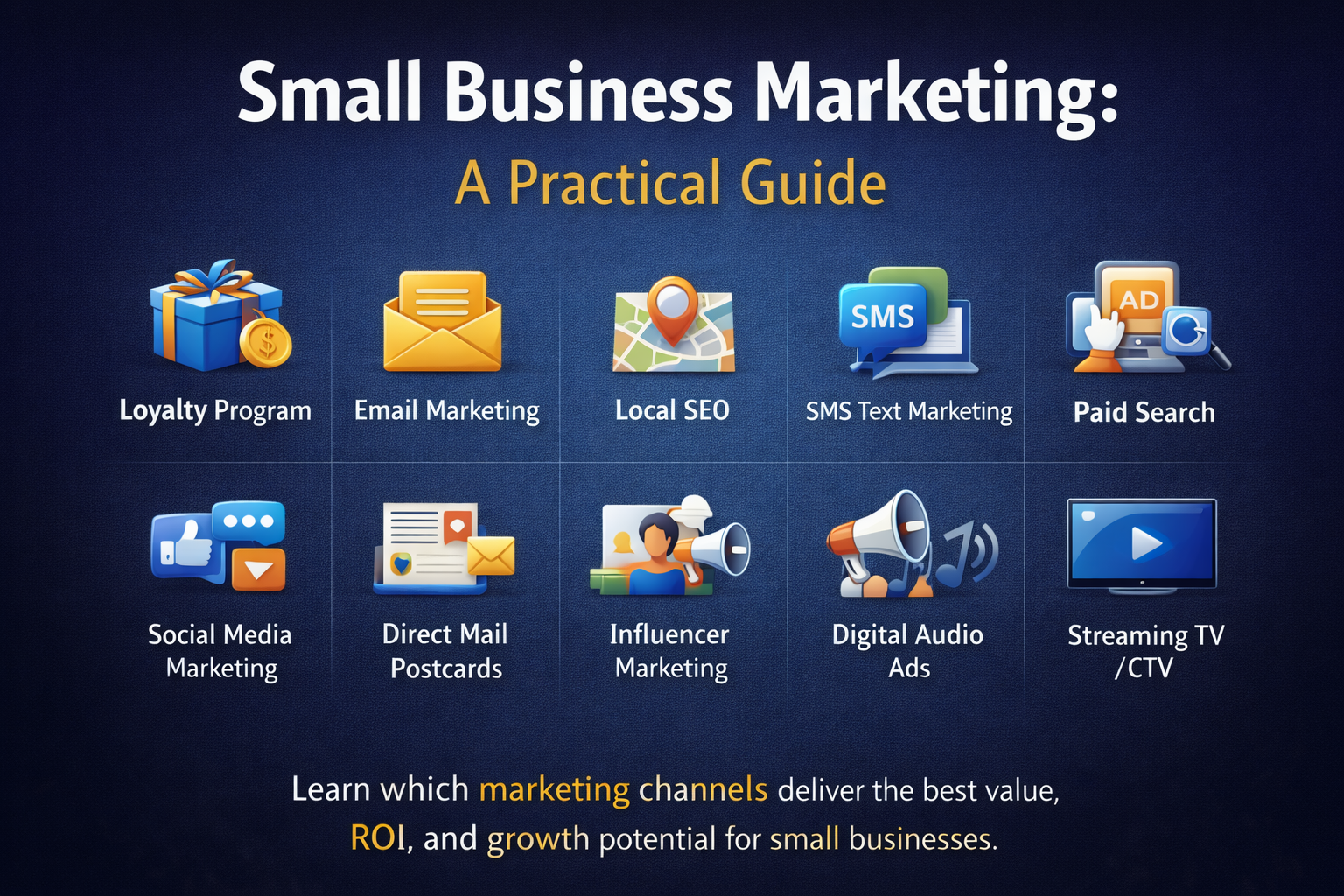
This guide ranks ten marketing channels by cost feasibility, expected ROI, new customer acquisition, impact on increasing business from existing customers, and overall bottom-line value. For loyalty programs, the endorsed solution is Preferred Patron’s small business loyalty platform. That is intentional. Preferred Patron gives small businesses a stronger retention engine than most point solutions because it combines digital stamp cards or points, built-in SMS and email, birthday and win-back automation, and a fast launch path without requiring a complex POS change. You can also review the broader loyalty feature set, compare editions on the pricing page, and use the FAQ page for rollout questions.
The goal of this guide is simple: help a small business marketer understand which channels deserve budget first, which ones work best together, and why loyalty should sit near the center of the stack rather than act as an afterthought.
How this guide ranks channels
Each channel is scored on a five-point scale across five criteria:
- Cost feasibility: How realistic the channel is for a typical small-business budget.
- Expected ROI: How likely the channel is to produce measurable return when executed reasonably well.
- New customer acquisition impact: How well the channel reaches and converts first-time buyers.
- Existing customer growth impact: How well the channel drives repeat visits, repeat purchases, and deeper customer value.
- Overall bottom-line impact: The combined effect of cost, measurability, and likely revenue influence.
Annual costs below are estimates for a typical small business, not guaranteed spend levels. Actual costs vary by list size, market competition, creative needs, geography, and how aggressively the business wants to grow.
Ranked channels from most viable to least viable for small business marketing
1. Loyalty program
Best-fit vendor: Preferred Patron Loyalty
Typical annual cost: $350 to $1,500+
Cost feasibility: 5/5
Expected ROI: 5/5
New customer acquisition: 3/5
Existing customer growth: 5/5
Bottom-line impact: 5/5
2. Email marketing
Best-fit vendor: Mailchimp
Typical annual cost: $156 to $1,200+
Cost feasibility: 5/5
Expected ROI: 4/5
New customer acquisition: 2/5
Existing customer growth: 5/5
Bottom-line impact: 4/5
3. Local SEO / Google Business Profile
Best-fit vendor: Google Business Profile
Typical annual cost: $0 to $720+
Cost feasibility: 5/5
Expected ROI: 4/5
New customer acquisition: 5/5
Existing customer growth: 2/5
Bottom-line impact: 4/5
4. SMS text marketing
Best-fit vendor: SimpleTexting
Typical annual cost: $400 to $2,400+
Cost feasibility: 4/5
Expected ROI: 4/5
New customer acquisition: 2/5
Existing customer growth: 5/5
Bottom-line impact: 4/5
5. Paid search
Best-fit vendor: Google Ads
Typical annual cost: $1,800 to $12,000+
Cost feasibility: 3/5
Expected ROI: 4/5
New customer acquisition: 5/5
Existing customer growth: 2/5
Bottom-line impact: 4/5
6. Social media marketing
Best-fit vendor: Meta Ads
Typical annual cost: $1,200 to $9,600+
Cost feasibility: 4/5
Expected ROI: 3/5
New customer acquisition: 4/5
Existing customer growth: 3/5
Bottom-line impact: 3/5
7. Direct mail postcards
Best-fit vendor: PostcardMania
Typical annual cost: $1,500 to $8,000+
Cost feasibility: 3/5
Expected ROI: 3/5
New customer acquisition: 4/5
Existing customer growth: 2/5
Bottom-line impact: 3/5
8. Influencer marketing
Best-fit vendor: Collabstr
Typical annual cost: $1,200 to $6,000+
Cost feasibility: 3/5
Expected ROI: 3/5
New customer acquisition: 3/5
Existing customer growth: 2/5
Bottom-line impact: 3/5
9. Digital audio ads
Best-fit vendor: Spotify Ads
Typical annual cost: $1,500 to $6,000+
Cost feasibility: 2/5
Expected ROI: 2/5
New customer acquisition: 3/5
Existing customer growth: 1/5
Bottom-line impact: 2/5
10. Streaming TV / CTV
Best-fit vendor: Disney Campaign Manager
Typical annual cost: $3,000 to $12,000+
Cost feasibility: 2/5
Expected ROI: 2/5
New customer acquisition: 3/5
Existing customer growth: 1/5
Bottom-line impact: 2/5
Why loyalty ranks first: it is one of the few channels that compounds over time. It strengthens retention, improves the performance of email and SMS, makes paid acquisition more efficient by giving new buyers a reason to return, and creates a more measurable path from first purchase to repeat revenue. That is why Preferred Patron for small business belongs at the top of the stack for most customer-facing businesses.
Channel-by-channel guide
1. Loyalty program
Best-fit vendor: Preferred Patron Loyalty
Estimated annual cost: $350 to $1,500+ for most small businesses
Loyalty is the most viable channel for many small businesses because it directly improves repeat business, average order value, and customer lifetime value. Preferred Patron’s small business platform gives merchants digital stamp cards or points-based rewards, birthday rewards, automated win-backs, built-in SMS and email, and a fast launch path without requiring a complex POS change. That combination makes it both a retention engine and a marketing coordination layer.
Loyalty is also one of the best complements to almost every other channel in this guide. Email works better when it is tied to loyalty status, points balance, or rewards reminders. SMS performs better when customers know there is a reason to return. Social and paid ads become more profitable when new customers enter a system designed to bring them back again. If you want the most practical place to start, begin with Preferred Patron’s small business loyalty programs, then review the full feature set, the pricing page, and the FAQ page.
Best at: repeat revenue, retention, list growth, segmentation, win-backs, and making other channels work harder.
2. Email marketing
Best-fit vendor: Mailchimp
Estimated annual cost: $156 to $1,200+
Email remains one of the most cost-feasible channels for small businesses because the platform cost is low and the message cost is effectively near zero once the list exists. It is ideal for newsletters, promotional campaigns, welcome flows, content updates, product education, seasonal launches, and simple reactivation sequences.
The tradeoff is that email rarely performs best in isolation. A list with weak segmentation, low-frequency buyers, or no loyalty hook often underperforms. That is why email usually works best when paired with a loyalty program. Preferred Patron is especially strong here because its small business plans already include built-in email and SMS, which can reduce tool sprawl for a small team.
Pros: low cost, high control, strong retention value, useful for newsletters and offers.
Tradeoffs: depends on list quality, open rates vary, and acquisition impact is limited unless it is fed by other channels.
3. Local SEO / Google Business Profile
Best-fit vendor: Google Business Profile
Estimated annual cost: $0 to $720+ if managed with optional tools
For most local small businesses, this is one of the most practical acquisition channels available. A Google Business Profile is free, shows up on Search and Maps, and captures high-intent customers who are already looking for a nearby solution. Optional tools such as Semrush Local can help with rank tracking and management, but the core listing itself is free.
Local SEO is not as strong as loyalty at driving revenue from existing customers, but it is often one of the best low-cost ways to capture new local demand. It deserves a top-three ranking for most service businesses, professional practices, home services, restaurants, and retail storefronts.
Pros: free entry point, high local intent, strong acquisition value, long-term visibility.
Tradeoffs: slower to compound than paid ads, more dependent on review quality and profile completeness, weaker as a retention channel.
4. SMS text marketing
Best-fit vendor: SimpleTexting
Estimated annual cost: $400 to $2,400+
SMS is one of the strongest channels for urgency, reminders, flash offers, and short lifecycle nudges. It is especially useful for appointment businesses, quick-return retailers, restaurants, health and beauty services, gyms, and local businesses that need fast action.
The biggest difference between SMS and email is timing. SMS is typically stronger for immediate action, while email is better for depth and longer-form communication. Like email, SMS performs best when it is attached to a loyalty framework. Preferred Patron already includes SMS and email in its pricing and ties those messages to loyalty events such as birthdays and win-backs, which can make it more effective than running texting as a disconnected broadcast tool.
Pros: fast response, strong for reminders and urgency, high retention value.
Tradeoffs: needs careful consent management, message fatigue can happen quickly, acquisition impact is limited without a lead source.
5. Paid search
Best-fit vendor: Google Ads
Estimated annual cost: $1,800 to $12,000+
Paid search is one of the strongest acquisition tools because it captures people who are already searching with intent. It is especially powerful for urgent needs, local services, healthcare, home services, legal, automotive, and any business where customers search before they buy.
The tradeoff is cost volatility. Search works when the economics of the business support paid acquisition. If customer retention is weak, paid search becomes much harder to justify. That is another reason loyalty belongs near the center of a small-business stack: when a business can retain more of the customers it acquires, search becomes far more profitable.
Pros: high intent, strong acquisition value, clear budget controls.
Tradeoffs: costs can rise fast in competitive categories, requires landing page and conversion discipline, weak on its own for retention.
6. Social media marketing
Best-fit vendor: Meta Ads
Estimated annual cost: $1,200 to $9,600+
Social media is often overused for awareness and underused for structured conversion. For small businesses, Meta is still the most practical social ad platform because it gives access to local targeting, creative testing, retargeting, and flexible budgets across Facebook and Instagram.
Social performs best when it supports a clear next step: join the loyalty program, book the appointment, claim the offer, sign up for the newsletter, or enter a seasonal campaign. Without that next step, businesses often end up paying for attention that never compounds. That is why social is usually more effective as a feeder channel into loyalty than as a standalone growth engine.
Pros: strong reach, flexible creative, good local targeting, useful for acquisition and remarketing.
Tradeoffs: creative fatigue is common, intent is lower than search, ROI varies heavily by execution.
7. Direct mail postcards
Best-fit vendor: PostcardMania
Estimated annual cost: $1,500 to $8,000+
Direct mail still works for many small businesses because it creates physical attention in a local market and can be tightly targeted by route or neighborhood. USPS Every Door Direct Mail remains one of the most practical mail options for local businesses because it does not require an address list and lets businesses target routes by geography and census-based filters.
Direct mail is usually strongest for local service businesses, med spas, clinics, home services, automotive, and businesses with a strong introductory offer. It also works better when the recipient is pushed into a retention system after the first visit. That is another reason loyalty matters. If a postcard brings in a first-time customer and nothing else happens, the business must keep paying to reacquire attention.
Pros: local targeting, tangible presence, can work well for neighborhood offers and grand openings.
Tradeoffs: printing and postage add up quickly, slower feedback loop, weaker for ongoing retention unless paired with loyalty, email, or SMS.
8. Influencer marketing
Best-fit vendor: Collabstr
Estimated annual cost: $1,200 to $6,000+
Influencer marketing can work for small businesses when the creator is locally relevant or highly trusted within a niche. It is often strongest for food and beverage, beauty, fitness, events, specialty retail, hospitality, and visually driven products.
The biggest mistake small businesses make is chasing follower count instead of fit. A small creator with strong local relevance can outperform a larger creator with weak audience alignment. Influencer campaigns work best when they drive a specific action such as joining a loyalty program, claiming a first-visit offer, or attending a launch event. Without that, the lift is often hard to measure.
Pros: social proof, local buzz, useful for launches and awareness spikes.
Tradeoffs: inconsistent performance, depends heavily on creator fit, harder to scale predictably than loyalty, email, or search.
9. Digital audio ads
Best-fit vendor: Spotify Ads
Estimated annual cost: $1,500 to $6,000+
Digital audio is the modern replacement for traditional local radio in this ranking because it is easier to buy, easier to target, and more accessible for small businesses. Spotify’s self-serve model is a good example of that.
Audio can build awareness and local familiarity, but it is rarely a first-budget channel for small businesses. It generally works best after a business already has strong basics in place such as local SEO, loyalty, email, and a clear landing experience.
Pros: more accessible than traditional radio, strong for local awareness and frequency.
Tradeoffs: weaker attribution, weaker retention value, not usually the first place a small business should invest.
10. Streaming TV / CTV
Best-fit vendor: Disney Campaign Manager
Estimated annual cost: $3,000 to $12,000+
Streaming TV is much more practical than traditional broadcast TV for small businesses because self-serve tools have lowered the entry barrier. Even so, it still sits near the bottom of the ranking because creative production, audience sizing, and attribution are harder for most small teams than channels like loyalty, email, and search.
CTV can make sense when a business has strong creative, a solid landing page, and a market large enough to support video reach. It is usually a scale channel, not a starting channel.
Pros: premium brand presence, local targeting is better than legacy TV, better entry point than broadcast TV.
Tradeoffs: higher creative burden, harder attribution, usually not a first-priority budget line for small businesses.
Best channel combinations for small businesses
The best starting stack for most local businesses
Loyalty + Email/SMS + Google Business Profile
This is the most practical starting stack for many small businesses because it covers both retention and local discovery. Loyalty gives customers a reason to return, email and SMS keep the business visible between visits, and Google Business Profile captures high-intent local searchers.
The best growth stack for businesses that need more new customers
Loyalty + Paid Search + Email/SMS
This mix works well when a business needs stronger acquisition but also wants to protect the economics of that spend. Search brings in demand. Loyalty and messaging make that demand more profitable over time.
The best brand-building stack for highly visual or community-driven businesses
Loyalty + Social + Influencers
This combination works well for food, beauty, wellness, apparel, events, and lifestyle-driven businesses. Social and creators create attention, but loyalty is what turns that attention into repeat revenue.
What to deprioritize first if budget is tight
For most small businesses, traditional local newspaper buying and traditional broadcast TV should be deprioritized before loyalty, email, local SEO, SMS, or search. They can still work in certain markets, but they are usually less measurable and less cost-feasible than the top-ranked channels in this guide.
Final thoughts
Small business marketing works best when you prioritize channels that compound.
That is why loyalty ranks first. It does not just drive its own results. It also makes email, SMS, search, social, and even direct mail more productive by giving customers a reason to come back and by helping you segment who should get which message next.
If you only remember one thing from this guide, make it this: most small businesses should build around a retention core first, then add acquisition channels with discipline. That is how you improve the bottom line instead of just increasing activity.
Want to put the strongest channel on the board first? Start with Preferred Patron’s small business loyalty programs, explore the broader loyalty platform capabilities, compare editions on the pricing page, and use the FAQ page to plan your rollout.
Small business marketing FAQ
What is the best marketing channel for a small business?
For most customer-facing small businesses, a loyalty program is the most practical channel to build around because it improves repeat business, increases customer lifetime value, and makes other channels such as email and SMS work harder.
Should a small business prioritize email or SMS?
Email is usually better for depth, newsletters, and longer-form promotions. SMS is better for urgency, reminders, and short action-driven campaigns. The strongest approach is usually to use both inside a broader retention system.
Is Google Business Profile more important than social media?
For many local small businesses, yes. A Google Business Profile captures nearby, high-intent searches, while social media often reaches people earlier in the decision cycle. Both matter, but Google Business Profile usually deserves budget and attention sooner.
Are direct mail postcards still worth it for small businesses?
They can be, especially for neighborhood targeting, local offers, and businesses with a clear first-visit incentive. They work best when new customers are then moved into a loyalty, email, or SMS program so the business can keep the relationship going.
Why does loyalty outrank paid acquisition in this guide?
Because loyalty changes the economics of growth. If a small business can bring customers back more often and spend more over time, every other acquisition channel becomes easier to justify and more profitable.