
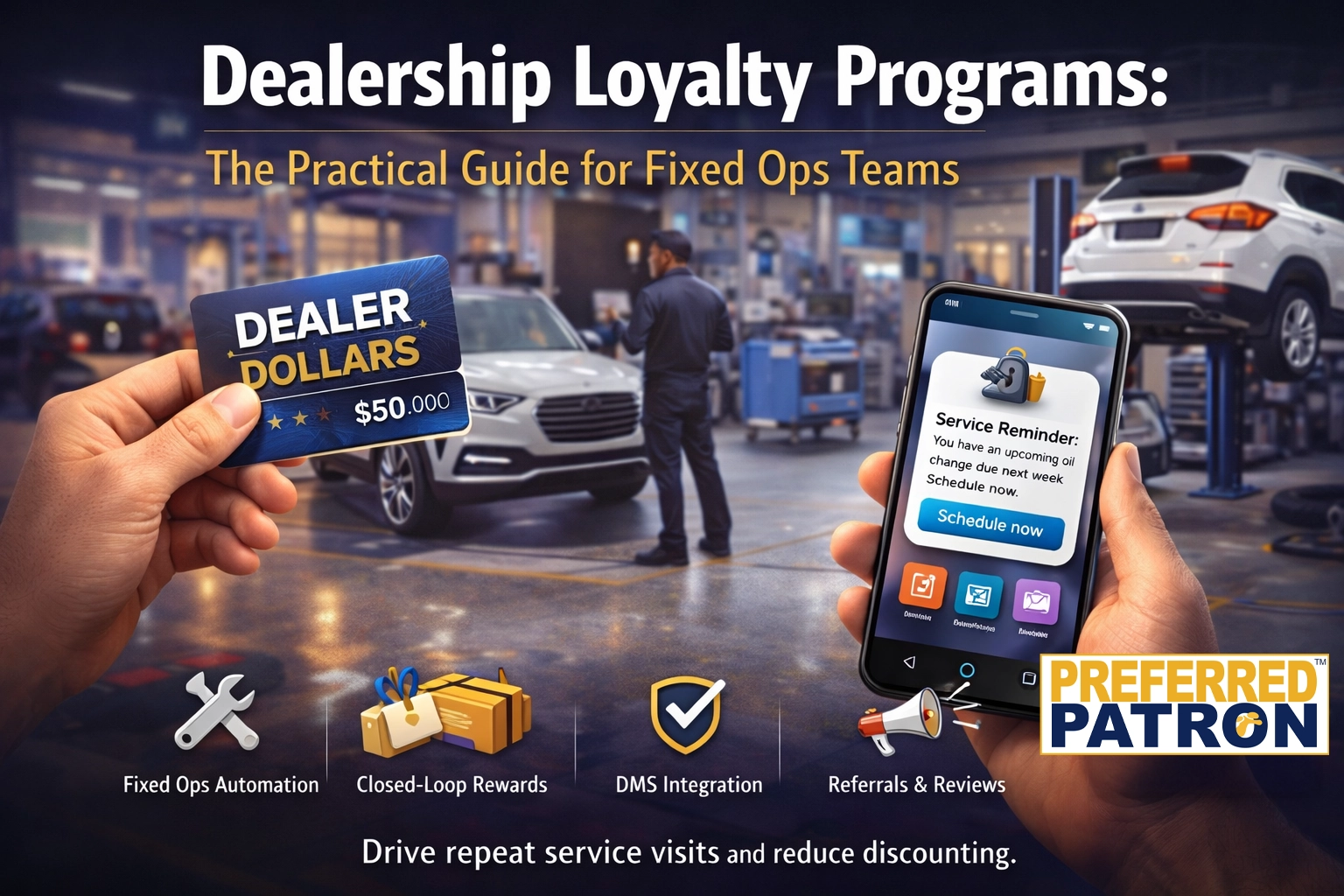
Dealership loyalty programs work best when they are built for Fixed Ops reality, not generic retail rewards.
Service departments are under constant pressure to increase RO frequency, improve customer-pay retention, bring post-warranty drivers back, and protect gross without falling into constant discounting. That is a very different challenge from simply handing out points.
For most dealerships, the real goal is not just launching a rewards program. It is creating a repeatable retention engine that keeps customers returning for maintenance, builds service habits, increases package utilization, and gives advisors better follow-up support without adding friction to the lane.
That is why dealership loyalty should be designed around service behavior, due reminders, presold maintenance, win-backs, closed-loop store credit, and measurable retention outcomes. If you want a platform built specifically for that environment, start with Preferred Patron’s dealership rewards program for service departments.
In this guide, we’ll walk through what makes dealership loyalty different, which program models work best in automotive service, what Fixed Ops leaders should look for in loyalty software, and why Preferred Patron is a strong fit for dealership groups that want more ROs without giving away gross.
Table of Contents
What is a dealership loyalty program?
A dealership loyalty program is a structured retention system that rewards customers for service, maintenance, referrals, reviews, test drives, vehicle purchases, or other dealership-defined actions that support long-term customer value.
In practice, dealership loyalty is most effective when it is centered on the service lane. That is because Fixed Ops drives repeat contact, strengthens post-sale relationships, and creates opportunities to keep customers in-house instead of losing them to independent shops after the warranty period.
A strong dealership rewards program should help you:
- increase RO frequency
- improve customer-pay retention
- bring lapsed service customers back sooner
- replace broad discounts with closed-loop value
- sell and track presold maintenance packages
- reward referrals, reviews, and loyalty milestones
- create more opportunities for service-to-sales lift
In other words, a dealership loyalty program should do more than issue rewards. It should give Fixed Ops teams a better way to influence return timing, customer behavior, and retention value over time.
Why dealership loyalty is different from ordinary rewards programs
Dealerships do not have the same retention rhythm as typical retail businesses.
A retailer may focus on the next transaction. A dealership service department needs to influence the next maintenance interval, the next due visit, the next package redemption, and the next decision about where the customer takes the vehicle for care. That is a different kind of loyalty challenge.
For dealerships, the best programs usually need to support:
- scheduled service return behavior
- presold maintenance package tracking
- due reminders tied to service cadence
- closed-loop rewards such as Dealer Dollars or service credits
- win-back automation for lapsed customers
- referrals, reviews, and milestone incentives
- optional service, sales, and test-drive earning rules
That is why generic points software often falls short in automotive. A dealership needs a loyalty platform that helps keep service work in-house, reduces script dependence for advisors, and supports repeatable follow-up around maintenance timing and customer lifecycle moments.
That also aligns with broader industry thinking. NADA emphasizes that service retention is critical for dealership success and points to multiple defection points in the service journey where loyalty is most at risk. NADA’s service-retention guidance reinforces why dealerships need a more structured retention strategy in Fixed Ops.
What the best dealership loyalty programs have in common
1. They reward service behavior without giving away gross
One of the biggest problems in dealership retention is over-reliance on discounts.
The strongest programs give customers a reason to return without training them to wait for the next coupon. That is where closed-loop rewards such as Dealer Dollars or service credits are especially valuable. They feel meaningful to the customer, but the value stays inside the store instead of leaking margin through cash discounts.
2. They make due visits easier to recover
Many customers do not leave the dealership because they are unhappy. They drift because nobody reached them at the right time.
A strong dealership loyalty program supports due reminders, maintenance follow-up, entitlement tracking, and win-back campaigns so customers are prompted to return before they become someone else’s service customer.
3. They create reasons to stay with the store after the sale
Post-warranty retention is where many dealerships feel the pain most clearly.
The best programs keep the store chosen by giving customers visible progress, package value, store-only rewards, and reasons to continue servicing with the dealership instead of shopping around after the original sale experience fades.
4. They reduce advisor friction
Loyalty should support the lane, not slow it down.
If advisors have to remember scripts, explain complex rules, or manage inconsistent follow-up manually, the program loses momentum. The best dealership loyalty programs automate reminders, acknowledgements, review requests, and win-backs so the experience stays consistent across advisors and rooftops.
5. They give Fixed Ops leaders metrics that actually matter
Dealership loyalty should not be judged only by enrollments.
The more useful questions are whether the program is increasing RO frequency, improving customer-pay return rate, driving package utilization, lifting review velocity, and creating more service-to-sales opportunities. Those are the signals that tell you whether loyalty is truly changing customer behavior.
Which loyalty models work best for Fixed Ops teams?
There is no single best model for every dealership. The right structure depends on your service mix, advisor process, retention goals, and whether you want to emphasize maintenance, closed-loop value, or broader lifecycle activity.
Dealer Dollars or service credits
For many dealerships, this is the most practical loyalty structure. Instead of relying on broad discounts, you issue dealership-branded value that customers can redeem only at your store. That creates urgency and perceived value without racing to the bottom on margin.
Presold service packages
Presold maintenance packages are one of the strongest dealership retention tools because they create a built-in reason to return. When the program can sell, track, and redeem bundled service items while also triggering due reminders, it becomes much easier to keep future service visits on schedule.
This works especially well for oil changes, tire rotations, inspections, detailing, and multi-visit maintenance bundles tied to vehicle ownership.
Points and boosters
Points still matter in automotive when they are flexible enough to reward the behaviors the dealership actually wants. Bonus multipliers, milestone rewards, and specific earning rules can help drive service spend, referrals, reviews, and timely return behavior without turning every interaction into a discount event.
Program tiers for long-term retention
Tiers are useful when the goal is to reward sustained loyalty rather than isolated visits. Bronze, Silver, and Gold structures can help customers feel progress, unlock higher-value perks, and create a stronger reason to keep more of their service business with the dealership.
Service-to-sales and test-drive incentives
Not every dealership wants loyalty limited to service. A stronger platform can also support rewards tied to test drives, purchases, or multi-program earning so service loyalty becomes part of a bigger dealership retention strategy.
How to build a dealership loyalty program that actually works
Step 1: Start with the retention problem you need to solve
Before choosing rewards, define the behavior you want to change.
Do you need more customer-pay maintenance? Better post-warranty retention? Higher package utilization? Faster return timing between ROs? More review volume? More referrals? More test-drive follow-up?
The best dealership loyalty programs are built around a specific Fixed Ops problem, not around a random list of perks.
Step 2: Choose a value structure that protects margin
If your current approach relies too heavily on discounting, move toward closed-loop value. Dealer Dollars, service credits, or loyalty cash-style store value help you reward action while keeping the economics inside the dealership.
Step 3: Add due reminders and win-backs early
A loyalty program is much stronger when it is connected to timing. Customers should be reminded when service is due, when packages still have value remaining, and when too much time has passed since the last RO. That is how loyalty starts influencing return timing instead of just sitting in the background.
Step 4: Use packages to lock in future visits
Presold service bundles create one of the clearest paths to repeat service behavior. When customers pre-buy maintenance, the dealership is no longer hoping for the next visit. It already has a reason to bring the customer back on schedule.
Step 5: Reward reviews, referrals, and milestones
Service loyalty should not stop at repair orders. Reviews, referrals, and milestone achievements are all meaningful behaviors that help strengthen customer value and social proof. Rewarding those actions helps the dealership create a more complete retention system.
Step 6: Measure the right outcomes
Track whether the program is increasing RO frequency, improving return rates, protecting gross, lifting review velocity, and reactivating lapsed customers. When those numbers move, loyalty is doing real work for the dealership.
What dealerships should look for in loyalty software
Choosing dealership loyalty software should start with operational fit, not generic feature lists.
The right platform should help you:
- support service-lane loyalty and customer-pay retention
- issue closed-loop Dealer Dollars or service credits
- sell, track, and redeem presold service packages
- run due reminders and timed win-back campaigns
- reward referrals, reviews, and milestones
- support service, sales, and test-drive accrual when needed
- launch without forcing a DMS replacement
- work with supported DMS integrations and grow into deeper integrations over time
- use SMS and email for consistent automated outreach
- support tiers, boosters, coupons, digital rewards, and multi-location growth
If you are comparing options, it helps to review the dealership-specific solution first, then the broader platform. Start with Preferred Patron for dealerships, then explore the full loyalty program features, compare plans on the pricing page, and use the loyalty FAQs if you want rollout and integration questions answered quickly.
Why Preferred Patron is a strong fit for dealership loyalty
Preferred Patron is a strong fit for dealerships because it is built around Fixed Ops retention, not generic consumer rewards.
For dealership service departments, it supports presold service packages, due reminders, Dealer Dollars, service credits, points, boosters, reviews, referrals, win-back automation, tiers, digital rewards, and service-lane outreach by SMS and email. It can also support broader dealership strategies through service, sales, and test-drive accrual options, depending on the program design.
Just as important, it does not require a DMS replacement to get started. Dealerships can launch with practical enrollment and earning workflows, then expand into supported DMS integrations, advanced rules, and multi-location coordination over time.
That gives Fixed Ops leaders a better way to build the kind of program they actually need:
- higher RO frequency without constant discounting
- better post-warranty customer retention
- more package utilization and due-visit recovery
- store-only value that keeps service in-house
- advisor-friendly automation instead of script dependence
- more measurable retention lift across rooftops
If your dealership wants a loyalty platform designed for service departments, Preferred Patron’s automotive dealership solution is the right place to start.
Final thoughts
Dealership loyalty programs work best when they are tied to the way service departments actually retain customers.
That means the strongest programs are not just about points. They are about due timing, package redemption, closed-loop value, advisor support, and smarter follow-up between visits.
For Fixed Ops leaders, the goal is not simply to launch a rewards program. It is to create a service retention system that increases customer-pay maintenance, keeps more work in-house, and protects gross while bringing customers back on schedule.
That is exactly where Preferred Patron fits best.
Want to turn service visits into repeat ROs? Explore Preferred Patron’s dealership rewards program, review the broader platform features, compare options on the pricing page, or use the FAQ page to get rollout questions answered.
Dealership loyalty program FAQ
What is the best loyalty program for a dealership service department?
The strongest dealership loyalty programs are built around Fixed Ops retention rather than generic retail discounts. In practice, that usually means a mix of closed-loop rewards, due reminders, presold maintenance packages, win-back automation, and measurable RO-focused outcomes.
Can dealerships use Dealer Dollars instead of discounts?
Yes. Many dealerships use Dealer Dollars or service credits because they give customers meaningful store-only value while helping the dealership avoid unnecessary cash discounting.
How do presold service packages help retention?
Presold maintenance packages create a built-in reason for customers to return. When the dealership can track redemptions and trigger due reminders, it becomes much easier to keep visits on schedule and reduce customer drift.
Do dealerships need to replace their DMS to launch a loyalty program?
No. A practical dealership loyalty platform should allow teams to launch without replacing their DMS, then add supported integrations and deeper automation as needed.
Can dealership loyalty support referrals, reviews, and test drives too?
Yes. A stronger dealership loyalty program can reward more than service spend. Reviews, referrals, test drives, and even broader sales-related activity can all be incorporated when they support the dealership’s retention strategy.