
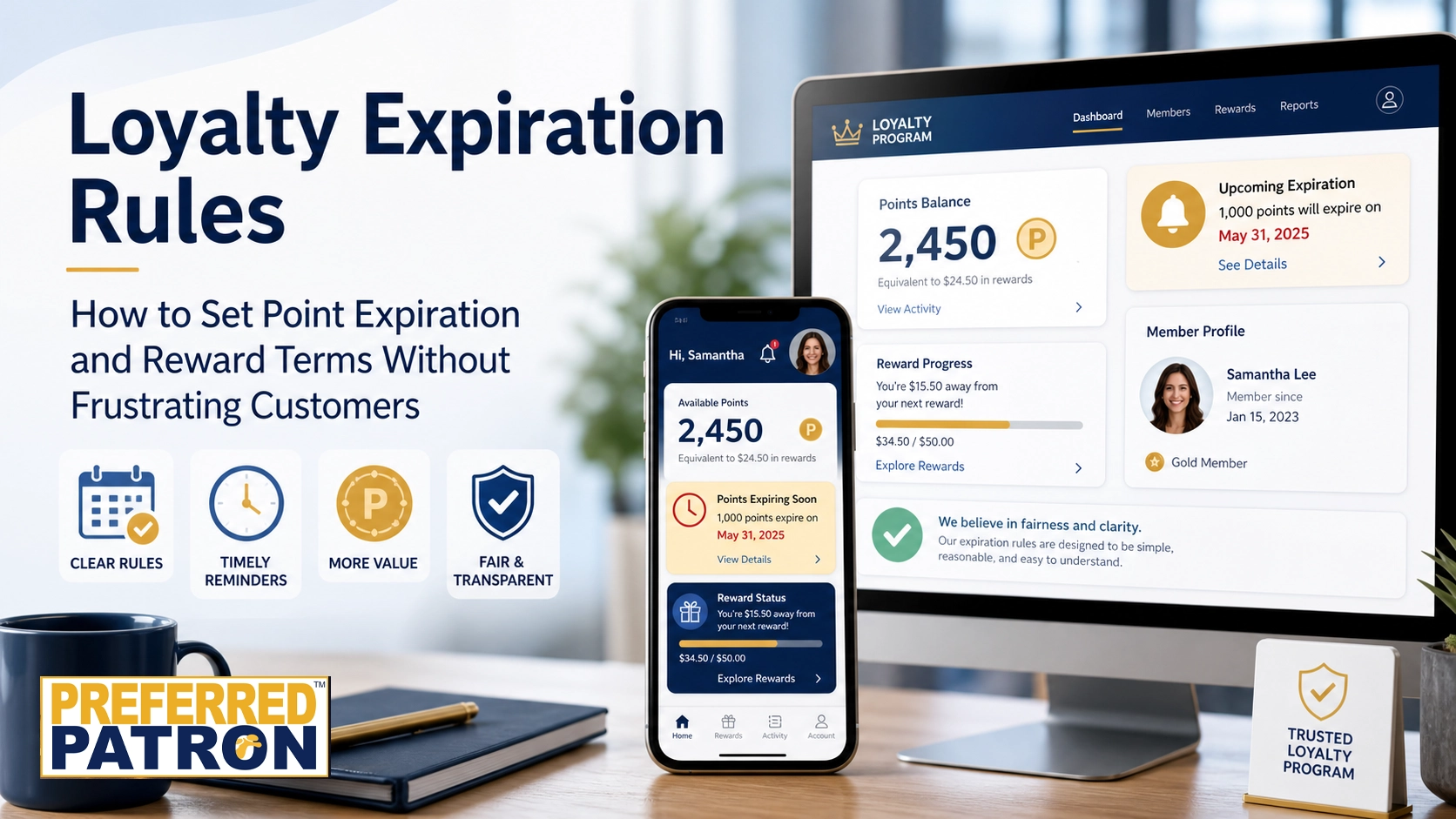
Loyalty expiration rules can help a program stay healthy, but handled badly, they can frustrate customers very quickly.
That is why the real issue is not whether points or rewards expire. The real issue is whether the loyalty expiration rules feel clear, fair, and easy for customers to understand.
Some businesses need point expiration and reward terms to manage liability, keep old balances from piling up, or encourage members to stay active. Those are valid reasons. But if the terms are vague, hidden, or communicated poorly, the trust damage can outweigh the business benefit.
Legal commentary on loyalty program risk often emphasizes clear, accessible program terms and conditions. That is a useful reminder that loyalty expiration rules should never come as a surprise to the customer.
That is why Preferred Patron is a strong fit. Preferred Patron’s platform supports points, tiers, rewards, automation, and business-rule management in a way that gives businesses more control over program structure while keeping communication and retention strategy connected.
In this guide, we’ll look at how to set loyalty expiration rules, when point expiration makes sense, how to reduce customer frustration, and why Preferred Patron helps businesses build rules that are easier to manage and easier to communicate.
Why loyalty expiration rules exist
Loyalty expiration rules usually exist for two reasons: program economics and member activity.
The business may want to keep old balances from sitting forever, and it may want to encourage members to stay engaged instead of disappearing after one visit.
Those are reasonable goals. The challenge is making sure the expiration policy supports the program without making customers feel tricked.
When loyalty expiration rules makes sense
Point expiration can make sense when the business needs a clean way to encourage regular activity or manage long-term outstanding balances.
It may also make sense in programs where points are meant to support recent, active behavior rather than permanent stored value.
The key is to make the timeline clear and the rule easy to understand from the start.
When loyalty expiration rules can backfire
Point expiration can backfire when the rule feels hidden, sudden, or too aggressive.
If a customer discovers that points disappeared without fair notice, the program can start to feel less like a reward and more like a trap. That kind of surprise can damage trust quickly.
This is especially true when loyalty expiration rules are buried in long terms or not reinforced through reminders and member messaging.
How to set fair loyalty expiration rules
The strongest loyalty expiration rules are simple, visible, and easy to explain.
Customers should know what expires, when it expires, what counts as activity, and how to keep value active if that option exists. Simpler rules are almost always better than complex ones.
Preferred Patron’s platform is well suited to this kind of rule management because it combines rewards logic, points structures, and customer communication, including templated point and offer expiration reminders, inside one system. To read more about the reward side of this, see Preferred Patron’s rewards program tools.
How to communicate reward terms clearly
Clear reward terms matter as much as the rule itself.
The terms should be visible at signup, easy to revisit later, and stated in ordinary language. Customers should not need to dig through fine print to understand how the program works.
This is where automation and loyalty messaging help. Clear reminders and easy access to balances make the rule feel more manageable and less surprising. For a broader look at how communication affects loyalty engagement, see The Psychology Behind Loyalty Programs and Why They Work.
How expiration reminders reduce frustration
Expiration reminders can do a lot to reduce frustration.
A well-timed reminder gives the customer a chance to use the value, make another visit, or understand what is about to happen before the expiration hits. That turns a negative surprise into a more transparent part of the program.
Preferred Patron’s automation tools are a strong fit here because they help businesses send time-based messages tied to customer activity and reward status. To read more about that workflow, see Preferred Patron’s marketing automation page.
What businesses get wrong with expiration policies
The biggest mistake is treating loyalty expiration rules as an internal accounting decision instead of a customer experience decision.
Another mistake is writing expiration policies that are technically valid but practically confusing. If the customer cannot tell what expires, when it expires, or how to avoid losing value, the program starts to feel unfair.
Businesses also get into trouble when they never review whether point expiration is actually helping retention. In some cases, a softer approach to reward terms can create a better long-term result. FTC business guidance is a useful general reminder that transparency and fair disclosure matter in customer-facing programs.
Why Preferred Patron is a strong fit
Preferred Patron is a strong fit because the platform gives businesses the tools to manage loyalty expiration rules without separating rule design from customer communication.
Preferred Patron combines points, rewards, tiers, automation, and reporting in one platform. That helps businesses set clear rules, remind customers before value expires, and keep the program focused on retention instead of confusion.
To read more about solution-specific information on this topic, see the Preferred Patron platform overview, the feature overview, the rewards page, and the pricing page.
Final thoughts
Loyalty expiration rules are not automatically bad. The problem starts when point expiration and reward terms feel confusing, hidden, or harsher than customers expect.
The strongest programs use loyalty expiration rules in a way that supports retention, protects trust, and keeps value clear. That means fair structure, simple communication, and timely reminders.
Preferred Patron helps businesses do that by connecting rule management, rewards, automation, and customer messaging in one system.
FAQ
What are loyalty expiration rules?
Loyalty expiration rules define when points, rewards, or related value expire in a loyalty program and what customers need to do to keep that value active.
When does point expiration make sense?
Point expiration can make sense when a business needs to manage long-term balances or encourage regular member activity, as long as the rule is clearly explained.
How do you reduce frustration around reward terms?
Use simple language, make the timeline visible, and send reminders before points or rewards expire so customers are not caught off guard.
How does Preferred Patron help with expiration policies?
Preferred Patron helps businesses manage loyalty expiration rules through points, rewards, automation, messaging, and reporting in one connected platform.