
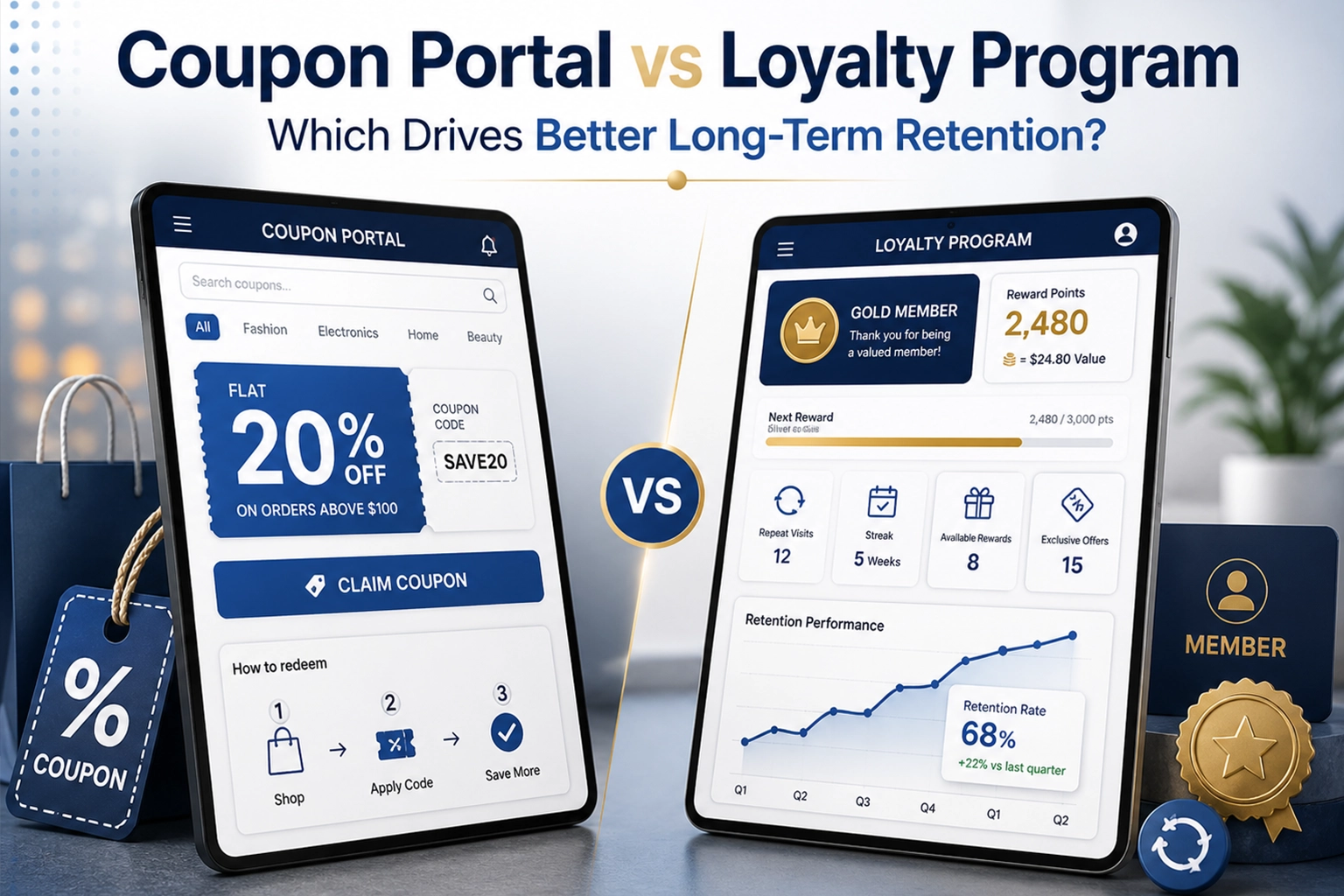
A coupon portal vs loyalty program comparison is really a question about customer acquisition vs long-term retention.
Both can help a business grow, but they do different jobs. A coupon portal is usually built to attract attention, generate claims, and drive first visits. A loyalty program is built to bring customers back, increase repeat behavior, and grow customer value over time.
That difference matters because many businesses still treat discounts, coupon claims, and retention strategy like the same thing. They are not. One helps create initial traffic. The other helps turn that traffic into a stronger long-term relationship.
Bain’s retention perspective is useful here because it highlights the value of keeping customers active over time instead of focusing only on acquisition bursts.
That is why Preferred Patron is a strong fit for this comparison. Preferred Patron offers Community Deals as a coupon-only portal with on-phone claim and redemption, and it also offers Patron Connect as a loyalty program with loyalty cash and/or points with rewards. That gives businesses a practical way to use the right model for the right goal, or connect both when it makes sense.
In this guide, we’ll break down coupon portal vs loyalty program strategy, where each model works best, which one drives better long-term retention, and how Preferred Patron helps businesses move from customer acquisition into measurable repeat business.
Coupon portal vs loyalty program: what each does best
A coupon portal does best when the goal is visibility, trial, and short-term action.
It is good at helping customers discover an offer, claim it quickly, and redeem it with very little friction. That can be useful for local awareness, community programs, seasonal traffic, and first-time visits.
A loyalty program does best when the goal is repeat behavior, stronger customer relationships, and better long-term retention. It helps businesses reward return visits, increase average spend, keep members engaged between purchases, and measure whether the program is creating more customer value over time.
Preferred Patron supports both models clearly. Community Deals is a coupon-only portal where customers browse deals, claim an offer by mobile number, and redeem on-phone without needing cashier software. Patron Connect supports loyalty cash and/or points with rewards, member recognition, email and SMS messaging, and one shared member base across participating merchants.
Why coupon portals and loyalty programs are not the same
Coupon portals and loyalty programs are not the same because they create different customer behavior.
A coupon portal is often built around a single offer. The customer sees a deal, claims it, and redeems it. That can be very effective for driving action now.
A loyalty program works differently. It gives the customer a reason to come back again, earn more, redeem later, and stay connected to the brand beyond one visit.
That means a coupon portal vs loyalty program decision should be judged by different success measures.
When a coupon portal makes sense
A coupon portal makes sense when a business needs reach, awareness, and a low-friction first action.
It can work especially well for community programs, local campaigns, merchant networks, and businesses that want to create fast customer traffic without asking the shopper to understand a full rewards program on the first visit.
That is where Community Deals is useful. It gives agencies and community programs a white-label coupon path that is easy to claim and redeem on-phone, and it can work without cashier software. To read more about that solution-specific path, see the marketing agency and community programs page.
When a loyalty program makes sense
A loyalty program makes sense when the goal is to keep customers active over time instead of simply creating a one-time response.
That is especially important when repeat visits, repeat purchases, customer lifetime value, and ongoing communication matter more than one claimed discount.
Preferred Patron’s broader loyalty platform is designed around exactly that. It supports points, tiers, digital stamp cards, rewards, automated email and SMS, and reporting that ties campaigns back to visits, spend, and repeat behavior.
Shopify’s retention guide is another useful outside reminder that repeat behavior and customer retention need their own strategy beyond first-purchase promotions.
Coupon portal vs loyalty program for retention
A loyalty program usually drives better long-term retention than a coupon portal because it is built for the relationship after the first visit.
A coupon portal can create a useful first step, but a claimed deal is not the same as a retained customer. A loyalty program is better at building repeat behavior because it gives customers a reason to return, progress, earn, and stay engaged.
This is where the retention economics matter. A coupon portal vs loyalty program comparison should not stop at claim rate or redemptions. It should ask which model creates more repeat behavior and stronger customer value over time.
How coupon portals and loyalty programs can work together
Coupon portals and loyalty programs can work well together when one feeds the other.
A coupon portal can attract the first visit. A loyalty program can take over after the first redemption and give the customer a reason to return again. That is a much stronger strategy than asking one tool to do both jobs badly.
Preferred Patron is especially strong here because Community Deals and Patron Connect can operate within one shared member base across participating merchants. That makes it easier to move from acquisition into retention without treating them like disconnected systems.
What businesses get wrong
The biggest mistake is assuming that a high claim rate means strong retention.
Another mistake is using discounts as a long-term relationship strategy when they are really only driving short-term behavior. A business may get attention from a deal and still fail to build repeat behavior if nothing meaningful happens after redemption.
Businesses also get into trouble when they compare coupon portals vs loyalty programs only by immediate traffic instead of by customer value over time.
Why Preferred Patron is a strong fit
Preferred Patron is a strong fit because it supports both sides of the comparison without confusing the two jobs.
Preferred Patron offers Community Deals for coupon-led acquisition and Patron Connect for loyalty-led retention. That makes it possible to choose the right model for the goal or connect both when the business wants an acquisition-to-retention path instead of a one-step promotion.
To read more about solution-specific information on this topic, see the marketing agency and community programs page, the platform overview, the feature page, and the pricing page.
Final thoughts
Coupon portal vs loyalty program is not really a question of which one is always better.
It is a question of what the business is trying to accomplish. Coupon portals are often better for fast awareness and first action. Loyalty programs are usually better for repeat behavior and long-term retention.
That is why Preferred Patron is such a strong fit. It gives businesses a practical way to use acquisition and retention tools more intentionally instead of expecting one model to do everything.
FAQ
What is the difference between a coupon portal and a loyalty program?
A coupon portal is usually built to drive claims and first visits, while a loyalty program is built to drive repeat visits, ongoing engagement, and stronger retention.
Do coupon portals help with long-term retention?
They can help with first action, but by themselves they are usually weaker than loyalty programs at driving long-term retention.
When should a business use a coupon portal?
A coupon portal makes sense when the goal is local awareness, fast claims, community deal campaigns, or low-friction first visits.
How does Preferred Patron help with both models?
Preferred Patron offers Community Deals for coupon-led acquisition and Patron Connect for loyalty-led retention, giving businesses a way to use both models more intentionally.