
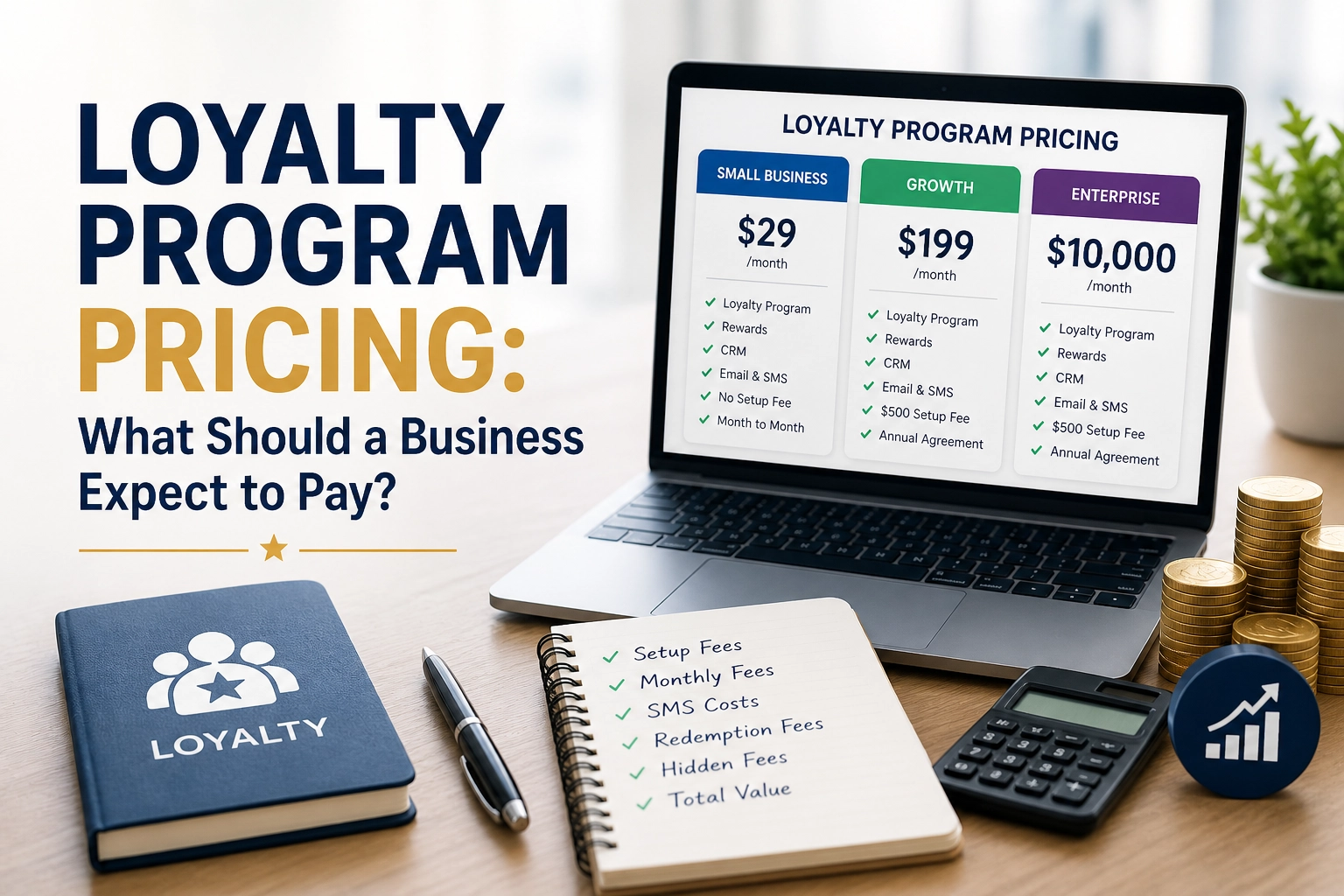
Loyalty program pricing can look simple at first, but the real cost is often more than the number on the top line.
That is why buyers need to look past the sticker price. A loyalty platform may look cheap at first and then become expensive once setup fees, SMS charges, add-ons, support limits, or redemption costs start to show up.
The right question is not just “What is the monthly fee?” The better question is “What will this loyalty program really cost my business, and what do I get for that cost?”
That is where Preferred Patron stands out. Preferred Patron’s platform is built around clear pricing, broad included features, and strong retention value. It gives businesses a way to compare loyalty program pricing based on real business outcomes, not just low entry pricing that gets more expensive later.
In this guide, we’ll break down loyalty program pricing, what a business should expect to pay, which costs matter most, where hidden fees often show up, and why Preferred Patron is a strong fit for businesses that want a better answer than “it depends.”
Why loyalty program pricing matters
Loyalty program pricing matters because cost affects more than budget. It affects what your team can launch, how fast you can grow, and whether the platform still fits once your member base gets larger.
A low monthly fee can look attractive, but it may not stay low if the platform charges for redemptions, transactions, support, SMS, or key features that most businesses need in real life.
This is why good buyers do not compare software on price alone. Capterra’s 2026 SaaS buying guide warns buyers not to focus only on subscription price and to account for implementation, training, integrations, and overages as part of total cost. Capterra’s software buying guide is a good outside reminder that the sticker price is rarely the full cost.
What drives loyalty program pricing
Loyalty program pricing is usually shaped by a few key things: business size, number of locations, feature depth, message volume, onboarding needs, and support level.
A simple single-location business may only need the core loyalty stack. A growing brand may need stronger promotions, better reporting, multi-location control, and more automation. An enterprise team may need higher volume support, wider location capacity, deeper controls, and more custom planning.
That is why Preferred Patron uses edition-based pricing instead of one flat plan for everyone. If you want the full view, start with the Preferred Patron pricing page and the feature comparison page.
Setup fees and onboarding costs
One of the first things buyers should ask about loyalty program pricing is setup cost.
Some loyalty vendors charge nothing to get started. Others charge a one-time onboarding or implementation fee. That fee may cover account creation, initial configuration, member onboarding, training, and launch support.
Preferred Patron is clear about this. Small Business plans have no setup fee. Growth and Enterprise plans currently have a one-time $500 setup fee tied to setup, onboarding, and training. That is useful because it helps buyers know what to expect instead of finding out after the contract starts.
Setup fees are not always a bad sign. In some cases, they reflect real onboarding work. The key is whether the fee is clearly stated and whether the business gets real value from it.
Monthly loyalty program pricing
Monthly loyalty program pricing is the number most buyers look at first, and it is still important.
At the time of writing, Preferred Patron’s pricing starts at $29 per month for Small Business, $199 per month for Growth, and $10,000 per month for Enterprise, with editions designed around business size and program scale. The pricing page also notes that Small Business is month to month, while Growth and Enterprise shown prices reflect annual-agreement pricing paid monthly.
That range is useful because it shows a realistic truth about loyalty software: the right cost depends on the business stage. A local business does not need enterprise pricing. A large multi-location organization should not expect small-business pricing.
The more important question is whether the monthly fee includes the tools your business actually needs to run the program well.
Redemption fees and transaction fees
This is one of the easiest places for loyalty program pricing to get expensive.
Some loyalty platforms look affordable until they start charging each time a reward is redeemed or each time the system processes qualifying activity. That can turn growth into a penalty. The more the program works, the more the business pays.
There is another pricing model buyers should watch closely: catalog-based programs where the merchant effectively funds points as they are issued and a third party handles redemption through a supplied reward catalog. In models like this, the business can end up paying for points at the time they are awarded, whether those points are ever redeemed or not. That matters because a meaningful share of points in many programs can go unused, sit idle for long periods, or disappear under expiration rules, which means the merchant may carry real program cost without getting a matching customer redemption moment.
Catalog-style reward programs can still look appealing because the reward selection feels broad. For example, offering a large third-party catalog structure buyers often find attractive, with gift cards, travel, donations, and mixed point-plus-cash redemption options. But the real buyer question is not just “How big is the catalog?” It is “When does the merchant incur cost, and does unused point liability create waste?”
Preferred Patron gives businesses more control over that equation. A mix of internally sourced rewards can carry high perceived value with low procurement cost, while externally fulfilled digital rewards can be offered at face value with no markup imposed. In practical terms, a $50 gift card costs the merchant $50 in procurement, not an inflated catalog price. That makes program economics easier to understand and helps businesses compare loyalty program pricing based on real cost instead of point-liability guesswork.
Preferred Patron also avoids per-transaction and redemption fees, which makes cost more predictable as the program grows. For a business that expects real member activity, this can make a major difference in long-term loyalty program pricing.
SMS costs and message costs
SMS is one of the most common areas where buyers get confused about loyalty program pricing.
Many businesses now expect built-in text marketing and automated messaging as part of a modern loyalty platform. But the details matter. Some platforms include basic messaging and charge extra for higher-volume texting, while others make SMS a separate add-on from the start.
Preferred Patron’s pricing page says every edition includes unlimited transactional SMS plus a sufficient volume of automated marketing email and SMS credits. At the same time, excessively high volume bulk SMS senders have the option to purchase an extended SMS plan, often at discounted pricing. That is exactly the kind of detail buyers should ask about early, because message volume can change the real cost of the program.
The right buyer question is not just “Does SMS exist?” It is “What kind of SMS is included, what scales separately, and how will that affect my real monthly cost?”
How to compare loyalty program pricing the right way
The smartest way to compare loyalty program pricing is to compare value, not just the monthly fee.
Ask these questions:
- Does the plan include the core loyalty tools I actually need?
- Are rewards, CRM, and automation included, or are they add-ons?
- Are there setup fees?
- Are there per-transaction or redemption fees?
- How is SMS priced?
- Are support and training included?
- Will the pricing still make sense when my member base grows?
This is where Preferred Patron compares well. Every edition includes loyalty, rewards, CRM, and automated email/SMS, which means buyers do not have to build the basic system from paid add-ons. If you want a broader feature view, use the feature overview.
What businesses should expect to pay
The simplest answer is this: a small business should expect a modern loyalty platform to cost tens of dollars per month at the low end, a growing multi-location brand should expect a few hundred dollars per month or more, and a large enterprise team should expect a much higher price tied to scale and complexity.
But the range alone is not the full answer. Businesses should also expect possible setup costs, message-related costs, and optional add-ons if they need more advanced workflows.
As a current example, Preferred Patron’s pricing starts at $29 per month for Small Business, with no setup fee on that edition, while Growth starts at $199 per month and Enterprise starts at $10,000 per month, with setup fees for Growth and Enterprise. That gives buyers a clear example of how loyalty program pricing can scale with business size and support needs.
For many businesses, the better question is not “What is the cheapest plan?” It is “Which edition gives me the best return for the stage I am in right now?”
Why Preferred Patron is a strong fit
Preferred Patron is a strong fit because it gives buyers a clearer and more useful answer to loyalty program pricing than many platforms do.
Preferred Patron’s pricing is structured by business size and use case. Every edition includes loyalty, rewards, CRM, and automated email/SMS. The platform also avoids per-transaction and redemption fees, which makes cost easier to predict as the program grows.
Just as important, Preferred Patron does not ask businesses to choose between price and capability. The platform supports points, tiers, digital stamp cards, rewards, promotions, marketing automation, SMS, mobile access, and reporting in one system. That gives buyers more real value inside the subscription instead of forcing them to piece together the platform from extra modules.
If you want to compare this against broader market options, the natural next read is your Top 10 Customer Loyalty Software Programs for 2026 post, followed by the pricing page and the FAQ page.
Final thoughts
Loyalty program pricing should be easy to understand and easy to compare.
The best buyers do not stop at the monthly fee. They look at setup, SMS, support, included features, transaction costs, redemption costs, and long-term fit. That is how they avoid false bargains and choose a platform that will still make sense after the program grows.
That is why Preferred Patron is a strong fit. Preferred Patron helps businesses compare loyalty program pricing based on real value, broad included features, and clearer long-term cost.
Want a clearer view of loyalty program pricing for your business? Start with the Preferred Patron pricing page, compare editions on the comparison page, review the feature overview, and use the FAQ page for rollout questions.
FAQ
What is loyalty program pricing?
Loyalty program pricing is the full cost of running a loyalty platform, including subscription fees, setup fees, SMS costs, add-ons, and any other charges tied to launch and use.
Do loyalty programs usually have setup fees?
Some do and some do not. Buyers should always ask whether setup, onboarding, training, or launch support is included or billed separately.
Do loyalty platforms charge redemption fees?
Some do. That is why businesses should always ask whether the platform charges per transaction or per reward redemption, especially if they expect high member activity.
Is SMS usually included in loyalty program pricing?
Not always. Some platforms include basic SMS tools while charging separately for higher-volume or bulk text messaging.
How does Preferred Patron handle loyalty program pricing?
Preferred Patron uses edition-based pricing by business size, includes loyalty, rewards, CRM, and automated email/SMS in every edition, and does not charge per transaction or redemption fees.