
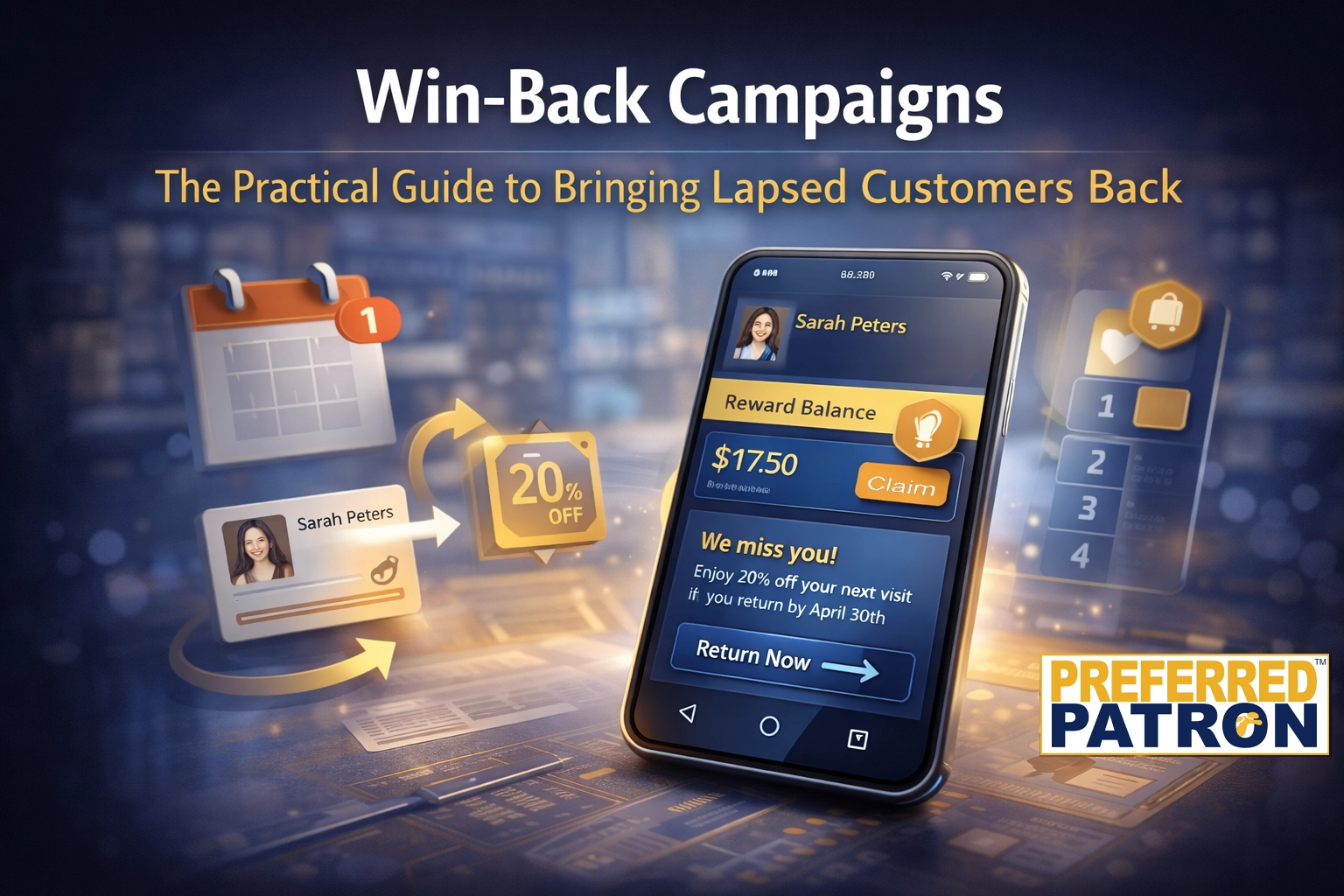
Win-back campaigns are one of the most practical ways to reactivate lapsed customers, increase repeat visits, and recover revenue that would otherwise drift to competitors.
That matters because many customers do not leave for dramatic reasons. They lapse because life gets busy, another option is more visible in the moment, they forget the value of your brand, or no one gives them a compelling reason to return. In other words, a large share of churn is not permanent rejection. It is preventable drift.
The economics behind this are hard to ignore. Bain’s well-known retention research found that even a 5% improvement in customer retention can increase profits by 25% to 95%, which helps explain why bringing existing customers back is often more efficient than relying only on new acquisition. Bain’s retention research remains one of the clearest reminders that small retention gains can have an outsized financial impact.
That is exactly why win-back campaigns matter so much. A strong reactivation program gives businesses a structured way to identify inactivity, reach customers at the right moment, make the next visit feel worthwhile, and measure whether the outreach is actually changing behavior. And that is where Preferred Patron Loyalty is a strong fit. Preferred Patron combines rewards, promotions, automated SMS/email, mobile member access, and retention reporting in one platform so businesses can build win-back campaigns that are timely, trackable, and designed to bring customers back without turning marketing into always discounting.
In this guide, we’ll break down why customers lapse, the psychology behind bringing them back, what types of win-back campaigns work best, how often to contact lapsed customers, when to use SMS versus email, what businesses lose when they do nothing, and why Preferred Patron is a smart platform for putting all of it into action.
What is a win-back campaign?
A win-back campaign is a structured reactivation effort designed to bring lapsed customers back after a period of inactivity.
That inactivity window can vary by business. A café may consider someone lapsed after 30 days. A retailer may wait 60 or 90 days. A service business may define lapsed customers around expected return timing, seasonal use, or appointment cadence. The point is not to use a generic number. The point is to identify when a customer has fallen outside their normal behavior and then respond before the relationship fades further.
A strong win-back campaign usually includes three things: a clear trigger for inactivity, a timely message, and a reason to return. That reason may be an offer, a reminder of value, a balance notice, a limited-time perk, a birthday or anniversary touchpoint, or simply a well-timed message that makes the next action easy.
Why customers lapse in the first place
Most lapsed customers do not disappear because of a single catastrophic moment. More often, they lapse because nothing pulled them back soon enough.
Customers stop visiting when your brand slips out of their active consideration set. That can happen because competitors are more visible, habits are broken, value is forgotten, another option is more convenient, or there was no timely reminder that made returning feel worthwhile. In many businesses, the customer did not make a formal decision to leave. They just stopped choosing you.
That is why reactivation should be treated as a real retention discipline rather than an occasional “we miss you” email. McKinsey’s personalization research found that consumers increasingly expect relevance in how brands communicate with them, and frustration rises when interactions feel generic or disconnected from behavior. McKinsey’s research on personalization is especially useful here because it reinforces that relevance, timing, and offer fit matter more than generic blasts.
The psychology behind win-back campaigns
1. Salience matters more than many businesses think
Customers are more likely to return when your business becomes mentally available again at the right moment.
A well-timed win-back campaign restores salience. It puts your brand back in front of the customer before a competitor captures the next decision. That may sound simple, but it has real psychological weight. People often choose what is easiest to remember, easiest to act on, and most visible in the moment.
2. Progress and balances create return momentum
Loyalty programs become especially useful in win-back campaigns because they give customers a concrete reason to come back.
Research on the endowed progress effect and the goal-gradient hypothesis shows that people work harder when they feel they have already started and when a goal feels close. That means a lapsed customer with visible points, available rewards, or progress toward the next threshold often has a much stronger reason to return than a customer who is simply told “come back soon.”
3. Relevance lowers friction
A win-back campaign works better when it feels like it was meant for the customer, not for everyone.
That could mean referencing inactivity, a prior category preference, a reward balance, a birthday, a membership tier, or a specific type of visit pattern. Relevance reduces mental effort. It helps the message feel useful instead of intrusive. This is one reason segmented win-back campaigns usually outperform generic promotions.
4. Urgency helps, but only when it is believable
Customers are more likely to act when there is a clear reason to act now rather than later.
That is why limited redemption windows, expiring points, short-term bonus offers, and threshold reminders often work so well in win-back campaigns. The key is to create real urgency without sounding artificial. A message that feels credible and time-bound can push a drifting customer back into action.
What types of win-back campaigns work best?
Reward-balance win-back campaigns
One of the strongest reactivation triggers is reminding a lapsed customer that they already have value waiting.
Available points, stored value, loyalty cash, tier progress, or unused offers all create a psychological nudge because the customer is no longer starting from zero. Preferred Patron is especially strong here because its loyalty platform supports rewards visibility, points, promotions, tiers, and member balances that can be turned into compelling win-back reminders.
Milestone and threshold win-back campaigns
If a customer is close to a reward, close to a tier, or close to completing a challenge, that is a powerful moment for reactivation.
These campaigns work because they transform the return visit into progress, not just another transaction. The closer the milestone feels, the stronger the reactivation pull usually becomes.
Personalized offer win-back campaigns
Not every lapsed customer needs the same incentive.
Some customers respond to a reward reminder. Others need a time-limited promotion. Others may respond better to a simple return invitation tied to what they previously liked or how they used the brand. Personalized win-back campaigns are often more effective because they reflect customer history instead of treating all churn risk the same way.
Birthday and anniversary win-back campaigns
Lifecycle moments can be especially effective for reactivation because they feel timely and naturally relevant.
Preferred Patron already supports automated birthday and milestone outreach as part of its broader messaging and automation stack, which makes these campaigns especially easy to operationalize through marketing automation.
Review-and-return or referral-and-return campaigns
Sometimes the best reactivation path is not just “come back.” It is “reconnect with the brand.”
For some businesses, a light-touch request for a review, referral, or participation action can restart engagement and make a later return offer more effective. This works best when the customer previously had a positive experience but simply drifted away.
Timing, frequency, and channel strategy for win-back campaigns
When should a win-back campaign start?
The best timing depends on the business model, but the rule is consistent: launch the win-back campaign after meaningful inactivity, not after permanent churn.
That means businesses should define a realistic inactivity threshold based on normal customer behavior and then trigger outreach early enough to interrupt drift. Waiting too long often means the customer has already formed a new habit elsewhere.
How often should you contact lapsed customers?
Most businesses do better with a short, intentional sequence than with one lonely message or constant promotions.
A strong win-back flow often includes an initial reactivation message, a follow-up reminder, and then a final urgency or balance-based prompt if the customer still has not returned. The point is not high frequency. The point is sequential relevance.
There is useful evidence here too. A field study on push messaging in loyalty programs found that messages improved spending and reward redemption relative to a control group, with different timing effects depending on whether the objective was earning or redemption. That suggests outreach cadence should be matched to the campaign goal, not treated as one-size-fits-all.
When should you use email versus SMS?
Email works well when the message needs a little more explanation, more visual space, or a slightly less urgent tone. SMS works well when the offer is time-sensitive, the call to action is simple, or the business needs fast visibility.
Many of the strongest win-back campaigns use both. Email can reintroduce the value proposition, and SMS can reinforce urgency closer to the action window. Preferred Patron supports both branded email and SMS, plus automated triggers and segmentation, which makes that coordination much easier to manage from one system.
What businesses lose when they do not run win-back campaigns
Businesses that do not run win-back campaigns usually underestimate how much revenue is quietly leaking away.
Without a structured reactivation strategy, lapsed customers are left to drift indefinitely. That means no timely reminder, no incentive to return, no visible reward progress, no reason to choose your brand over a competitor, and no clear reporting on whether lost customers could have been saved.
That absence shows up in the bottom line. When returning customers lapse, the business loses future visits, future margin, future referrals, and future lifetime value. It also becomes more dependent on acquisition spending and broader discounting to fill the gap. Bain’s retention research is useful here again because it shows why even modest retention gains can materially improve profitability.
How to build a win-back campaign program that actually works
Step 1: Define what “lapsed” means for your business
Start with real customer behavior, not a borrowed number from another industry.
Map the typical return window, then identify when a customer has gone meaningfully beyond it. That is your reactivation trigger.
Step 2: Segment lapsed customers by likely response
Not all inactive customers are equal.
Some were top customers who simply stopped showing up. Some were one-time buyers. Some still have reward value waiting. Some are close to a threshold. Some respond to convenience and others to urgency. Segmenting them creates much better win-back campaigns than treating all lapsed customers the same.
Step 3: Choose an offer or message that matches the reason to return
The best win-back message usually gives the customer one clear reason to act now.
That might be a reward balance reminder, a time-limited promotion, a tier nudge, a birthday touchpoint, a milestone offer, or a simple reminder that the brand is still relevant. The key is that the offer should fit the customer and the context.
Step 4: Automate the sequence
Manual reactivation efforts usually become inconsistent very quickly.
This is where Preferred Patron becomes especially useful. Through marketing automation, businesses can trigger win-back campaigns automatically, coordinate SMS and email, personalize offers, and keep the outreach consistent without forcing staff to remember every follow-up step.
Step 5: Make the return path easy
If the reactivation message creates friction, response drops.
Customers should be able to understand the offer quickly, see their value clearly, and act with as little effort as possible. Preferred Patron’s mobile member portal helps here by giving customers a convenient place to view rewards, balances, consent preferences, and digital value between visits.
Step 6: Measure real reactivation, not just opens and clicks
Open rates are useful, but they are not the final goal.
The most important question is whether win-back campaigns actually bring lapsed customers back and whether those customers continue returning afterward. Preferred Patron’s reporting is designed to tie campaigns back to visits, spend, and repeat behavior, which is exactly what businesses need if they want to evaluate reactivation seriously.
Why Preferred Patron is a strong fit for win-back campaigns
Preferred Patron is a strong fit for win-back campaigns because it combines the parts of reactivation that most businesses otherwise split across multiple tools.
It supports points, rewards, promotions, tiers, branded email and SMS, marketing automation, mobile member access, and reporting in one platform. That means businesses can define inactivity, trigger automated outreach, personalize the message, remind customers of available value, create urgency, and measure whether the campaign actually brought people back.
Just as important, Preferred Patron is built to grow repeat business without forcing brands into constant discounting. That makes it especially useful for businesses that want to reactivate lapsed customers by using rewards, progress, and relevance more intelligently instead of relying on blunt offers every time. If you want to see how that works in practice, start with the core loyalty platform overview, then explore automation, the mobile member portal, the pricing page, and the FAQ page.
Final thoughts
Win-back campaigns matter because lapsed customers are rarely a lost cause by default. Very often, they are simply waiting for a relevant reason to return.
The businesses that win at reactivation understand that timing, salience, reward visibility, and message relevance all matter. They do not treat churn like a mystery. They treat it like a recoverable part of the customer lifecycle.
That is why Preferred Patron is such a strong fit. It gives businesses a practical way to build win-back campaigns around real customer behavior, automate them at scale, and track whether they are actually increasing repeat business.
Want to bring lapsed customers back with smarter win-back campaigns? Start with the Preferred Patron feature overview, explore marketing automation, review the mobile member portal, compare options on the pricing page, and use the FAQ page to answer rollout questions.
Win-back campaign FAQ
What is a win-back campaign?
A win-back campaign is a structured effort to reactivate lapsed customers after a period of inactivity. The goal is to give them a timely reason to return before the relationship fades further.
When should a business start a win-back campaign?
A business should start a win-back campaign after a customer moves meaningfully beyond their normal return window, but before the lapse becomes permanent. The exact timing depends on the business model and customer cadence.
Do win-back campaigns work better with email or SMS?
It depends on the message and the urgency. Email is often better for fuller explanations and richer content, while SMS is stronger for timely reminders and simple calls to action. Many businesses get the best results by coordinating both.
What offer works best in a win-back campaign?
The best offer depends on the customer and the context. Reward-balance reminders, milestone prompts, personalized offers, birthday campaigns, and limited-time value can all work well when they match the reason the customer is likely to return.
How can Preferred Patron help with win-back campaigns?
Preferred Patron helps businesses run win-back campaigns by combining loyalty rewards, promotions, automated email and SMS, mobile member access, and reporting in one platform. That makes it easier to trigger reactivation outreach, personalize the message, and measure whether customers actually came back.