
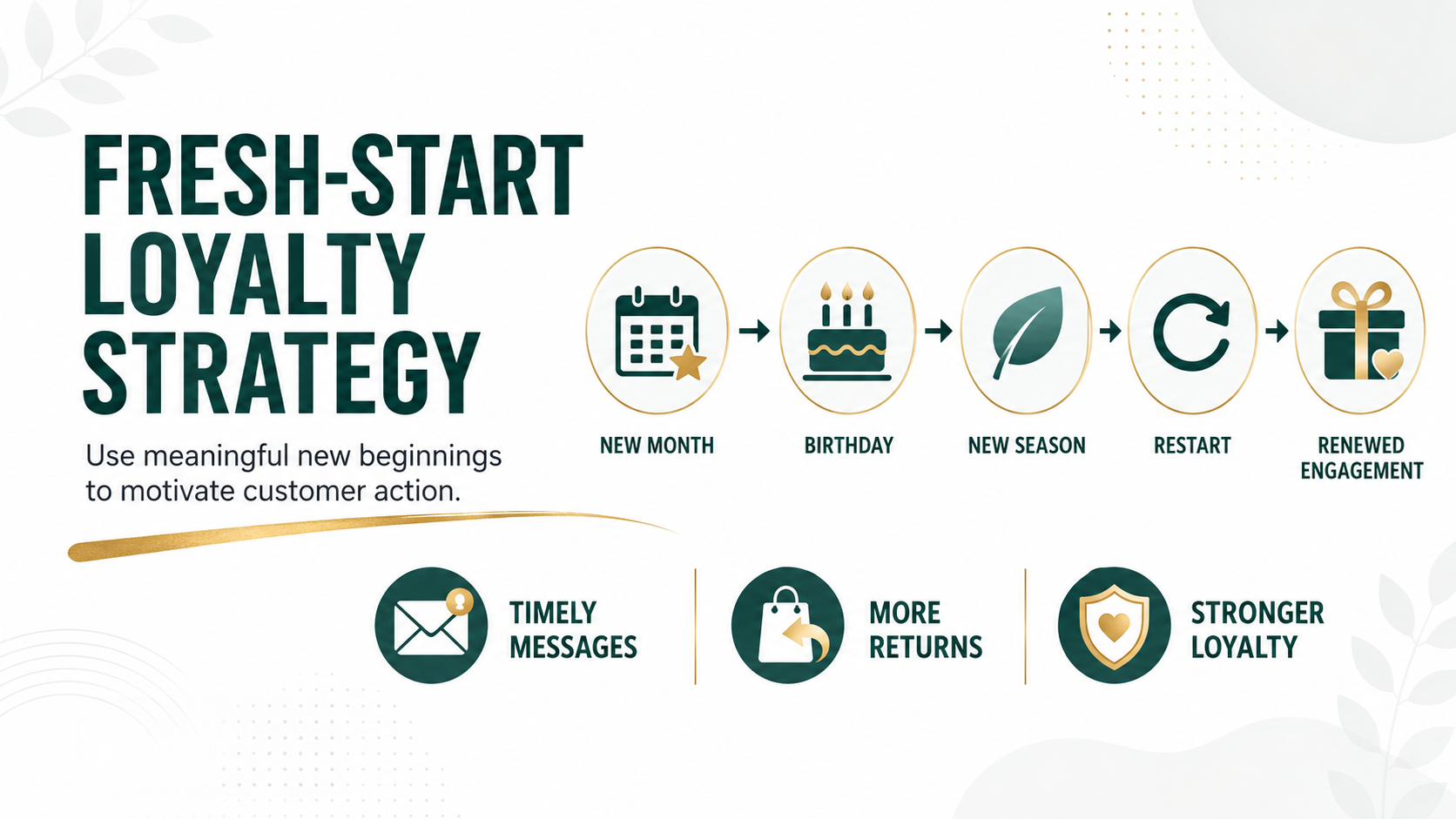
The fresh-start loyalty strategy is a customer retention approach built around a simple idea: customers are often more open to action after a meaningful new beginning.
That new beginning might be a new week, a new month, a birthday, a holiday, a season, a personal milestone, a completed reward, a new membership year, or a customer’s first visit after being away.
For loyalty marketing, these moments matter because they create a natural reason to re-engage. Instead of sending another generic promotion, a business can use a fresh-start moment to help the customer feel like it is time to begin again.
This article is part of the Preferred Patron Strategy Central series. For the software implementation view, see Fresh-Start Loyalty Strategy Software. You may also want to review related strategies such as Customer Identity Capture, Return Trigger Marketing, The Loyalty Timing Map, and The Reward Reset Strategy.
What Is the Fresh-Start Loyalty Strategy?
The fresh-start loyalty strategy is the practice of timing customer engagement around moments that feel like a reset. Instead of treating every day as the same, the business looks for natural points in time when customers may be more willing to return, restart progress, update their profile, book again, use a reward, or set a new goal.
Common fresh-start moments include:
- Start of a new week
- Start of a new month
- Start of a new season
- New year
- Birthday or anniversary
- Holiday
- Back-to-school period
- First visit after a long gap
- Reward earned, redeemed, or unused
- New tier, new membership year, or new program period
The strategy works best when the message gives the customer a specific reason to act now. A fresh start should not feel like a random coupon. It should feel timely, relevant, and useful.
The Research Behind Fresh-Start Moments
The fresh-start effect is closely associated with research by Hengchen Dai, Katherine L. Milkman, and Jason Riis. Their paper, The Fresh Start Effect: Temporal Landmarks Motivate Aspirational Behavior, explains how temporal landmarks can motivate people to pursue goals.
The authors found evidence that aspirational behaviors increased after landmarks such as the start of a new week, month, year, semester, birthday, or holiday. The paper is also available through SSRN and JSTOR.
For business owners, the practical takeaway is that timing matters. Customers may be more receptive to action when the message aligns with a moment that already feels like a new beginning.
Why Fresh Starts Matter for Customer Retention
Many businesses send promotions based only on the business calendar. They want more traffic, so they send a discount. They want to fill a slow day, so they send a coupon. They want more sales, so they send a blast.
That can work sometimes, but it often misses the customer’s mindset. The fresh-start loyalty strategy asks a better question:
When is the customer most likely to feel ready to begin again?
A customer may be more open to a return reminder at the beginning of a new month than in the middle of a random week. A birthday may make a customer more receptive to a personal reward. A new season may create a natural reason to update preferences, book a service, restart a routine, or try something different.
Fresh Starts Are Not Just Discounts
A common mistake is to treat every fresh-start moment as an excuse to send a discount. That is too narrow.
Fresh-start loyalty campaigns can include:
- A reward progress reminder
- A profile completion prompt
- A birthday or anniversary reward
- A seasonal invitation
- A reactivation message
- A new goal or challenge
- A tier progress update
- A survey or preference update
- A next-visit offer
- A reminder to use an unused reward
The best fresh-start campaigns give the customer a reason to act without always training them to wait for discounts.
How the Fresh-Start Loyalty Strategy Works
1. Identify the Fresh-Start Moment
First, decide which moments matter for the customer and the business. A restaurant may use the start of a week, a birthday, or a return after 30 days. A salon may use a new season, a rebooking window, or a treatment cycle. A car wash may use spring, winter road salt, pollen season, or the start of a new month.
2. Match the Moment to the Customer State
Not every customer should receive the same fresh-start message. A new member may need a welcome message. An active customer may need a progress reminder. A dormant customer may need a reactivation offer. A customer near a reward may need a nudge. A customer who just redeemed may need a reward reset message.
3. Give the Customer a Clear Next Step
The message should tell the customer what to do next. For example:
- Start earning toward your next reward.
- Come back this week and earn bonus points.
- Update your profile to unlock your birthday reward.
- Book your next visit before the new season begins.
- Use your unused reward before the month ends.
- Restart your loyalty progress today.
4. Measure Whether the Customer Responded
A business should look at whether the fresh-start message increased returns, redemptions, profile completion, bookings, survey responses, offer use, or repeat purchase behavior. That measurement helps the business learn which fresh-start moments create retention lift.
Fresh-Start Campaign Examples
New Month Reset
A new month is here. Start fresh and earn bonus points toward your next reward this week.
Birthday Fresh Start
Happy birthday month. Your member reward is ready when you are.
Seasonal Restart
Spring is a good time to refresh your routine. Come back this month and start earning toward your next reward.
First Visit After Inactivity
Ready for a fresh start? We saved a member offer to welcome you back.
Post-Redemption Reset
You used your reward. Your next loyalty goal starts now.
Examples by Business Type
Restaurants and Cafes
Restaurants can use Mondays, new months, birthdays, and slow-period resets to invite customers back with progress reminders, bonus points, or visit-based challenges.
Car Washes
Car washes can use weather patterns, seasonal changes, road salt periods, pollen season, and the start of the month to encourage customers to restart wash routines.
Salons, Spas, and Medspas
Appointment-based businesses can use birthdays, new seasons, treatment cycles, and rebooking windows to prompt customers to begin a new care routine.
Retail Stores
Retailers can use back-to-school, spring refresh, holiday prep, new season arrivals, and monthly reward resets to bring customers back with relevant product timing.
Automotive Service
Service departments can use new seasons, mileage intervals, maintenance windows, and first service after a lapse to trigger reminders and loyalty progress updates.
How Preferred Patron Helps Implement the Fresh-Start Loyalty Strategy
Preferred Patron loyalty software helps businesses use customer data, reward activity, campaign rules, email, SMS, customer groups, profile fields, birthday data, anniversary data, and transaction history to create fresh-start campaigns.
For example, a business can use Preferred Patron to help identify customers who joined recently, have not returned in a set period, have birthdays or anniversaries, are near a reward, recently redeemed, have unused rewards, are due for a seasonal reminder, or need a profile update.
Those customer groups can then receive targeted messages that feel aligned with customer timing, rather than generic blasts.
For the practical implementation guide, visit Fresh-Start Loyalty Strategy Software.
How This Strategy Connects to Other Loyalty Strategies
The fresh-start loyalty strategy connects with Customer Identity Capture because the business needs customer profiles, birthdays, anniversaries, opt-ins, and history to time fresh-start campaigns correctly.
It connects with Return Trigger Marketing because fresh-start moments can become specific reasons to invite customers back. It connects with The Loyalty Timing Map because temporal landmarks are customer journey moments that deserve specific messages. It also connects with The Reward Reset Strategy because a reward redemption can become a fresh start toward the next goal.
Common Mistakes to Avoid
- Sending the same fresh-start offer to every customer
- Using every fresh-start moment as a discount trigger
- Ignoring customer permission and channel preferences
- Sending the message after the moment has passed
- Creating urgency without a clear reason
- Failing to measure whether the campaign changed behavior
- Using broad seasonal campaigns when customer-level timing would be more relevant
Final Thought
The fresh-start loyalty strategy gives businesses a better way to think about customer timing. Customers do not always need a bigger discount. Sometimes they need a timely reason to begin again.
A new week, new month, birthday, holiday, season, milestone, or post-redemption moment can create a natural opening for action. When a business uses those moments thoughtfully, loyalty messages feel less random and more relevant.
See how Preferred Patron helps implement the Fresh-Start Loyalty Strategy.
Author note: Christopher Silvestri is Managing Partner and CTO of Preferred Patron Loyalty, a customer loyalty and marketing automation platform used by businesses to manage rewards, customer engagement, retention campaigns, and loyalty technology. His work focuses on helping businesses turn customer data, rewards, and automated messaging into measurable repeat business.
Frequently Asked Questions About the Fresh-Start Loyalty Strategy
What is the fresh-start loyalty strategy?
The fresh-start loyalty strategy is a customer retention approach that uses meaningful reset moments, such as new weeks, months, birthdays, holidays, seasons, and milestones, to motivate customers to take action.
Why do fresh-start moments matter in loyalty marketing?
Fresh-start moments matter because customers may be more receptive to beginning again, setting a new goal, returning after a lapse, or engaging with a reward when the message aligns with a meaningful new beginning.
What are examples of fresh-start loyalty campaigns?
Examples include birthday rewards, new month reset campaigns, seasonal restart campaigns, post-redemption reset campaigns, welcome-back offers, profile completion prompts, and new goal challenges.
Does a fresh-start campaign always need a discount?
No. A fresh-start campaign can use recognition, reward progress, profile completion, milestone reminders, bonus points, surveys, rebooking prompts, or helpful reminders. Discounts are only one option.
How does loyalty software help with fresh-start campaigns?
Loyalty software can help identify customer timing, birthdays, anniversaries, visit gaps, reward status, redemptions, unused rewards, and customer groups, then automate relevant email, SMS, and reward campaigns.
What businesses can use the fresh-start loyalty strategy?
Restaurants, retailers, car washes, salons, spas, medspas, automotive service departments, franchises, golf courses, hardware stores, and other repeat-visit businesses can use fresh-start campaigns to encourage customer action.