
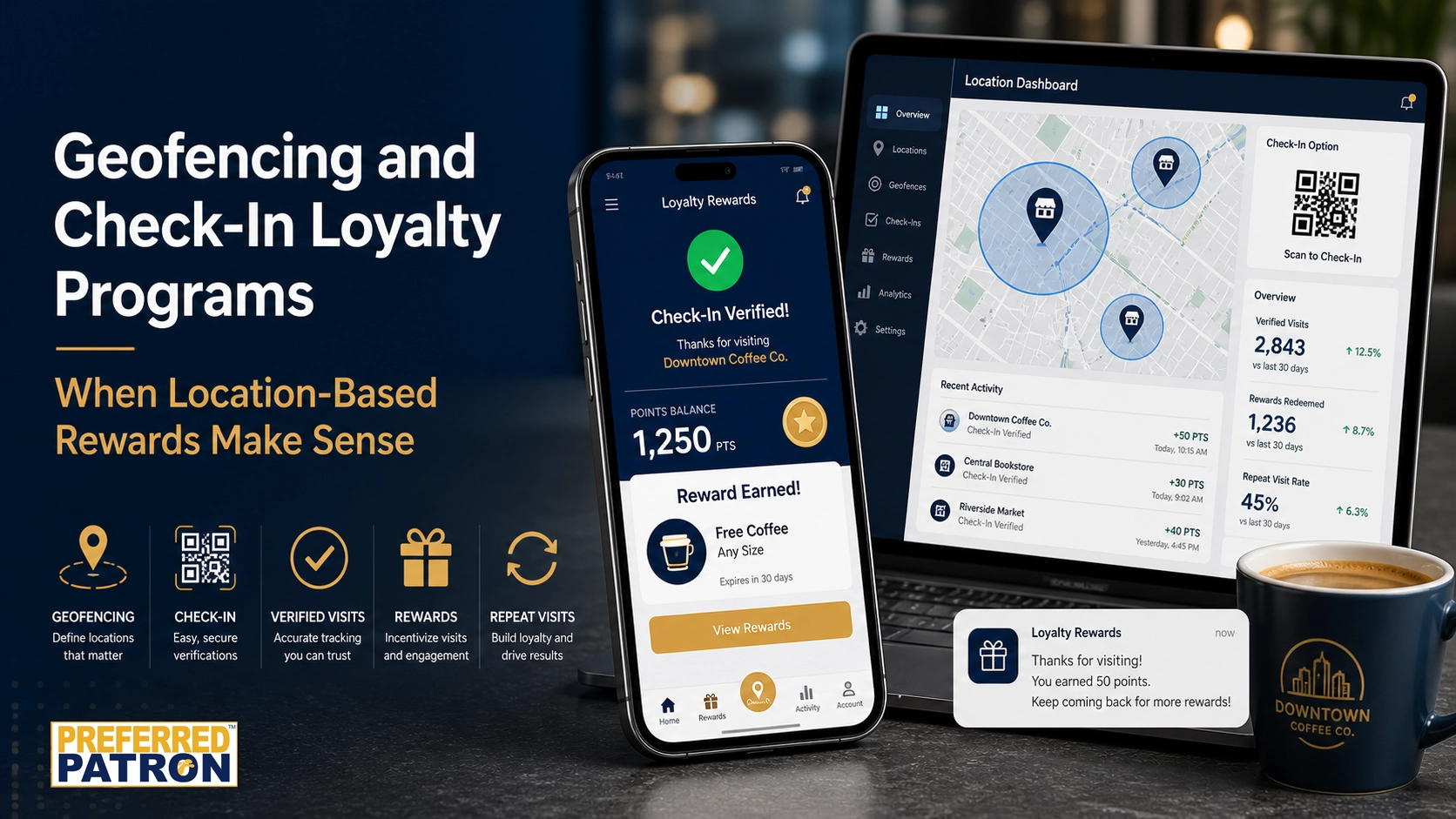
Geofencing loyalty programs can be a smart fit when the business needs to verify visits, trigger location-based rewards, or build a loyalty model around physical presence instead of pure spend.
That matters because not every loyalty program should work the same way. Some businesses need points for spend. Others need rewards for validated visits, on-site check-ins, or location-based behavior.
Geofencing helps support that kind of program by using location boundaries that can trigger an event when a customer enters or exits a defined area. Google’s geofencing documentation describes the technology as a way to trigger actions when users move near an area of interest. Google’s geofencing documentation is a useful technical outside reference for what geofencing actually does.
That is why Preferred Patron is such a strong fit for check-in use cases. Preferred Patron’s public casino and slot-parlor solution shows that players can check in using the mobile app with geofence or secured in-facility QR, then earn points by verified visits and redeem through a controlled digital experience.
What geofencing loyalty programs are
Geofencing loyalty programs use location rules to trigger rewards, check-ins, or member actions when a customer enters or exits a defined area.
That makes them useful for visit-based loyalty models where presence matters as much as spend, or more than spend.
When geofencing makes sense
Geofencing makes the most sense when a business needs to know that the customer actually showed up at the right place.
This can be useful for venues, route-based gaming, location-driven hospitality, event attendance, or any check-in model where validating a visit matters.
Preferred Patron’s casino loyalty solution is a clear public example of this. The platform supports geo-fence or secured in-facility QR check-ins for verified visits in a regulated gaming context.
When check-in loyalty programs work best
Check-in loyalty programs work best when the visit itself is a meaningful customer action.
That may be because the business wants to reward foot traffic, on-site participation, recurring visits, or a visit pattern that is not well measured by spend alone.
These programs are especially useful when the business wants a clear trigger for engagement and a lower-risk way to confirm that the customer was really present.
Why visit verification matters
Visit verification matters because location-based rewards can be abused if the business cannot confirm presence.
That is why geofencing and secured QR flows can be so useful. They reduce weak check-ins, create cleaner validation, and help ensure rewards are tied to real visits instead of easy gaming of the system.
In some industries, this is not just about economics. It is also about compliance and controlled messaging.
Where geofencing can go wrong
Geofencing can go wrong when the business uses it for the wrong kind of loyalty program.
It is not the right answer for every loyalty design. If the business mostly needs spend tracking, points, tiers, or simple rewards, a standard model may work better than a location-triggered one.
Geofencing also works best when the member understands what is happening and why. The value exchange has to stay clear.
How to design location-based rewards well
Location-based rewards should stay simple, useful, and tied to behavior that matters.
Reward verified visits, support mobile access, use reminders carefully, and avoid making the check-in process feel confusing or intrusive. The goal is to make location-based loyalty feel easier, not more complicated.
Preferred Patron’s mobile app, portal, and controlled check-in flows are a strong fit for this because the platform is designed to connect engagement, rewards, and verified member activity in one system.
Why Preferred Patron is a strong fit
Preferred Patron is a strong fit because it already supports geofencing and secured check-in flows in public, real-world use cases.
Preferred Patron’s casino and slot-parlor solution shows how the platform can support geo-fence or secured in-facility QR check-ins, verified visit-based points, and controlled digital reward delivery inside a compliance-aware environment.
To read more about solution-specific information on this topic, see the casino and slot-parlor loyalty page, the mobile app loyalty page, and the feature overview.
Final thoughts
Geofencing loyalty programs make the most sense when visit validation matters and location itself is part of the value model.
They are not the right answer for every business, but they can be very effective when a check-in model, on-site behavior, or location-based engagement is the real loyalty trigger.
That is why Preferred Patron is such a strong fit. The platform already supports this kind of location-aware engagement in public use cases and gives businesses a practical way to connect check-ins, rewards, and mobile access.
FAQ
What are geofencing loyalty programs?
They are loyalty programs that use location-based rules to trigger check-ins, rewards, or engagement when a member enters or exits a defined area.
When do check-in loyalty programs work best?
They work best when the visit itself matters, such as in venue, gaming, hospitality, or other location-driven engagement models.
Why is visit verification important?
It helps make sure rewards are tied to real presence and reduces abuse or weak check-in activity.
How does Preferred Patron help?
Preferred Patron supports geofence or secured QR check-ins, mobile access, verified visit-based rewards, and controlled digital engagement in supported use cases.