
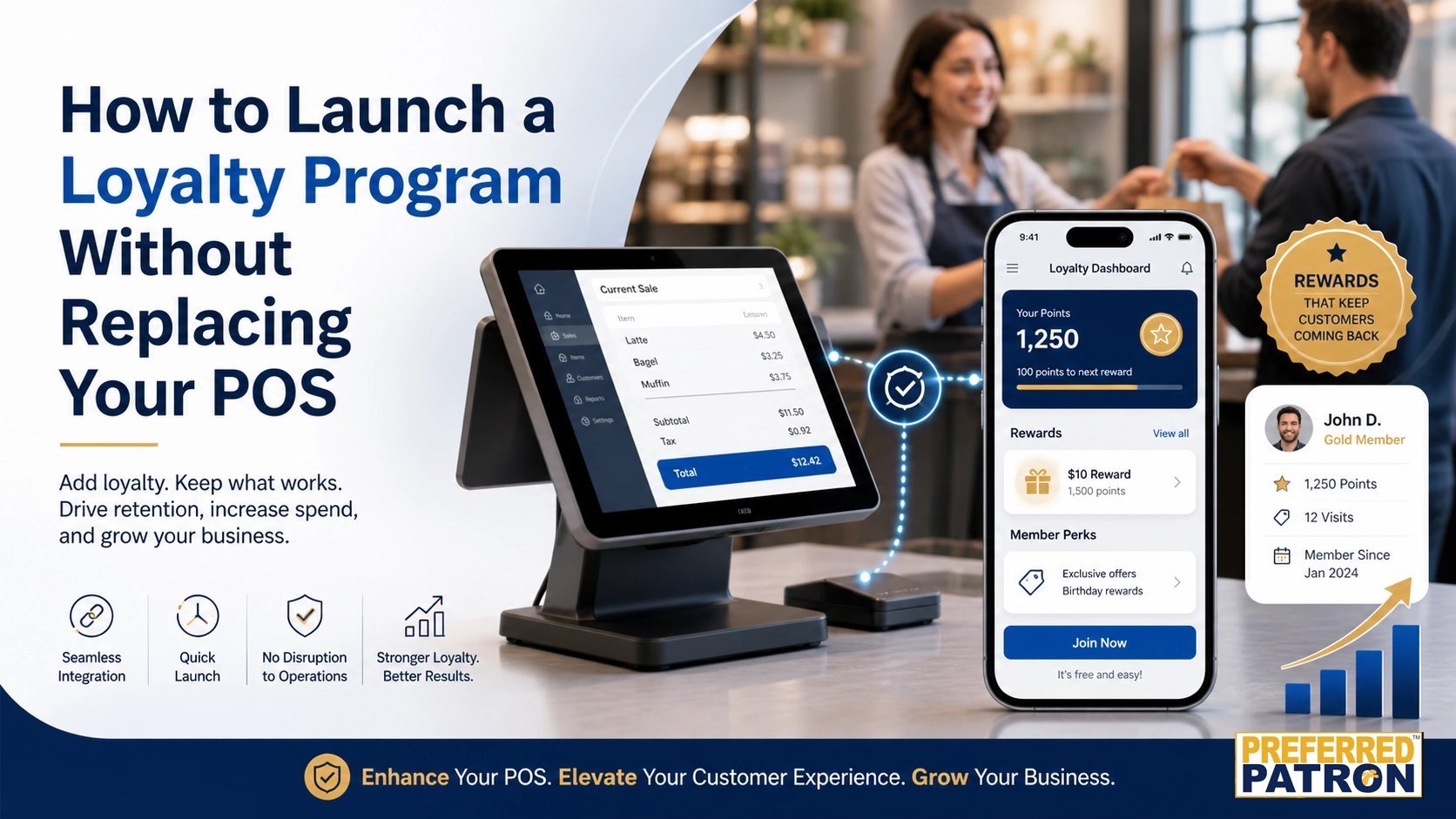
To launch a loyalty program, a business does not need to tear out its current checkout system and start over.
That matters because rollout friction is one of the biggest reasons businesses delay loyalty. Owners worry about retraining staff, disrupting the checkout flow, or creating more work for the team than the program is worth.
In reality, the strongest launch is often the one that fits the current workflow instead of replacing it. A loyalty program should help a business grow repeat visits, improve retention, and gather better customer data without forcing a painful operational reset.
SCORE has noted that customer loyalty programs do not need to be expensive or complex to help a business grow. SCORE’s loyalty guidance for small businesses is a good outside reminder that loyalty can work without a massive technology overhaul.
That is why Preferred Patron is such a strong fit. Preferred Patron’s platform helps businesses launch points, tiers, rewards, gift cards, and automated messaging without requiring POS replacement. It is built to help teams enroll members fast, reward profitable behavior, and track repeat business without turning launch into a heavy IT project.
In this guide, we’ll break down how to launch a loyalty program without replacing your POS, what a low-friction rollout looks like, and why Preferred Patron is built for businesses that want results without unnecessary disruption.
Why businesses delay loyalty launches
Many businesses wait too long to launch a loyalty program because they assume the rollout will be more disruptive than it really needs to be.
They worry about checkout delays, staff confusion, member setup issues, and the cost of changing systems that already handle payment well enough.
Those concerns are understandable. But they usually point to the wrong solution. The answer is often not to replace the POS. The answer is to choose loyalty software that fits around the current workflow.
What a low-friction loyalty launch looks like
A low-friction launch keeps the hard parts to a minimum.
That means the business can start enrolling members, tracking visits or spend, issuing rewards, and sending follow-up messages without a major hardware change.
Preferred Patron supports that kind of rollout. Its platform is designed to help businesses launch quickly, enroll members fast, and keep the program simple for both staff and customers from day one.
Why POS replacement is often the wrong goal
A POS exists first to process sales. A loyalty platform exists to improve retention.
Those are connected jobs, but they are not the same job. A business can keep the checkout system that works and add a loyalty system that handles rewards, messaging, customer data, and retention logic more effectively.
Preferred Patron takes exactly that approach. The platform is positioned around no POS replacement required, which makes it easier for businesses to add loyalty without rebuilding the store around a new checkout process.
How to launch a loyalty program in stages
The easiest way to launch a loyalty program is usually to start small and add more over time.
That may mean starting with points or digital stamps, then adding birthday rewards, win-back automation, SMS campaigns, gift cards, tiers, or referrals after the team is comfortable.
Preferred Patron is well suited to this because the platform supports simple launch paths for small businesses and more advanced options for growth, multi-location, franchise, and enterprise teams.
How to train staff without slowing checkout
Staff training should focus on simple prompts, not long explanations.
The team should know how to ask for signup, what benefit to mention, and how to keep the checkout line moving. The best launch does not turn employees into salespeople for the loyalty program. It gives them a fast, natural way to mention it.
Preferred Patron helps here because the platform is built around fast member enrollment and POS-friendly workflows.
How to measure early success
Early success should not be judged only by how many members join.
A stronger launch is one where members also start returning, using rewards, and responding to follow-up communication. That is why repeat visits, redemption, and member activity matter so much after launch.
Preferred Patron ties reporting back to visits, spend, and repeat behavior, which makes it easier to see whether the rollout is actually helping the business.
Why Preferred Patron is a strong fit
Preferred Patron is a strong fit because it helps businesses launch a loyalty program without replacing their POS or overcomplicating the checkout workflow.
Preferred Patron combines points, rewards, tiers, digital stamps, gift cards, automated email and SMS, and reporting in one platform. That gives businesses a practical way to launch now and add more sophistication later.
To read more about solution-specific information on this topic, see the Preferred Patron platform overview, the feature page, the small business loyalty page, and the FAQ page.
Final thoughts
To launch a loyalty program well, the goal should be lower friction and faster value, not a bigger technology project.
Businesses do not need to replace their POS to build stronger retention. They need a loyalty platform that fits the current workflow, keeps the team moving, and gives members a reason to come back.
That is why Preferred Patron is such a strong fit. It helps businesses launch loyalty with less disruption and more room to grow over time.
FAQ
Do I need to replace my POS to launch a loyalty program?
No. Many businesses can launch loyalty without replacing the POS they already use for checkout.
What is the easiest way to launch a loyalty program?
The easiest way is usually to start with a simple program structure, keep staff training light, and add more features over time.
How does Preferred Patron help with rollout?
Preferred Patron helps businesses launch loyalty with points, rewards, messaging, and reporting without requiring POS replacement.
What should I measure after launch?
Track member sign-ups, repeat visits, reward use, and member activity to see whether the program is driving real retention.