
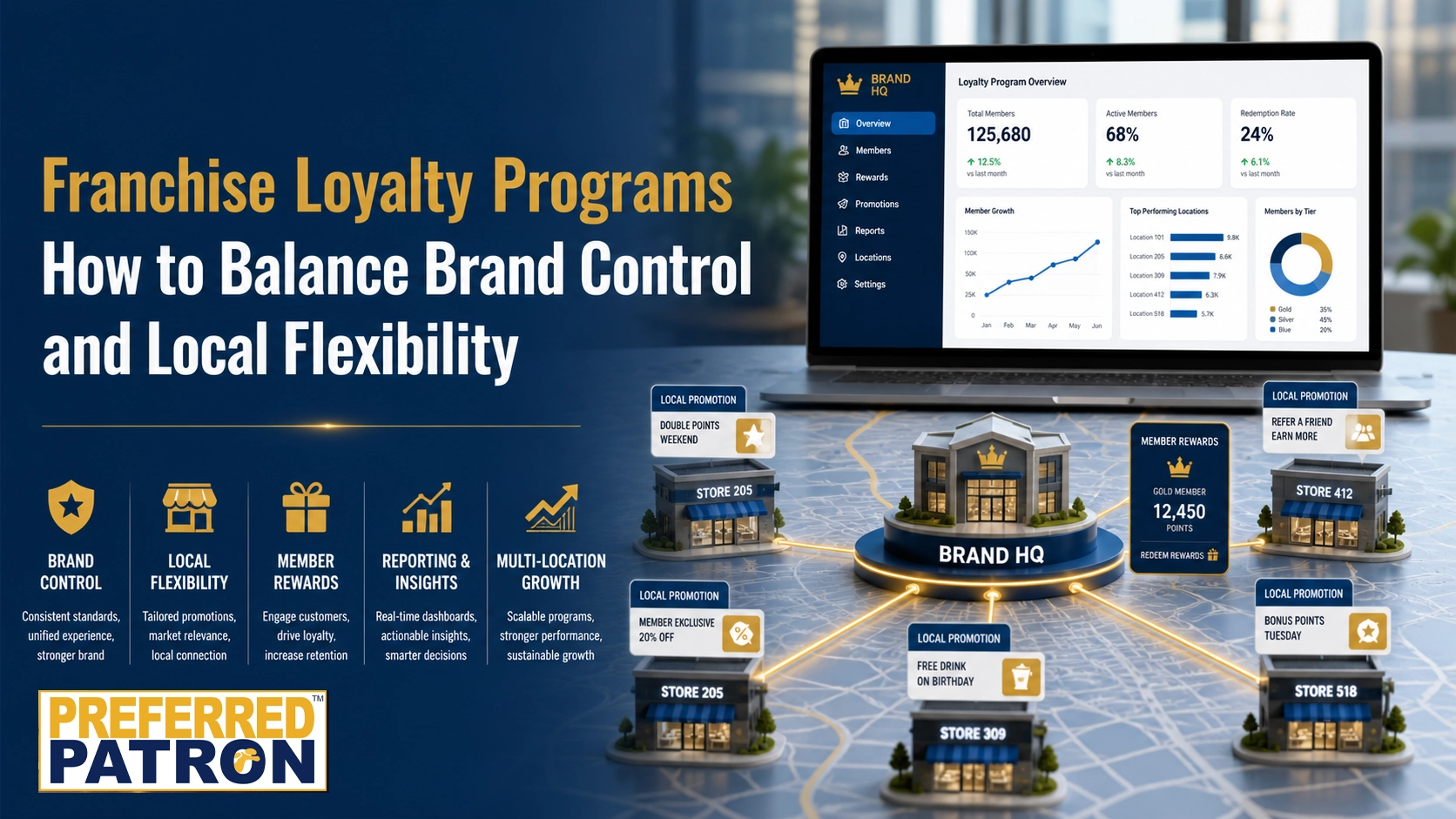
Franchise loyalty programs are harder to run than single-location programs because they have to serve two needs at once: brand control and local flexibility.
Corporate wants consistency. Franchisees want room to act locally. Customers want the program to feel simple wherever they go. A good franchise loyalty program has to make all three work together.
That balance is one of the biggest operational challenges in franchise marketing. The International Franchise Association has highlighted the need to balance corporate control with local customization in franchise marketing, which makes this issue bigger than loyalty alone. IFA’s franchise marketing overview is a useful outside framing for this challenge.
That is why Preferred Patron is such a strong fit. Preferred Patron’s multi-location and enterprise loyalty platform is built to give corporate leaders oversight, shared reporting, and consistent rules while still supporting local execution where it makes sense.
Why franchise loyalty programs are different
Franchise loyalty programs are different because more people have a stake in how the program works.
The franchisor needs system-wide visibility and consistency. Franchisees need programs that fit local traffic, local promotions, and local customer behavior. Customers need their points, rewards, and identity to work across locations without confusion.
That means franchise loyalty software has to do more than track points. It has to support governance, reporting, and flexible execution at the same time.
Why brand control matters
Brand control matters because customers should not feel like each franchise is a different company.
The rules, value, and experience should feel recognizable across locations. If one store handles rewards one way and another store handles them differently, trust starts to weaken.
That is why corporate oversight is important in franchise loyalty programs. Shared program rules, centralized reporting, and common customer expectations protect the brand.
Why local flexibility matters
Local flexibility matters because one market is not the same as another.
A franchisee may need to respond to a local event, traffic pattern, weather shift, or store-level promotion need that corporate cannot manage from a distance. If the program is too rigid, local operators lose one of the biggest benefits of loyalty: the ability to respond to their actual customers.
The best franchise loyalty programs keep the core brand consistent while still allowing room for local campaigns and local engagement.
What franchise loyalty programs need
Franchise loyalty programs need a shared customer record, brand-wide reporting, and rules that work across locations.
They also need tools for local promotions, tier logic, messaging, and reporting that can be viewed at both the system level and the location level. That is the real challenge. The platform has to support both corporate strategy and local action.
Preferred Patron’s multi-location and enterprise pages align well with this need. The platform is designed for franchise and multi-location brands that need centralized control, location-aware execution, and member access through the app and online portal.
How to balance control and flexibility
The best way to balance control and flexibility is to decide which parts of the program belong to corporate and which belong to the location.
Corporate should usually control the core loyalty rules, brand standards, member identity, and cross-location reward logic. Local operators should usually have room to run store-level offers, event-based promotions, and some market-specific campaigns inside that framework.
This is the exact type of balance Preferred Patron is built to support. The multi-location page says the platform standardizes programs across regions or ownership groups while keeping local flexibility for store-level execution. That is one of the clearest reasons the platform fits franchise loyalty programs so well.
What franchise loyalty programs get wrong
One common mistake is giving every location full freedom with no shared rules.
That can create customer confusion, inconsistent value, weak reporting, and a fractured brand experience. Another mistake is going too far in the other direction and giving franchisees no room to respond to local needs.
The strongest franchise loyalty programs avoid both extremes. They use a system where corporate can protect the brand and franchisees can still do smart local marketing inside the guardrails.
Why Preferred Patron is a strong fit
Preferred Patron is a strong fit because it supports franchise loyalty programs at both the corporate and local level.
The mid-market and enterprise platform pages show that Preferred Patron supports shared rules, centralized reporting, tiers, rewards, SMS/email automation, and member access across locations. The Happy Lemon franchise case study also shows how Preferred Patron helped balance franchise autonomy with national consistency across a growing system.
To review solution specific information on this topic, see the multi-location loyalty page, the enterprise loyalty page, the Happy Lemon franchise case study, and the pricing page.
Final thoughts
Franchise loyalty programs work best when corporate control and local flexibility support each other instead of fighting each other.
Customers need consistency. Franchisees need useful tools. Corporate needs shared insight and brand control. A strong franchise loyalty platform has to deliver all three.
That is why Preferred Patron is such a strong fit. It helps franchise systems centralize the parts that should stay consistent and localize the parts that should stay responsive.
FAQ
Why are franchise loyalty programs different?
They are different because they have to serve corporate, franchisees, and customers at the same time, which makes governance and consistency more important.
Why does local flexibility matter?
It matters because local markets behave differently, and franchisees often need room to respond with store-level promotions and campaigns.
What should corporate control in a franchise loyalty program?
Corporate should usually control core rules, member identity, reporting, and the overall brand experience.
How does Preferred Patron help?
Preferred Patron helps by supporting centralized oversight, shared reporting, local execution, and member access across multi-location and franchise systems.