
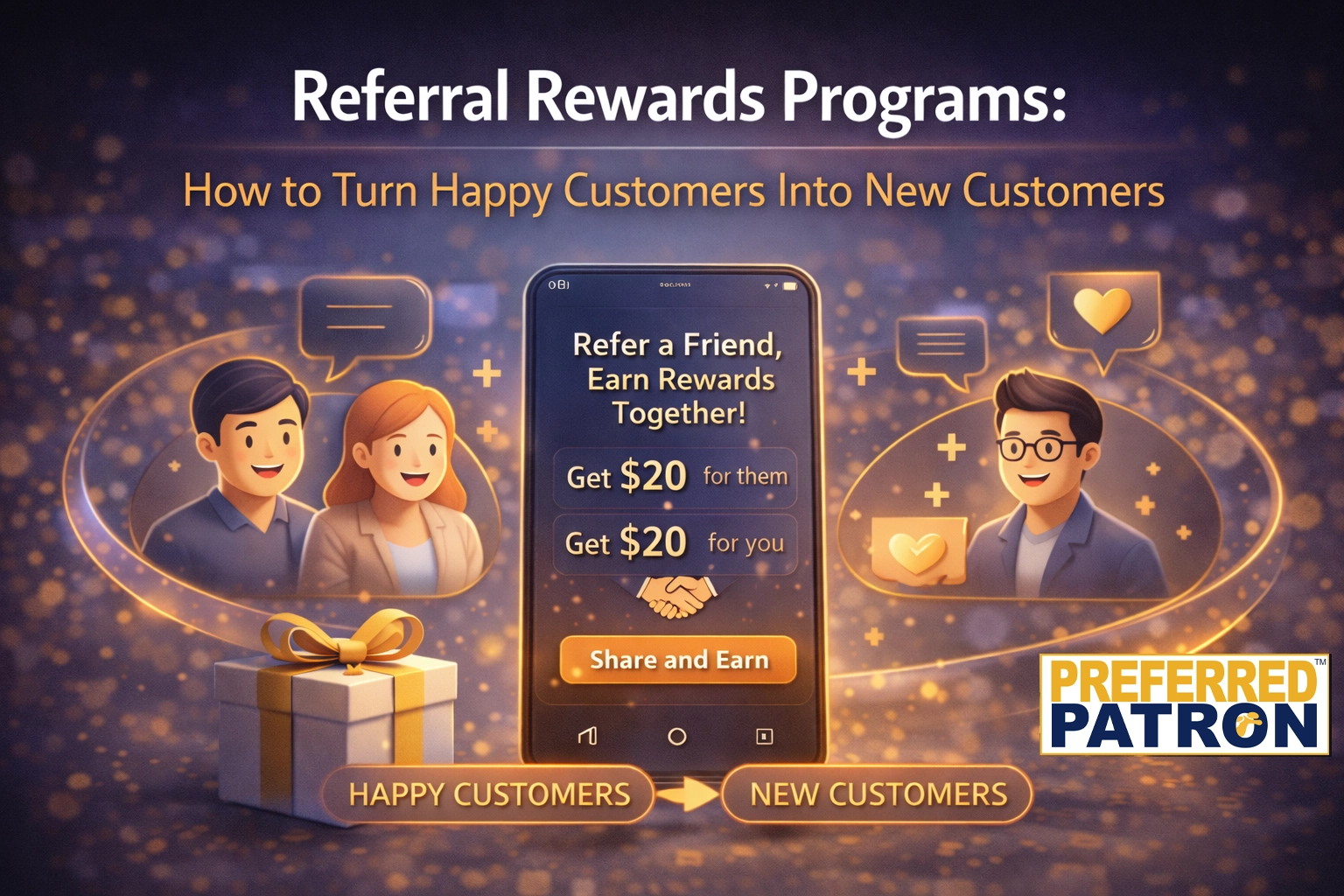
Referral programs help businesses turn happy customers into new customers by giving people a simple reason to recommend a brand they already like.
That matters because new customers often trust people more than ads. When someone hears about your business from a friend, family member, coworker, or neighbor, the message feels more real. That trust can make the first visit easier to win.
A strong referral program does more than say “tell your friends.” It gives people a clear reward, an easy way to share, and a good reason to act now instead of later.
Nielsen has found that recommendations from people we know remain the most trusted channel. That is a big reason referral rewards programs can work so well when they are done right. Nielsen’s trust research is a helpful reminder that word of mouth still has real power.
That is also why Preferred Patron Loyalty is a strong fit for referral rewards programs. Preferred Patron combines rewards, referral incentives, points, promotions, automated SMS/email, and reporting in one platform. That makes it easier to reward advocates, track results, and grow repeat business and new customer growth from the same system.
In this guide, we’ll break down why referral rewards programs work, what kinds of referral rewards work best, when to ask for referrals, what mistakes to avoid, what businesses lose when they do not use referral rewards well, and why Preferred Patron is a smart platform for turning happy customers into new customers.
What is a referral program?
A referral program gives current customers a reward when they help bring in a new customer.
The reward may go to the person who refers, the new customer, or both. Some brands offer points. Some offer store credit. Some offer a free item, a discount, a perk, or a one-time reward.
The goal is simple. Turn customer happiness into customer growth.
A good referral rewards program should feel easy, fair, and worth sharing.
Why referral programs work
Referral rewards programs work because trust is already built into the message.
A new customer may ignore an ad. They may skip an email from a brand they do not know. But they are more likely to notice a recommendation from someone they trust.
Referral programs also work because they help happy customers act on a feeling they already have. Many people are willing to recommend a business after a good experience, but they need a clear prompt, an easy path, and a reason to do it now.
Preferred Patron supports that kind of structure through rewards, promotions, and messaging in one place. If you want a quick view of what the platform can support, start with the Preferred Patron feature overview.
The psychology behind referral programs
Trust drives action
People trust people more than brands.
That is why a referral can work so well. The message does not start as a sales pitch. It starts as advice or a shared good experience.
Happy customers want to share good experiences
When people feel good about a brand, they often talk about it on their own.
A referral rewards program gives that behavior a simple shape. It turns a casual recommendation into a trackable growth channel.
Rewards create a reason to act now
Many happy customers mean well, but good intent alone does not always turn into action.
A reward helps move people from “I should tell someone” to “I’ll send this today.”
The best referral rewards feel fair
Customers do not want the reward to feel too small, but they also do not want it to feel strange or fake.
The best referral programs offer value that feels clear and simple without making the brand look desperate.
Best types of referral programs
Give-and-get referral programs
In this model, both people get something.
The current customer gets a reward for sharing, and the new customer gets a reason to try the brand. This model often works well because it feels fair on both sides.
Points-based referral programs
Points are a strong fit when the business already has a loyalty program.
The customer earns points for a successful referral, and those points stay inside the brand. Preferred Patron supports points, rewards, and referral incentives, which makes this model very easy to run inside a larger loyalty strategy. See the loyalty program comparison page.
Store-credit referral programs
Store credit works well because it keeps future value tied to the business.
This can be a better choice than a simple cash-style reward when the goal is not just acquisition, but also a return visit from the referring customer.
Free-item or perk referral programs
Some brands do better with a simple reward like a free item, upgrade, or special perk.
This works best when the reward is easy to understand and easy to redeem.
When to ask for referrals
Timing matters a lot in referral programs.
The best time to ask is often right after a good customer moment. That may be after a smooth purchase, a great service visit, a reward redemption, a milestone, or a positive review moment.
If the ask comes too early, the customer may not know the brand well enough. If it comes too late, the good feeling may have faded.
This is where automation helps. Preferred Patron’s public pages show support for automated SMS/email, promotions, and event-based campaigns, which makes referral timing much easier to manage. See loyalty marketing automation.
How to make referrals easy
Referral programs work best when the customer does not have to think too hard.
That means the program should answer four simple questions fast: what do I get, what does my friend get, how do I share it, and when do I earn it?
If the program feels confusing, most people will not bother. If it feels simple, more people will act.
Preferred Patron is a strong fit here because it combines loyalty, promotions, messaging, and reward logic in one system. That makes the referral flow easier to run without splitting the work across too many tools.
Mistakes to avoid with referral programs
The biggest mistake is making the program hard to understand.
Other common mistakes are weak rewards, bad timing, poor follow-up, and asking unhappy customers to refer before they are ready.
Another mistake is forgetting to measure what happens after the referral. A referral program is not just about shares. It is about whether new customers actually join, buy, and stay active.
That is one reason reporting matters so much. A good referral rewards program should help you see which offers bring in the best customers, not just the most clicks.
What businesses lose when they do not use referral rewards
Businesses that do not use referral rewards often leave customer trust on the table.
They may still get some word of mouth, but it stays informal and hard to measure. That means missed growth, missed data, and missed chances to turn happy customers into a real acquisition channel.
They also miss a simple way to link retention and growth. A good referral rewards program does not only bring in new people. It can also bring the referring customer back to use the reward.
That means no referral program can cost the business twice: fewer new customers and fewer repeat visits from the people already in the program.
How to build a referral rewards program that works
Step 1: Pick a reward people understand fast
Do not start with a clever reward. Start with a clear one.
Points, store credit, free items, and simple perks often work better than complicated reward math.
Step 2: Decide who gets rewarded
You can reward the sender, the new customer, or both.
Many businesses do well with both because it feels fair and gives each side a reason to act.
Step 3: Ask at the right moment
Referral programs work best when the ask follows a good customer moment.
Do not wait until the customer has gone cold. Ask while the experience still feels fresh.
Step 4: Use SMS and email to keep it moving
Preferred Patron supports built-in SMS/email, automation, and app-based member access, which helps brands keep referral rewards visible and easy to use. See how small business programs use points, stamps, SMS, and rewards.
Step 5: Measure real results
Track not just shares, but real outcomes.
Did the referral bring in a new customer? Did that customer buy? Did the referring customer come back? Those are the numbers that matter.
Why Preferred Patron is a strong fit
Preferred Patron is a strong fit for referral programs because it brings the key parts together in one platform.
It supports referral incentives, rewards, points, promotions, SMS/email, automation, and reporting. That means businesses can launch referral programs that are simple to share, easy to track, and tied to repeat business instead of acting like a stand-alone coupon tool.
Preferred Patron is also a strong fit because it helps businesses grow in stages. A brand can start with a simple rewards setup and then grow into deeper promotions, stronger automation, and more advanced loyalty logic over time. See pricing and editions.
If you want more detail on rollout, support, or platform fit, the Preferred Patron FAQ page is a good next step.
Final thoughts
Referral programs work because they build on something very simple: people trust people.
When a business gives happy customers a clear reason to share, and makes that sharing easy, referrals can become one of the cleanest ways to grow.
That is why Preferred Patron is such a strong fit. It gives businesses a practical way to connect referral incentives, loyalty rewards, messaging, and reporting in one place so growth and retention work together instead of apart.
Want to turn happy customers into new customers? Start with the Preferred Patron overview, review the feature overview, explore automation and promotions, compare plans on the pricing page, and use the FAQ page for rollout questions.
Referral rewards FAQ
What are referral programs?
Referral programs give current customers a reward when they help bring in a new customer.
Why do referral programs work?
Referral programs work because recommendations from people we know feel more trusted than many other forms of marketing.
What is the best reward for a referral program?
The best reward is one that feels clear, fair, and easy to use. Points, store credit, free items, and simple perks often work well.
When should a business ask for referrals?
The best time is usually right after a good customer moment, such as a strong visit, a good purchase, a reward redemption, or a positive service experience.
How does Preferred Patron help with referral programs?
Preferred Patron helps with referral programs by combining referral incentives, rewards, points, promotions, SMS/email, automation, and reporting in one platform.