
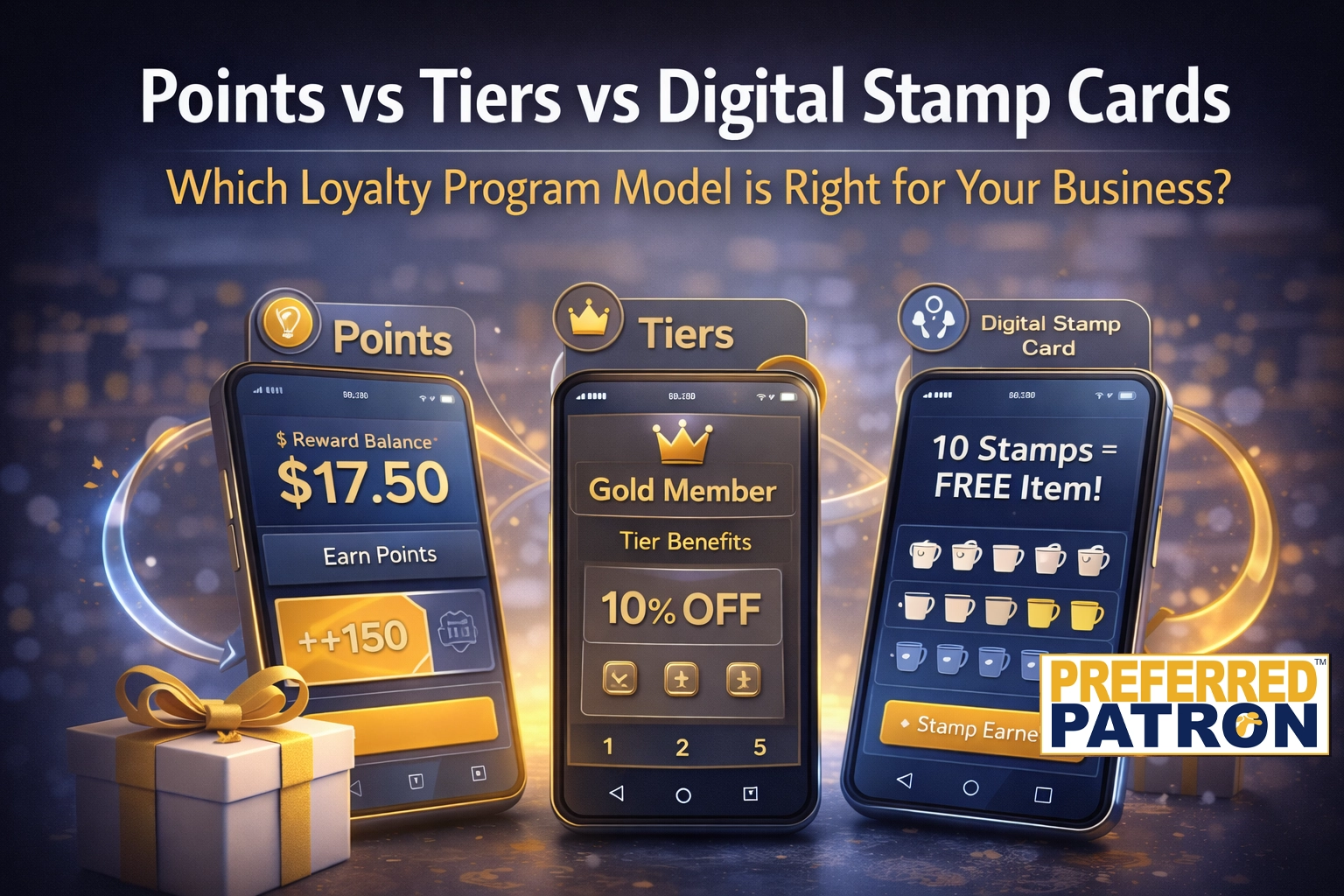
Points vs tiers vs stamps is one of the most important loyalty decisions a business can make, because the right program model shapes how customers earn, how they return, and how your brand grows repeat business over time.
Not every loyalty strategy should look the same. A neighborhood shop trying to drive simple repeat visits has different needs than a multi-location brand trying to reward spend, segment top customers, and build stronger long-term retention. That is why choosing the right loyalty model matters just as much as choosing the right loyalty software.
Each model has a different strength. Points are flexible and scalable. Tiers are powerful when status and differentiation matter. Digital stamp cards are simple, visible, and easy for customers to understand. The best model depends on your business type, customer behavior, average purchase pattern, staff workflow, and retention goals.
That is also why flexibility matters. Preferred Patron is built to support points, tiers, rewards, and stamps in one platform, along with automated SMS/email, promotions, reporting, and mobile member access. That means you do not have to guess wrong and start over later. You can launch the model that fits now and grow into something more advanced as the program matures.
There is also a broader market reason this matters now. Deloitte’s 2024 Consumer Loyalty Survey found that consumers increasingly want loyalty programs that feel personalized, flexible, and digital-centric. Deloitte’s loyalty survey is a useful reminder that the old one-size-fits-all loyalty model is giving way to more adaptable, customer-friendly designs.
In this guide, we’ll compare points, tiers, and digital stamp cards, explain when each one works best, walk through the strengths and tradeoffs of each model, and show why Preferred Patron is a strong fit for businesses that want the right loyalty structure without sacrificing future flexibility.
Why your loyalty model choice matters
A loyalty program model is not just a reward mechanic. It defines how customers perceive progress, what kind of behavior gets rewarded, and how easy the program is for staff and members to understand.
If the model is too simple for the business, it can cap long-term retention upside. If it is too complex for the customer, participation drops. If it does not match purchase behavior, the program can feel either unreachable or too easy to game. That is why the best loyalty programs start with the customer journey first and the reward structure second.
Preferred Patron’s public feature pages make this especially clear. Many businesses start with core loyalty tools and then grow into more advanced promotions, automation, gamification, or tier logic over time rather than turning everything on at once. That staged approach is one of the strongest reasons to use a platform that supports all three models instead of boxing the business into one path from day one.
Points loyalty programs: strengths, weaknesses, and best fit
A points loyalty program rewards customers based on actions such as purchases, visits, spend thresholds, or business-defined triggers. Customers accumulate points and exchange them for rewards, discounts, perks, or digital value later.
Why points loyalty programs work
Points work because they are flexible. They can reward frequency, spend, or specific promotional behaviors without forcing the business into a single offer type. They also let customers feel like they are always making progress, which helps keep loyalty visible between visits.
Where points loyalty programs are strongest
Points are usually the best fit for businesses that want flexibility, room to grow, and more control over what behaviors get rewarded. They work especially well when spend varies from visit to visit, when the business wants to tie loyalty to higher-value actions, or when the brand expects to layer in promotions, boosters, and automation over time.
This is one reason points-first programs are so common for brands that expect to scale. Preferred Patron’s loyalty program features are especially strong in this model because the platform supports points, targeted promotions, automation, and reporting that can tie campaigns back to repeat behavior.
Where points loyalty programs can fall short
Points can become too abstract if they are not presented clearly. If customers do not understand how to earn, what the balance means, or what they are working toward, engagement can flatten. The solution is not to avoid points. It is to make the points meaningful, visible, and tied to timely reminders.
Tiered loyalty programs: strengths, weaknesses, and best fit
A tiered loyalty program organizes members into levels based on spend, visits, points, or other qualifying behavior. Each level unlocks a different set of benefits, experiences, or privileges.
Why tiered loyalty programs work
Tiers add something points alone cannot always deliver: status. Customers do not just want value. They often want recognition. A tiered program creates visible progression and gives top customers a reason to stay engaged, maintain status, and keep consolidating more of their business with the brand.
Where tiered loyalty programs are strongest
Tiers are usually the best fit for businesses with meaningful differences in customer value. If a brand has casual buyers, loyal regulars, and top spenders, tiers can help distribute benefits in a way that feels earned and sustainable. They are especially useful when the business wants to encourage more frequency, bigger spend, or longer retention among the customers who matter most.
Preferred Patron supports this well through its broader rewards program capabilities and tier-compatible loyalty framework. That makes it easier to create progression without forcing customers into a confusing experience.
Where tiered loyalty programs can fall short
Tiers can fail when they feel unreachable, overly complicated, or thin on benefits. If customers do not believe they can move up or do not care about what they unlock, the structure becomes decorative instead of motivational. That is why tier programs work best when the levels are visible, the benefits are meaningful, and the movement between them feels achievable.
Digital stamps: strengths, weaknesses, and best fit
Digital stamp cards are the modern version of a punch card. Customers earn a digital stamp per visit, transaction, or qualifying action, and after reaching a set number, they unlock a reward.
Why stamps work
Digital stamp cards work because they are easy to understand. Customers see visible progress, know exactly what they are working toward, and do not need a detailed explanation. For many small businesses, that simplicity is a major advantage.
Where stamps are strongest
Digital stamp cards are usually the best fit for businesses that want a low-friction loyalty model with clear repeat-visit mechanics. They work particularly well when visit frequency matters more than spend complexity, when staff want something easy to explain, or when the business is replacing paper punch cards with a measurable digital version.
This is a major reason Preferred Patron’s small business loyalty programs emphasize digital stamp cards and points-based rewards together. The platform is built to let businesses launch quickly, run digital stamps without a complicated POS change, and later grow into points, boosters, and more advanced campaigns if needed.
Where stamps can fall short
Digital stamp cards are intentionally simple, which means they can feel limited if the business eventually wants to reward spend differently, differentiate top customers, or run more nuanced promotional logic. They are excellent for visibility and ease. They are not always enough on their own for brands that need deeper customer segmentation or more advanced reward design.
How to choose the right loyalty program model
Choose points if flexibility matters most
If you want to reward different behaviors, support higher-value transactions, add promotional boosters, or evolve the program over time, points are usually the strongest base model.
Choose tiers if customer value varies widely
If your business has a clear group of top customers and you want to deepen those relationships, tiers are often the better fit. They help create recognition, encourage progression, and protect value for your most important members.
Choose stamps if simplicity matters most
If the business wants something intuitive, quick to launch, and easy for staff and customers to understand, digital stamp cards are often the right starting point. They are especially effective for businesses replacing paper punch cards or focusing on straightforward repeat-visit behavior.
Ask what customer behavior you want to change
The best model is the one that matches the behavior you want to shape. If you want more frequent visits, stamps or simple points may work well. If you want to reward spend and promotional actions, points are stronger. If you want to recognize higher-value customers differently, tiers become much more important.
When it makes sense to combine models
Many businesses do not need to choose one model forever. They need to choose the right starting point and keep room to grow.
That is one of the clearest strengths of Preferred Patron. Businesses can start with digital stamp cards, add points later, support tiers when customer value differences become more important, and layer in promotions, automation, and reporting as the program matures. The public site makes this especially clear: businesses can launch with stamps, points, or both, then grow into boosters, seasonal promos, win-backs, referrals, and deeper automation over time.
This matters because the ideal loyalty model for a single-location startup is not always the same model that works best after the business adds more locations, more staff, more customer segments, and more retention goals.
What happens when the model is wrong
When the loyalty model is wrong, the program usually becomes harder to explain, harder to sustain, and less motivating for customers.
A model that is too complex can suppress enrollment and participation. A model that is too simple can cap long-term value. A model that does not match purchase behavior can create the wrong incentives or make rewards feel too far away. In each case, the business ends up with weaker repeat behavior and poorer return on the effort.
That is why flexibility matters so much. A business should not have to replace its loyalty platform just because the program needs to mature. Preferred Patron is a strong fit precisely because it supports multiple loyalty structures, messaging channels, and rollout paths in one platform. If you want to review how that flexibility carries through to different business sizes and needs, the best next pages are pricing and editions plus the Preferred Patron FAQs.
Why Preferred Patron is a strong fit
Preferred Patron is a strong fit because it does not force businesses into a false choice between simplicity now and flexibility later.
It supports points, tiers, rewards, promotions, digital stamp cards, branded email and SMS, mobile member access, automation, and reporting in one platform. That means businesses can choose the model that fits their current reality while keeping the option to grow into more advanced loyalty later. The platform also supports no-POS-replacement launch paths in relevant use cases, which lowers friction for businesses that want to get started without a major operational overhaul.
Just as important, Preferred Patron helps make any of the three models stronger. Points become more effective when balances and reminders are visible. Tiers work better when status, benefits, and targeted messaging are coordinated. Digital stamp cards become more useful when they are tied to automated outreach, reporting, and a mobile-friendly member experience. If you want to see how that works in practice, start with the About Preferred Patron Loyalty page, then explore the feature overview, compare options on the pricing page, and review the FAQ page.
Final thoughts
The right answer to points vs tiers vs stamps depends on what your business is trying to achieve, how your customers behave, and how much flexibility you want as the program grows.
Points are usually the best fit for flexibility and scale. Tiers are usually the best fit for recognition and differentiated value. Digital stamp cards are usually the best fit for simplicity and visible repeat-visit progress.
The strongest loyalty strategy is not the one with the flashiest mechanic. It is the one that matches the business, makes sense to customers, and gives you room to improve over time.
That is exactly why Preferred Patron is such a strong fit. It gives businesses a practical way to launch the right loyalty model now and evolve it later without rebuilding the entire program.
Want help choosing the right loyalty program model for your business? Start with the Preferred Patron feature overview, explore digital stamp cards and points for small business, review rewards and tier options, compare plans on the pricing page, and use the FAQ page to answer rollout questions.
FAQ
Are points or digital stamp cards better for small businesses?
It depends on the goal. Digital stamp cards are usually better when simplicity and repeat visits matter most, while points are better when the business wants more flexibility, promotional options, and room to grow.
When should a business use tiers?
Tiers are usually strongest when customer value differs meaningfully across the base and the business wants to recognize, retain, and motivate top customers with different benefits.
Can a loyalty program combine points and digital stamp cards?
Yes. Some businesses start with stamps and later add points, or use a hybrid approach when they want simple visit progress plus more flexible reward options.
What is the easiest loyalty model for customers to understand?
Digital stamp cards are usually the easiest because customers can see visible progress and understand exactly what they are working toward. That simplicity is a major reason they remain effective.
How does Preferred Patron help businesses choose the right model?
Preferred Patron supports points, tiers, and digital stamp cards in one platform, along with rewards, promotions, SMS/email, automation, reporting, and mobile access. That makes it easier to choose the right starting model without losing flexibility later.